The best bathroom scales
The one specification worth paying for is the one most listings bury, and the flashy metrics are the ones nobody certifies.
By Sawyer V. · · How we research
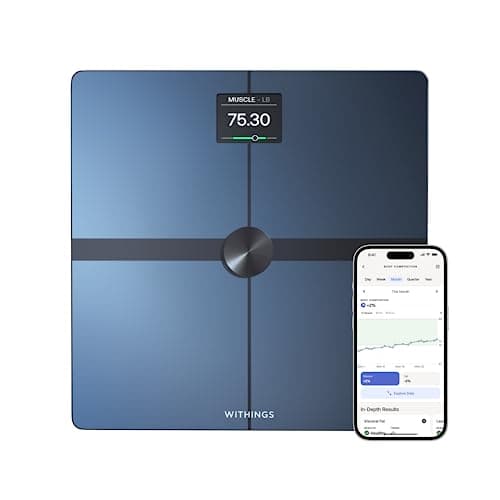
The short answer
We earn a commission if you buy through the links on this page, at no extra cost to you. It does not change which products we pick or what we say about them — here is exactly how that works.
Quick picks
Tap any row for the full write-up. Prices are checked against Amazon rather than remembered — where we have no verified figure the button says so.
| # | Product | Best for | Renter | Price |
|---|---|---|---|---|
| 1 |  Body Smart Scale Published accuracy to within 50 g, Wi-Fi sync that works without the phone nearby, and over 15 months of battery. | An accurate weight that records itself | Safe | |
| — |  Body Comp Scale More metrics, none of them published with an accuracy figure — you are paying extra for numbers nobody certifies. | Skip this one | Safe | No buy link |
The one specification worth paying for
A bathroom scale does one thing well and several things approximately. The thing it does well is weigh you, and the specification for that is accuracy — how close the reading is to the truth — and repeatability, which is whether it gives the same answer twice in a row.
Withings publishes 50 g for the Body Smart. Most makers publish nothing at all, or publish a graduation (the smallest increment displayed) and let you assume it means accuracy. It does not: a scale can display to 0.1 lb and be several pounds out.
If a listing does not publish an accuracy figure, you are buying a display resolution and hoping.
Body composition, honestly
Nearly every scale in this price bracket reports body fat, muscle mass and water percentage. Here is what is actually happening.
The scale sends a tiny current up one leg and down the other and measures the resistance. Fat, muscle and water conduct differently, so the resistance implies a composition. That is called bioelectrical impedance analysis, and it is a real technique.
The limitation is that the current takes the path of least resistance through your lower body and largely misses your torso, and the result is affected by hydration, when you last ate, exercise and skin temperature. Which is why the same person can produce noticeably different readings within a day.
No manufacturer on this site publishes an accuracy figure for any body-composition metric. We are not going to tell you those numbers are meaningless — as a trend measured under identical conditions they can be informative. We will tell you they are not a measurement in the way the weight is, and we will not pretend otherwise.
The floor matters more than the scale
This is the most common cause of a scale that seems wrong, and it is free to fix.
A scale measures the force on four load cells, one at each corner. That arithmetic assumes all four are on the same rigid plane. On a soft or uneven surface the load redistributes and the reading changes.
Use a hard, level floor. Tile over a solid subfloor is ideal.
Never weigh on a bath mat or rug. This is the big one. Anything compressible under the feet will change the reading, often by several pounds.
Use the same spot every time. Even on tile, a slight rock in one corner is consistent if the position is consistent.
Watch out for underfloor heating. Some scales specify an operating temperature range, and a warm floor sits at the edge of it. Nobody here publishes one.
If you have a stone bath mat, it is rigid rather than compressible — but it is still a second surface between the scale and the floor, and we would put the scale directly on the tile.
Weigh yourself properly or not at all
Body weight swings by several pounds through a normal day from food, drink and hydration. If you weigh at different times you are measuring that swing rather than any change in you.
Same time of day, first thing, after the toilet, before eating or drinking, without clothes. That removes almost all of the noise.
Look at the weekly trend, not the daily number. This is what a Wi-Fi scale is genuinely good for — it records every reading without you doing anything, so the trend line exists whether or not you paid attention on any given morning.
Two things nobody publishes
Maximum user weight. Withings publishes a 5–180 kg (9–396 lb) range for its Body scale, which is a different product from either on this page, and publishes nothing for the Body Smart or the Body Comp. If you are near any published limit, ask the manufacturer directly before buying.
Warranty. Neither product page states one. That is a notable absence on an electronic device that lives on a bathroom floor.
Both scales rate Safe on our install rating — they are battery-powered objects placed on a floor, with nothing mounted, nothing drilled and no mains connection anywhere near a wet room.
Every pick in full
1 we would buy, and one we would not. Each carries its Renter-Safe Install Rating, the published specs behind it, and the honest gap in what we know.
1. Best overall
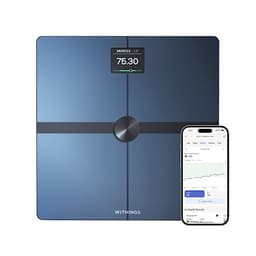
Body Smart Scale
Withings · Body Smart · best for an accurate weight that records itself
Published accuracy to within 50 g, Wi-Fi sync that works without the phone nearby, and over 15 months of battery.
The Withings Body Smart is the pick because Withings publishes the number that matters and most makers do not.
Withings states weight accuracy “to within 50g”. That is the specification you are actually buying — everything else on a smart scale is derived, estimated or cosmetic.
The Wi-Fi sync is the practical advantage over cheaper Bluetooth scales. Withings publishes it as working without the phone nearby, which means stepping on it is the entire interaction. A Bluetooth scale that needs your phone unlocked and in the room is a scale people stop using.
It publishes a 2.8 inch, 320 x 240 display, dimensions of 12.8 x 12.8 x 1.1 in, and “over 15 months” on replaceable batteries — replaceable rather than a sealed rechargeable, which is the right choice for a device you want to ignore.
Renter-Safe Install Rating
- Drilling
- None
- Tools
- None
- Time to fit
- None — it is placed on the floor
- Power
- None — replaceable batteries
- Reversible on move-out
- Fully
Why: A freestanding object on the floor with no mains connection. Nothing is mounted and nothing is altered.
Read from published documentation, not from fitting one. Withings — Body Smart, published accuracy, metrics, dimensions, display and battery life. How the verdict is derived: renter-safe ratings explained.
What’s wrong with it
It needs a Withings account and app to be worth having. As a dumb scale you are paying for features you are not using.
What we can’t tell you
Withings publishes no maximum user weight for this model and no warranty on the product page — two things you would expect to find.
Published specifications
| Weight accuracy | Withings publishes accuracy “to within 50g” |
|---|---|
| Metrics | Weight plus body composition — fat mass, muscle mass and water |
| Connectivity | Wi-Fi sync, published as working without the phone nearby |
| Display | 2.8 in. graphical display, 320 x 240 pixels |
| Dimensions | 12.8 x 12.8 x 1.1 in. (325 x 325 x 25.6 mm) |
| Battery | Withings publishes “over 15 months” on replaceable batteries |
| Maximum user weight | Not published on the product page |
| Warranty | Not published on the product page |
Source: Withings — Body Smart, published accuracy, metrics, dimensions, display and battery life
#ad Price $129.95 as of October 18, 2026. Prices change; Amazon’s listing is the one that counts. How we’re funded.
The one to skip
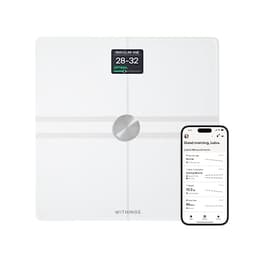
Body Comp Scale
Withings · Body Comp · best for people who genuinely act on cardiovascular trend data
More metrics, none of them published with an accuracy figure — you are paying extra for numbers nobody certifies.
The skip here is the upgrade, and the reasoning applies to every scale sold on its metric count.
The Body Comp is the same physical object — Withings publishes identical dimensions of 12.8 x 12.8 x 1.1 in — with an extended body-composition and cardiovascular metric set on top.
What Withings does not publish is an accuracy figure for any of those extra metrics. It publishes 50 g for weight on the Body Smart and nothing comparable for body fat, muscle mass or vascular age on any model.
That is the whole problem with this tier. You can check the weight claim; you cannot check the rest, and the rest is what the price difference buys.
If you are under clinical supervision and have been asked to track something specific, buy what you have been asked to buy. Otherwise the cheaper scale weighs you just as accurately.
Renter-Safe Install Rating
- Drilling
- None
- Tools
- None
- Time to fit
- None — it is placed on the floor
- Power
- None
- Reversible on move-out
- Fully
Why: A freestanding object on the bathroom floor. Nothing is mounted or altered.
Read from published documentation, not from fitting one. Withings — Body Comp, published dimensions and metric set. How the verdict is derived: renter-safe ratings explained.
What’s wrong with it
No published accuracy for the metrics that justify the price, and no published maximum user weight.
What we can’t tell you
Withings publishes no battery life, warranty or accuracy figures on this product page at all.
Published specifications
| Dimensions | 12.8 x 12.8 x 1.1 in. (325 x 325 x 25.6 mm) |
|---|---|
| Metrics | Weight plus an extended body-composition and cardiovascular metric set |
| Connectivity | Wi-Fi sync to the Withings app |
| Maximum user weight | Not published for this model. Withings publishes a 5–180 kg (9–396 lb) range for its Body scale, which is a different product |
| Accuracy of composition metrics | Not published |
| Battery | Not published on the product page |
| Warranty | Not published on the product page |
Source: Withings — Body Comp, published dimensions and metric set
There is no buy button on this one. It is easy enough to find if you want it anyway — we would rather point you at something that is still on the wall in a year.
Where to buy
Everything recommended on this page, in one place. Each link is an Amazon Associates link — we earn a commission at no extra cost to you, and it never decides a pick.
- $129.95View on Amazon
Body Smart Scale
Withings · Body Smart · Renter verdict: Safe
#ad Prices are not shown because we only publish figures we have verified on the day. How we’re funded.
Questions people actually ask
how accurate are bathroom scales
It depends whether the maker publishes a figure. Withings publishes the Body Smart to within 50 g; most brands publish only a display resolution, which is not the same thing — a scale can read to 0.1 lb and still be pounds out.
are body fat scales accurate
Treat them as a trend, not a measurement. They pass a small current through your lower body and infer composition from resistance, which is affected by hydration, food and temperature. No manufacturer we cover publishes an accuracy figure for those metrics.
why does my bathroom scale give different readings
Usually the floor. Weighing on a bath mat, rug or any compressible surface redistributes the load across the four sensors and can shift the reading by several pounds. Use hard, level tile and the same spot every time.
what is the best time of day to weigh yourself
First thing, after the toilet, before eating or drinking, without clothes — and always the same. Body weight swings by several pounds through a normal day, so weighing at different times measures the swing rather than any change in you.
Sources
Read next
Back to Hardware & Storage.