
Best shower head filter
The best shower head filters
The certified shower filters, what NSF/ANSI 177 actually tests, and the excellent showerhead that filters nothing.
Top pick: Aquasana Shower Filter with Chrome Handheld Wand
A shower filter is one of the few products in this category with an actual certification standard behind it. It is also routinely sold for a problem it cannot solve.
The short version
Best shower head filter
The certified shower filters, what NSF/ANSI 177 actually tests, and the excellent showerhead that filters nothing.
Top pick: Aquasana Shower Filter with Chrome Handheld Wand
Best for hard water
Heads that survive hard water: wipeable nozzles, fewer openings, and one filter that will not help with hardness.
Top pick: High Sierra Classic Fixed Showerhead (FCS-100)
Head to head
What each one actually removes, what it costs, and why only one of them is available to a renter.
Top pick: Aquasana Shower Filter with Chrome Handheld Wand

Worth it?
What is certified, what is claimed, and where we stop — the honest verdict on shower filtration.
Top pick: Aquasana Shower Filter with Chrome Handheld Wand

How to
The cartridge change in five minutes, the published intervals, and why a spent filter is worse than none.
Top pick: Aquasana Shower Filter with Chrome Handheld Wand
Plain English
What the shower filtration standard tests, what it excludes, and how to verify a certification claim.
Top pick: Aquasana Shower Filter with Chrome Handheld Wand
Best all-in-one filtered head
All-in-one filtered heads certified to NSF/ANSI 177, compared against inline filters on cost, flow and cartridge life.
Top pick: Culligan Wall-Mount Filtered Shower Head
Worth it?
What the shower filter standard certifies, why chloramine is different, and how to check which your utility uses.
Top pick: Aquasana Shower Filter with Chrome Handheld Wand

Plain English
What NSF 177 certification covers, what a filter cannot do, and why we decline to make a health claim.
Top pick: Aquasana Shower Filter with Chrome Handheld Wand
Worth it?
What a shower filter can and cannot do for well water, what the CDC says to test for, and the EPA's iron and manganese guidance.
Top pick: Aquasana Shower Filter with Chrome Handheld Wand
Worth it?
What the Forest Service found about vitamin C and chlorine, the dose a shower would need, and why certification still decides the pick.
Top pick: Aquasana Shower Filter with Chrome Handheld Wand

Worth it?
Why a shower-head device cannot soften water, what the certified shower products actually claim, and the options if your water is hard.
Top pick: Culligan Wall-Mount Filtered Shower Head

Head to head
KDF and activated carbon compared as shower filter media, with what the media maker publishes and what NSF/ANSI 177 actually certifies.
Top pick: Aquasana Shower Filter with Chrome Handheld Wand

Head to head
Aquasana's inline filter against Culligan's filtered shower head, on certification, capacity, spray options and warranty.
Top pick: Aquasana Shower Filter with Chrome Handheld Wand
What it costs
What a shower filter costs after checkout: the published cartridge interval, how many showers that is, and the arithmetic for your own cost per shower.
Top pick: Culligan WHR-140 Replacement Shower Filter Cartridge
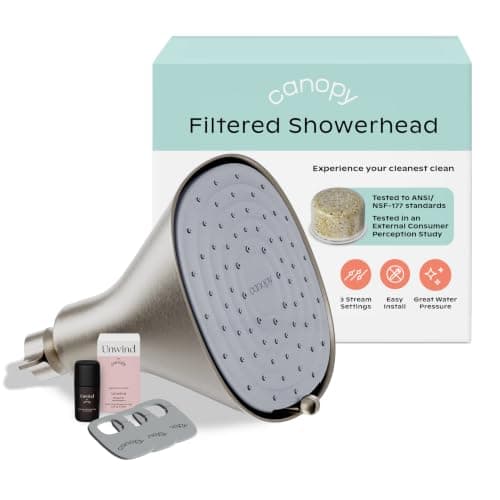
Best premium filtered shower head
Premium filtered heads from $150 to $200 ranked on published media, certification language, cartridge interval and flow, against a certified option at half the money.
Top pick: Canopy Filtered Showerhead
Worth it?
The Jolie filtered showerhead judged on published media, flow rate, size and returns — plus the cartridge interval and test figures it does not publish.
Top pick: Jolie Filtered Showerhead
Most of the bathroom is a marketing-claims free-for-all. Shower filtration is the exception: NSF/ANSI Standard 177 exists specifically for shower filtration systems, and a manufacturer either has the certification or does not.
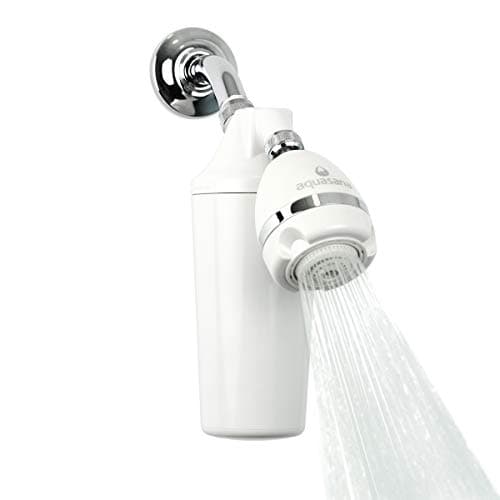
Aquasana publishes that its filter is “independently tested to NSF/ANSI Standard 177 to reduce over 90% of chlorine for 10,000 gallons or up to 6 months”. Culligan publishes that the WSH-C125 is “certified to meet NSF standard 177 for filtered showerhead systems” with a “KDF Filter Capacity of 6 months or 10,000 gallons”. Those are checkable statements with numbers attached.
The practical filter is simple: if a product does not name NSF/ANSI 177, treat its percentage claims as advertising. Plenty of filters reduce chlorine without being certified — certification costs money and small brands skip it — but you have no way to tell which ones from the outside, and neither do we.
Chlorine and hardness are different problems with different solutions, and the listings blur them constantly.
Chlorine is the disinfectant your utility adds. It is what makes water smell like a swimming pool and is the thing most commonly blamed for dry skin and dull hair after a shower. A carbon and KDF cartridge on your shower arm reduces it, and NSF 177 is the standard that measures exactly that.
Hardness is dissolved calcium and magnesium picked up from rock before the water ever reached the treatment plant. It is what leaves white crust on your fittings, what makes shampoo refuse to lather, and what clogs a showerhead over a couple of years. Removing it requires ion exchange — a softener, plumbed into the main, with a brine tank and a regeneration cycle. A cartridge cannot do it, and a filter that claims to “soften” is using the word loosely.
Both Aquasana and Culligan describe scale reduction, which is a fair and much narrower claim than softening. The full comparison, including what a softener costs you in space and salt, is in shower filter vs water softener.
You cannot filter your way out of hardness at the shower arm, but you can buy hardware that copes with it better. Two things help.
The first is nozzle design. Delta’s Touch-Clean is published as “soft rubber spray holes allow you to easily wipe away calcium and lime build-up” — you rub the nozzles with a thumb and the scale comes off. That is a genuinely useful feature in a hard-water house and it costs nothing extra.
The second is fewer, larger nozzles. High Sierra’s single-nozzle design has less surface area for scale to accumulate on, and the company backs it with a published never-clog guarantee — with the honest caveat, in their own words, that the “NEVER-CLOG GUARANTEE is void if the mesh screen is removed”. Our picks for hard-water houses are in best shower heads for hard water.
A shower filter is a subscription with extra steps. The unit is cheap; the cartridges are forever. Both certified filters here publish the same interval — 10,000 gallons or about six months — which is two cartridges a year for as long as you own it.
We would like to give you a dollars-per-month figure, and we are not going to make one up. Cartridge prices move, and we only publish prices that come from a live check. What we can tell you is the shape of the sum: cartridge price ÷ 6 = your monthly cost to keep filtering. Run it with today’s cartridge price before you buy the unit, because that number, not the unit price, is what you are actually signing up for.
We have not tested chlorine reduction on any of these, and we have no laboratory to do it in. We are relying entirely on the certifications the manufacturers publish and on the fact that NSF/ANSI 177 is an independent standard with a real testing protocol behind it.
Nor can we tell you whether a filter will fix your skin. The claims made about that are much broader than the evidence behind them, so we describe what the certification measures — chlorine reduction, in gallons, to a stated percentage — and leave the rest alone.
They solve different problems. A shower filter reduces chlorine at one outlet and is certified to NSF/ANSI 177 for exactly that. A water softener removes dissolved calcium and magnesium from the whole house by ion exchange, needs plumbing into the main, and is the only one of the two that addresses hardness.
If your water is chlorinated enough to smell, a certified filter measurably reduces it and the units are inexpensive. The thing to weigh is the cartridge: both certified filters we cover publish a 10,000-gallon or six-month interval, so it is two cartridges a year for the life of the unit.
Look for wipeable nozzles or fewer, larger ones. Delta publishes soft rubber spray holes that let you rub calcium off with a thumb; High Sierra uses a single-nozzle design and backs it with a never-clog guarantee that is void if you remove the mesh screen. Neither removes hardness — they just cope with it.