Do shower filters remove chloramine?
Many US utilities disinfect with chloramine rather than chlorine, and the shower filter standard was written for only one of them.
By Sawyer V. · · How we research
The short answer
We earn a commission if you buy through the links on this page, at no extra cost to you. It does not change which products we pick or what we say about them — here is exactly how that works.
Quick picks
Tap any row for the full write-up. Prices are checked against Amazon rather than remembered — where we have no verified figure the button says so.
| # | Product | Best for | Renter | Price |
|---|---|---|---|---|
| 1 |  Aquasana Shower Filter with Chrome Handheld Wand Independently tested to NSF/ANSI 177 to reduce over 90% of chlorine for 10,000 gallons or up to six months. | Utilities that disinfect with free chlorine | Safe | |
| 2 | No photo yet Culligan Wall-Mount Filtered Shower Head Certified to NSF standard 177 for filtered showerhead systems, with a published 6 month or 10,000 gallon cartridge. | One fitting instead of two | Safe |
The short answer, and why
NSF describes NSF/ANSI 177 — the standard written specifically for shower filters — as certifying reduction of free available chlorine. That is its scope. It does not certify chloramine reduction.
NSF points to a different standard for that: NSF/ANSI 42 includes claims for chloramine, alongside chlorine, taste and odor. That standard is written for drinking water treatment systems, not shower filters.
So a shower filter carrying a 177 certificate has been proven against chlorine. Whether it does anything about chloramine is, on the certification alone, unknown. We have not found a shower filter in our research that publishes certified chloramine reduction. What NSF/ANSI 177 tests is covered in full here.
What chloramine is
The EPA describes chloramines as disinfectants used to treat drinking water, most commonly formed when ammonia is added to chlorine. Utilities use them because they “provide longer-lasting disinfection as the water moves through pipes to consumers”.
The CDC adds that chloramine can keep killing germs in water pipes longer than chlorine and makes fewer disinfection byproducts. Those are the reasons many utilities have switched.
We are not going to tell you chloramine in shower water is harmful. Neither the EPA nor the CDC pages we used make that claim for bathing, and we do not make health claims in our own voice.
How to find out which your water uses
This is the step to take before buying any shower filter. The CDC says to check your utility’s annual water quality report, which states whether there is disinfectant in your water and what kind it is.
Your utility publishes it every year, usually on its website. Search your utility’s name with “water quality report”, or look for it with your bill.
If it says free chlorine, a 177-certified filter is a proven match — the two picks above.
If it says chloramine, no shower filter we cover is certified for it. Buying one anyway means buying on an unverified claim.
The vitamin C claim
You will find shower filters sold on the claim that vitamin C neutralizes chloramine. We have not found one that publishes certified performance for it, and a claim without a certificate is not something we can rank.
That is not the same as saying it does not work. It is saying nobody has shown us the evidence in a form we can check, which is the standard every product on this site is held to. What shower filters demonstrably do is covered here.
Two groups the CDC singles out
These are not shower concerns, but they are the reason chloramine matters to some households, and the CDC is specific about them.
Dialysis. The CDC notes that dialysis centers must treat water to remove all chemical disinfectants, including chloramine. Anyone on home dialysis should already be following their clinical team’s guidance.
Fish, reptiles and amphibians. The CDC advises not keeping aquatic animals, turtles or frogs in water containing chlorine or chloramine. That matters for tanks, not showers.
If your water uses chloramine
You have three honest options. Accept the shower water as it is — utilities use chloramine at levels the EPA regulates for drinking water. Treat the water at the whole-house level, which is a plumbing project with its own certifications to check. Or buy a shower filter on an unverified claim, knowing that is what you are doing.
What we would not do is buy a 177-certified filter believing the certificate covers chloramine. It does not. How shower filters compare with whole-house treatment is covered here.
Every pick in full
2 we would buy. Each carries its Renter-Safe Install Rating, the published specs behind it, and the honest gap in what we know.
1. Best if your water uses chlorine
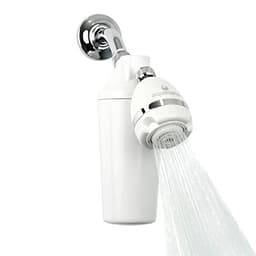
Aquasana Shower Filter with Chrome Handheld Wand
Aquasana · AQ-4100 (handheld wand configuration) · best for utilities that disinfect with free chlorine
Independently tested to NSF/ANSI 177 to reduce over 90% of chlorine for 10,000 gallons or up to six months.
If your water report says free chlorine, the Aquasana shower filter is the one we would buy.
Aquasana publishes “Independently tested to NSF/ANSI Standard 177 to reduce over 90% of chlorine for 10,000 gallons or up to 6 months”, using “Patented Copper-Zinc (KDF) media and coconut shell carbon”.
Note what that claim covers: chlorine. Aquasana makes no chloramine claim on the product page, and we are not going to imply one.
Renter-Safe Install Rating
- Drilling
- None
- Tools
- Hands only
- Time to fit
- Not published
- Power
- None
- Reversible on move-out
- Fully
Why: The filter body screws onto the existing shower arm between the arm and the head. Unscrew it on move-out day and the original head goes straight back.
Read from published documentation, not from fitting one. Aquasana, Shower Filter with Chrome Handheld Wand (AQ-4100). How the verdict is derived: renter-safe ratings explained.
What’s wrong with it
Its certified claim is chlorine only — if your utility uses chloramine, this is not a certified fix.
What we can’t tell you
Aquasana publishes no chloramine performance figure.
Published specifications
| Certified reduction | “Independently tested to NSF/ANSI Standard 177 to reduce over 90% of chlorine for 10,000 gallons or up to 6 months” |
|---|---|
| Filter media | “Patented Copper-Zinc (KDF) media and coconut shell carbon” |
| Operating pressure | “30-80 psi” |
| Maximum temperature | “115°F” |
| Optimum flow rate | “2.5 gallons per minute” |
| Included | Chrome handheld wand with three settings — Tropical Rain, Massage, Combination |
| Fitting | “All shower filter options quickly attach to your existing shower pipe”; compatible with heads “up to 4.5″ in diameter” on standard 1/2-inch connections |
| Cartridge interval | “The filter should be changed every 10,000 gallons” |
| Warranty | “1-Year Limited Warranty and a 90-Day Satisfaction Guarantee” |
Source: Aquasana, Shower Filter with Chrome Handheld Wand (AQ-4100)
#ad Price $79.99 as of October 18, 2026. Prices change; Amazon’s listing is the one that counts. How we’re funded.
2. Best all-in-one for chlorinated water
Culligan Wall-Mount Filtered Shower Head
Culligan · WSH-C125 · best for one fitting instead of two
Certified to NSF standard 177 for filtered showerhead systems, with a published 6 month or 10,000 gallon cartridge.
The Culligan WSH-C125 is the all-in-one option, and the same caveat applies.
Culligan publishes “Certified to meet NSF standard 177 for filtered showerhead systems”, a “KDF Filter Capacity of 6 months or 10,000 gallons”, and a five-year limited warranty.
That certification is to the chlorine standard. It is a good buy for chlorinated water and not a certified answer for chloramine.
Renter-Safe Install Rating
- Drilling
- None
- Tools
- Hands only
- Time to fit
- Not published
- Power
- None
- Reversible on move-out
- Fully
Why: Culligan publishes “no tools required” for fitting it to a standard 1/2″ shower arm. One threaded joint, nothing in a wall.
Read from published documentation, not from fitting one. Culligan WSH-C125 wall-mount filtered shower head, published product data (Fresh Water Systems listing). How the verdict is derived: renter-safe ratings explained.
What’s wrong with it
Certified for chlorine, not chloramine.
What we can’t tell you
Culligan publishes no chloramine claim.
Published specifications
| Flow rate | “maximum flow rate of 2.5 gpm as required by ASME standards” |
|---|---|
| Filter capacity | “KDF Filter Capacity of 6 months or 10,000 gallons” |
| Certification | “Certified to meet NSF standard 177 for filtered showerhead systems” |
| Spray settings | Five — full body, soft rain spray, invigorating pulse, full body spray/rain combo, full body spray/pulse combo |
| Connection | “installs onto standard 1/2″ IPS shower arm” |
| Installation | “Easy to install - no tools required” |
| Cartridge included | “One Culligan WHR-140 filter included” |
| Warranty | “5-year limited warranty” |
#ad We have no verified live price for this one right now, so we are not showing a number. How we’re funded.
Where to buy
Everything recommended on this page, in one place. Each link is an Amazon Associates link — we earn a commission at no extra cost to you, and it never decides a pick.
- $79.99View on Amazon
Aquasana Shower Filter with Chrome Handheld Wand
Aquasana · AQ-4100 (handheld wand configuration) · Renter verdict: Safe
- Check price on Amazon
Culligan Wall-Mount Filtered Shower Head
Culligan · WSH-C125 · Renter verdict: Safe
#ad Prices are not shown because we only publish figures we have verified on the day. How we’re funded.
Questions people actually ask
do shower filters remove chloramine
Not on any certified basis. NSF/ANSI 177, the shower filter standard, certifies free available chlorine reduction only. Chloramine claims fall under NSF/ANSI 42, a drinking water standard. We have not found a shower filter publishing certified chloramine reduction.
how do i know if my water has chlorine or chloramine
Check your utility's annual water quality report, as the CDC recommends — it states whether there is disinfectant in your water and what kind. Utilities publish it every year, usually on their website.
what is the difference between chlorine and chloramine
Chloramine is formed by adding ammonia to chlorine. The EPA says it provides longer-lasting disinfection as water moves through pipes, and the CDC notes it makes fewer disinfection byproducts — which is why many utilities have switched.
do vitamin c shower filters remove chloramine
We have not found one that publishes certified performance for chloramine, so we cannot recommend one. That is not proof it does nothing — only that there is no certified evidence we can check.
Sources
Read next
Back to Shower Water Filtration.