What NSF/ANSI 177 actually certifies
Almost nothing in a bathroom has an independent standard behind it. Shower filters are the exception, and the standard is narrower than the marketing.
By Sawyer V. · · How we research

The short answer
We earn a commission if you buy through the links on this page, at no extra cost to you. It does not change which products we pick or what we say about them — here is exactly how that works.
Quick picks
Tap any row for the full write-up. Prices are checked against Amazon rather than remembered — where we have no verified figure the button says so.
| # | Product | Best for | Renter | Price |
|---|---|---|---|---|
| 1 |  Aquasana Shower Filter with Chrome Handheld Wand “Independently tested to NSF/ANSI Standard 177 to reduce over 90% of chlorine for 10,000 gallons or up to 6 months.” | Seeing exactly what was certified and for how long | Safe | |
| 2 | No photo yet Culligan Wall-Mount Filtered Shower Head NSF 177 certified with a published 6-month or 10,000-gallon KDF filter capacity and a named cartridge. | Certification without a second component on the arm | Safe |
Why a standard matters more here than elsewhere
Look across this site and notice how little of it has independent verification. Showerheads have a federal flow cap and WaterSense labeling. Heaters have UL and ETL safety listings. Towel rails have cULus. Those are safety and efficiency marks.
Almost nothing has a third-party performance standard. There is no independent test for whether a bidet washes well, whether a caddy holds what it claims, or whether a towel dries quickly.
Shower filtration is the exception. NSF/ANSI 177 exists specifically for this product category, and both filters we recommend publish certification to it. That makes this the one place on the site where a performance claim can be checked rather than believed.
What the standard tests
Free available chlorine reduction. That is the performance requirement. The filter must reduce free chlorine by a defined amount under defined conditions.
Across the claimed capacity. This is the part that gives the standard its teeth. It is not a test on a fresh cartridge; performance must hold across the whole life the maker claims. Aquasana’s “for 10,000 gallons” is a certified duration, not a certified moment.
Material safety and structural integrity. The filter must not itself contribute contaminants, and it must withstand the water pressure it will see.
The capacity element is why the same figure appears on two unrelated products. Both makers are certifying to the same test, so both arrive at what a KDF-and-carbon cartridge can genuinely sustain.
What it deliberately excludes
The exclusions are the whole reason to read this page.
Hardness. Not covered. Calcium and magnesium require ion exchange, which is a different technology in a different place.
Heavy metals. Not covered by 177. Other NSF standards address lead and similar, and they are separate certifications requiring separate testing.
Fluoride. Not covered.
Bacteria and cysts. Not covered.
Any health outcome. The standard measures chlorine in water. It says nothing about hair, skin, or anything else, and no certified filter may claim otherwise under it. We treat that question separately and carefully.
How to check a certification claim
The phrasing on a product page tells you a great deal, and it is worth learning to read.
Strong: “Independently tested to NSF/ANSI Standard 177 to reduce over 90% of chlorine for 10,000 gallons or up to 6 months.” Standard named, performance quantified, duration stated.
Weaker: “NSF certified.” NSF maintains dozens of standards. Certified to which one? Certification to a material-safety standard is not certification of performance.
Weakest: “Tested to NSF standards” or “meets NSF standards”. Neither phrase means a certification body has verified anything. Tested by whom, against what, with what result?
The distinction between “certified to” and “tested to” is not pedantry. One involves an independent body and ongoing audit; the other can mean a manufacturer ran its own test once.
KDF and carbon, which is what is inside
Both certified filters use the same two-media approach, and it is worth knowing why.
KDF is a copper-zinc alloy. It removes chlorine by a redox reaction, converting free chlorine into a harmless chloride. Crucially, it works at the higher temperatures a shower runs at, where carbon alone becomes less effective.
Activated carbon — Aquasana publishes coconut shell carbon — adsorbs organic compounds onto an enormous internal surface area. It handles taste, odor and the by-products.
Together they cover a hot-water application better than either alone, which is exactly why the standard for showers exists separately from the standards for drinking water.
The one thing certification cannot survive
A certification is a claim about a filter operating within its published capacity. Past that point, it means nothing.
Both makers publish 10,000 gallons or six months, and neither publishes any kind of indicator to tell you the point has passed. There is no light, no color change, no gauge.
A spent cartridge does not stop quietly — it stops filtering while continuing to restrict flow. You get a weaker shower and no filtration, which is strictly worse than having no filter fitted at all.
Which means the most important thing about a certified filter is the date you wrote down. The five-minute cartridge change is here.
Every pick in full
2 we would buy. Each carries its Renter-Safe Install Rating, the published specs behind it, and the honest gap in what we know.
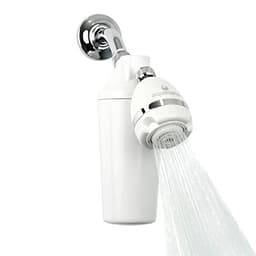
1. Clearest published certification
Aquasana Shower Filter with Chrome Handheld Wand
Aquasana · AQ-4100 (handheld wand configuration) · best for seeing exactly what was certified and for how long
“Independently tested to NSF/ANSI Standard 177 to reduce over 90% of chlorine for 10,000 gallons or up to 6 months.”
The useful thing about the Aquasana filter is that its published claim contains all three components a certification should have.
Aquasana publishes it as “independently tested to NSF/ANSI Standard 177 to reduce over 90% of chlorine for 10,000 gallons or up to 6 months”.
Read the three parts. Which standard — NSF/ANSI 177. What performance — over 90% chlorine reduction. Over what duration — 10,000 gallons or six months.
A claim missing the third part is much weaker than it looks, because any filter performs well when new. The media is published as “patented Copper-Zinc (KDF) media and coconut shell carbon”.
Renter-Safe Install Rating
- Drilling
- None
- Tools
- Hands only
- Time to fit
- Not published
- Power
- None
- Reversible on move-out
- Fully
Why: The filter body screws onto the existing shower arm between the arm and the head. Unscrew it on move-out day and the original head goes straight back.
Read from published documentation, not from fitting one. Aquasana, Shower Filter with Chrome Handheld Wand (AQ-4100). How the verdict is derived: renter-safe ratings explained.
What’s wrong with it
It reduces chlorine and nothing else. That is the standard's scope, not a fault.
What we can’t tell you
No published indicator for when the cartridge is spent. The date is the only signal.
Published specifications
| Certified reduction | “Independently tested to NSF/ANSI Standard 177 to reduce over 90% of chlorine for 10,000 gallons or up to 6 months” |
|---|---|
| Filter media | “Patented Copper-Zinc (KDF) media and coconut shell carbon” |
| Operating pressure | “30-80 psi” |
| Maximum temperature | “115°F” |
| Optimum flow rate | “2.5 gallons per minute” |
| Included | Chrome handheld wand with three settings — Tropical Rain, Massage, Combination |
| Fitting | “All shower filter options quickly attach to your existing shower pipe”; compatible with heads “up to 4.5″ in diameter” on standard 1/2-inch connections |
| Cartridge interval | “The filter should be changed every 10,000 gallons” |
| Warranty | “1-Year Limited Warranty and a 90-Day Satisfaction Guarantee” |
Source: Aquasana, Shower Filter with Chrome Handheld Wand (AQ-4100)
#ad Price $79.99 as of October 18, 2026. Prices change; Amazon’s listing is the one that counts. How we’re funded.
2. Same standard, in the showerhead
Culligan Wall-Mount Filtered Shower Head
Culligan · WSH-C125 · best for certification without a second component on the arm
NSF 177 certified with a published 6-month or 10,000-gallon KDF filter capacity and a named cartridge.
The Culligan WSH-C125 holds certification to the same standard with the cartridge inside the head.
Culligan publishes a “KDF Filter Capacity of 6 months or 10,000 gallons”, certified to NSF standard 177, and names the replacement cartridge: “One Culligan WHR-140 filter included”.
The identical interval across two unrelated manufacturers is the clearest evidence that the standard is doing real work. Both are certifying against the same test, so both arrive at the same honest capacity.
It also publishes “easy to install - no tools required”, which keeps it firmly in renter-safe territory.
Renter-Safe Install Rating
- Drilling
- None
- Tools
- Hands only
- Time to fit
- Not published
- Power
- None
- Reversible on move-out
- Fully
Why: Culligan publishes “no tools required” for fitting it to a standard 1/2″ shower arm. One threaded joint, nothing in a wall.
Read from published documentation, not from fitting one. Culligan WSH-C125 wall-mount filtered shower head, published product data (Fresh Water Systems listing). How the verdict is derived: renter-safe ratings explained.
What’s wrong with it
The cartridge is inside Culligan's own showerhead, so the head comes with the filter.
What we can’t tell you
No published operating pressure or temperature range on the pages we could reach.
Published specifications
| Flow rate | “maximum flow rate of 2.5 gpm as required by ASME standards” |
|---|---|
| Filter capacity | “KDF Filter Capacity of 6 months or 10,000 gallons” |
| Certification | “Certified to meet NSF standard 177 for filtered showerhead systems” |
| Spray settings | Five — full body, soft rain spray, invigorating pulse, full body spray/rain combo, full body spray/pulse combo |
| Connection | “installs onto standard 1/2″ IPS shower arm” |
| Installation | “Easy to install - no tools required” |
| Cartridge included | “One Culligan WHR-140 filter included” |
| Warranty | “5-year limited warranty” |
#ad We have no verified live price for this one right now, so we are not showing a number. How we’re funded.
Where to buy
Everything recommended on this page, in one place. Each link is an Amazon Associates link — we earn a commission at no extra cost to you, and it never decides a pick.
- $79.99View on Amazon
Aquasana Shower Filter with Chrome Handheld Wand
Aquasana · AQ-4100 (handheld wand configuration) · Renter verdict: Safe
- Check price on Amazon
Culligan Wall-Mount Filtered Shower Head
Culligan · WSH-C125 · Renter verdict: Safe
#ad Prices are not shown because we only publish figures we have verified on the day. How we’re funded.
Questions people actually ask
what is nsf ansi 177
The American standard written specifically for shower filtration. It tests free available chlorine reduction sustained across the capacity the maker claims, plus material safety and structural integrity. It does not cover hardness, heavy metals, fluoride or bacteria.
is nsf certification the same as nsf tested
No, and the difference matters. Certified means an independent body verified performance against a named standard and audits it. Tested to standards can mean the manufacturer ran its own test once. Look for the standard number and a quantified claim.
does nsf 177 cover hard water
No. The standard tests chlorine reduction only. Removing hardness requires ion exchange in a whole-house softener, which is a different technology in a different place.
what is kdf filter media
A copper-zinc alloy that removes chlorine by a redox reaction, converting free chlorine into harmless chloride. It works at shower temperatures where activated carbon alone becomes less effective, which is why both certified filters pair the two.
Sources
Read next
Back to Shower Water Filtration.