How to change a shower filter cartridge
A filter you stop maintaining is worse than no filter at all — it becomes a flow restriction that removes nothing. Here is the five-minute job that prevents it.
By Sawyer V. · · How we research

The short answer
We earn a commission if you buy through the links on this page, at no extra cost to you. It does not change which products we pick or what we say about them — here is exactly how that works.
Quick picks
Tap any row for the full write-up. Prices are checked against Amazon rather than remembered — where we have no verified figure the button says so.
| # | Product | Best for | Renter | Price |
|---|---|---|---|---|
| 1 |  Aquasana Shower Filter with Chrome Handheld Wand NSF/ANSI 177 certified for over 90% chlorine reduction “for 10,000 gallons or up to 6 months” — a certified duration, not just a certified moment. | Knowing exactly when to change it | Safe | |
| 2 | No photo yet Culligan Wall-Mount Filtered Shower Head Published as “easy to install - no tools required”, with a named replacement cartridge so you order the right one. | A tool-free swap on a filtered head | Safe |
Why the interval is what it is
Both certified filters we cover publish the same figure — 10,000 gallons or about six months — and that is not a coincidence. It is roughly what a KDF-and-carbon cartridge can sustain while still meeting NSF/ANSI 177 for chlorine reduction.
The certification is what makes the number trustworthy. NSF 177 does not test a fresh cartridge and stop; it requires the reduction to hold across the claimed capacity. So 10,000 gallons is not a marketing estimate, it is the point at which the maker is no longer prepared to stand behind the claim.
In practice, six months is the number to use. At a 2.5 GPM head and an eight-minute daily shower you are pushing roughly 7,300 gallons a year through it, so a single-person household lands close to the gallon figure and the calendar figure at about the same time. A household of three or four will hit 10,000 gallons well before six months, and should change sooner.
What a spent cartridge is actually doing
This is the part worth internalizing, because it inverts the intuition.
A filter does not stop working dramatically. The carbon’s adsorption sites fill up and it quietly stops removing chlorine, while the physical cartridge carries on obstructing the water path exactly as before — and slightly more, as sediment accumulates.
The result is the worst of both: you have a flow restriction that removes nothing. A shower with an unchanged filter is measurably worse than a shower with no filter fitted at all.
And there is no warning. Neither manufacturer publishes any kind of indicator — no color change, no gauge, no light. The date you wrote down is the entire monitoring system, which is why the last step of the guide above is not optional.
The symptoms people misread
The shower feels weaker. Usually blamed on building pressure, frequently a spent cartridge. If your shower has gradually declined over about six months and you have a filter, that is the first thing to check.
The chlorine smell comes back. The clearest signal, and the one people trust least because it returns gradually rather than overnight.
Nothing at all. The most common case. Chlorine reduction is not something you can perceive directly, so an unchanged filter can sit there for two years while the household assumes it is working.
The cost nobody adds up before buying
A shower filter is a subscription with a hardware down payment. The unit is the small number; two cartridges a year, for as long as you own it, is the real one.
The sum is simple: cartridge price ÷ 6 = your cost per month to keep filtering. Over three years the cartridges will cost more than the filter did.
We are not going to fill in the cartridge price, because we only publish figures verified on the day and cartridge prices move. But run that number before you buy the unit, not afterwards — it is the honest cost of the product, and it is the reason a lot of shower filters end up permanently spent.
Ordering the right cartridge
Cartridges are not interchangeable between brands, and often not between models within a brand. Two things make this easier:
Write the model number down at installation. Culligan publishes the WHR-140 as the WSH-C125’s cartridge. Put that on the same piece of tape as the date.
Buy two at a time. A spare in the cupboard converts the change from an order-and-wait into a five-minute job on the day you notice. The single biggest predictor of whether a filter gets changed is whether the replacement is already in the house.
Changing it is renter-safe, like everything upstream of it
Both filters score Safe on our install rating, and a cartridge change touches nothing beyond the filter housing itself. No wall, no valve, no supply line.
The one rule carried over from fitting a showerhead: if the housing is stiff, hold the upstream part still so you are not putting torque into the shower arm and the fitting inside the wall. Everything else about this job is trivially reversible.
Every pick in full
2 we would buy. Each carries its Renter-Safe Install Rating, the published specs behind it, and the honest gap in what we know.
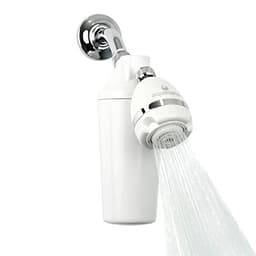
1. Clearest published interval
Aquasana Shower Filter with Chrome Handheld Wand
Aquasana · AQ-4100 (handheld wand configuration) · best for knowing exactly when to change it
NSF/ANSI 177 certified for over 90% chlorine reduction “for 10,000 gallons or up to 6 months” — a certified duration, not just a certified moment.
The useful thing about the Aquasana filter is that its certification includes a lifespan. Aquasana publishes it as “independently tested to NSF/ANSI Standard 177 to reduce over 90% of chlorine for 10,000 gallons or up to 6 months”.
That is a claim about sustained performance across the cartridge’s whole life rather than a measurement on a fresh one, which is precisely what makes the replacement interval meaningful rather than arbitrary.
The media is published as “patented Copper-Zinc (KDF) media and coconut shell carbon”, and the body attaches to the existing shower pipe, so a cartridge change never involves the wall.
Renter-Safe Install Rating
- Drilling
- None
- Tools
- Hands only
- Time to fit
- Not published
- Power
- None
- Reversible on move-out
- Fully
Why: The filter body screws onto the existing shower arm between the arm and the head. Unscrew it on move-out day and the original head goes straight back.
Read from published documentation, not from fitting one. Aquasana, Shower Filter with Chrome Handheld Wand (AQ-4100). How the verdict is derived: renter-safe ratings explained.
What’s wrong with it
Aquasana publishes the interval but not a cartridge price, so we cannot give you a cost per month — that is a number you have to check yourself before committing.
What we can’t tell you
No published indicator of any kind for when the cartridge is spent. The date is the only signal you get.
Published specifications
| Certified reduction | “Independently tested to NSF/ANSI Standard 177 to reduce over 90% of chlorine for 10,000 gallons or up to 6 months” |
|---|---|
| Filter media | “Patented Copper-Zinc (KDF) media and coconut shell carbon” |
| Operating pressure | “30-80 psi” |
| Maximum temperature | “115°F” |
| Optimum flow rate | “2.5 gallons per minute” |
| Included | Chrome handheld wand with three settings — Tropical Rain, Massage, Combination |
| Fitting | “All shower filter options quickly attach to your existing shower pipe”; compatible with heads “up to 4.5″ in diameter” on standard 1/2-inch connections |
| Cartridge interval | “The filter should be changed every 10,000 gallons” |
| Warranty | “1-Year Limited Warranty and a 90-Day Satisfaction Guarantee” |
Source: Aquasana, Shower Filter with Chrome Handheld Wand (AQ-4100)
#ad Price $79.99 as of October 18, 2026. Prices change; Amazon’s listing is the one that counts. How we’re funded.
2. Easiest change
Culligan Wall-Mount Filtered Shower Head
Culligan · WSH-C125 · best for a tool-free swap on a filtered head
Published as “easy to install - no tools required”, with a named replacement cartridge so you order the right one.
The Culligan WSH-C125 publishes two things that make the maintenance straightforward: it is “easy to install - no tools required”, and the replacement cartridge has a name — “One Culligan WHR-140 filter included”.
A named cartridge model matters more than it sounds. The most common reason a filter goes unchanged is not laziness, it is that six months later nobody can remember what fits.
The interval matches Aquasana’s: a “KDF Filter Capacity of 6 months or 10,000 gallons”, certified to NSF standard 177.
Renter-Safe Install Rating
- Drilling
- None
- Tools
- Hands only
- Time to fit
- Not published
- Power
- None
- Reversible on move-out
- Fully
Why: Culligan publishes “no tools required” for fitting it to a standard 1/2″ shower arm. One threaded joint, nothing in a wall.
Read from published documentation, not from fitting one. Culligan WSH-C125 wall-mount filtered shower head, published product data (Fresh Water Systems listing). How the verdict is derived: renter-safe ratings explained.
What’s wrong with it
The cartridge sits inside the showerhead, so you are committed to Culligan's head as well as its filter.
What we can’t tell you
Culligan's published data does not give an operating pressure or temperature range on the pages we could reach.
Published specifications
| Flow rate | “maximum flow rate of 2.5 gpm as required by ASME standards” |
|---|---|
| Filter capacity | “KDF Filter Capacity of 6 months or 10,000 gallons” |
| Certification | “Certified to meet NSF standard 177 for filtered showerhead systems” |
| Spray settings | Five — full body, soft rain spray, invigorating pulse, full body spray/rain combo, full body spray/pulse combo |
| Connection | “installs onto standard 1/2″ IPS shower arm” |
| Installation | “Easy to install - no tools required” |
| Cartridge included | “One Culligan WHR-140 filter included” |
| Warranty | “5-year limited warranty” |
#ad We have no verified live price for this one right now, so we are not showing a number. How we’re funded.
Where to buy
Everything recommended on this page, in one place. Each link is an Amazon Associates link — we earn a commission at no extra cost to you, and it never decides a pick.
- $79.99View on Amazon
Aquasana Shower Filter with Chrome Handheld Wand
Aquasana · AQ-4100 (handheld wand configuration) · Renter verdict: Safe
- Check price on Amazon
Culligan Wall-Mount Filtered Shower Head
Culligan · WSH-C125 · Renter verdict: Safe
#ad Prices are not shown because we only publish figures we have verified on the day. How we’re funded.
Questions people actually ask
how often should you change a shower filter
Both certified filters we cover publish the same interval: 10,000 gallons or about six months. A single-person household reaches both at roughly the same time; a household of three or four hits the gallon figure considerably sooner and should change earlier.
what happens if you do not change a shower filter
The carbon stops removing chlorine but the cartridge keeps restricting flow, so you end up with a weaker shower and no filtration — strictly worse than having no filter at all. There is no indicator, so the date you wrote down is the only signal.
shower head filter cost
The unit is the smaller cost. Two cartridges a year for as long as you own it is the real figure: cartridge price divided by six is your monthly cost to keep filtering, and over three years that exceeds what the filter cost.
why is my water gray after changing a shower filter
Loose carbon fines from the new cartridge, and it is normal. Run the shower for a minute or two after fitting and it clears. If it persists beyond a few minutes, check the cartridge is seated the right way round.
Sources
Read next
Back to Shower Water Filtration.