Shower filter vs water softener
These get compared as though they are competing options. They are not. They remove different things, from different places, at wildly different cost.
By Sawyer V. · · How we research
The short answer
We earn a commission if you buy through the links on this page, at no extra cost to you. It does not change which products we pick or what we say about them — here is exactly how that works.
Quick picks
Tap any row for the full write-up. Prices are checked against Amazon rather than remembered — where we have no verified figure the button says so.
| # | Product | Best for | Renter | Price |
|---|---|---|---|---|
| 1 |  Aquasana Shower Filter with Chrome Handheld Wand NSF/ANSI 177 certified for over 90% chlorine reduction across 10,000 gallons, fitted in five minutes with no tools. | Chlorine, at one outlet, this afternoon | Safe | |
| 2 | No photo yet Culligan Wall-Mount Filtered Shower Head NSF 177 certified for chlorine, and published as reducing scale as well — which is a narrower claim than softening, and correctly so. | Chlorine plus some scale reduction, in one part | Safe | |
| 3 | No photo yet High Sierra Classic Fixed Showerhead (FCS-100) If hardness is the problem and a softener is not an option, a never-clog metal head is the cheapest thing that survives it. | Hardness, without a softener or a cartridge | Safe |
They remove different things
| Shower filter | Water softener | |
|---|---|---|
| What it removes | Free available chlorine, certified to NSF/ANSI 177 | Dissolved calcium and magnesium, by ion exchange |
| Where it works | One outlet | The whole house |
| Fixes scale on fittings | Reduces it; does not stop it | Yes |
| Fixes shampoo not lathering | No | Yes |
| Removes chlorine smell | Yes, certified | No — softeners do not remove chlorine |
| Install | Five minutes, no tools | Plumbed into the main, plus a drain and a power outlet |
| Consumables | A cartridge every ~6 months | Salt, continuously |
| Renter verdict | Safe | Not possible |
The thing most people get wrong
Softeners do not remove chlorine. Filters do not remove hardness. They are frequently discussed as though one is a cheaper version of the other, and they overlap in almost nothing.
A softener swaps calcium and magnesium ions for sodium ions across a resin bed. That eliminates scale and restores lather — and it does nothing whatever to the chlorine your utility added, which passes straight through.
A shower filter uses carbon and KDF media to reduce chlorine. It has no mechanism for removing dissolved hardness minerals, which is why NSF/ANSI 177 is a chlorine standard and why no certified filter claims to soften.
If you have both problems, you need both products. Households with a softener frequently add a shower filter for exactly this reason.
Which problem do you have?
Chlorine symptoms. The water smells like a swimming pool, especially first thing. Skin and hair feel dry after a shower in a way they did not at a previous address. There is no white crust anywhere. That is a filter problem.
Hardness symptoms. White crust on taps and shower glass that comes back within days. Shampoo that will not lather. A showerhead that blocks. Gray film on shower doors. That is a softener problem, or a hardware-that-copes problem.
Both. Common, and it means both answers. There is no single product that does both jobs well.
Cost, in the only honest terms we have
We do not publish remembered prices, so instead of inventing figures here is the structure of each cost, which does not change with the market.
A shower filter is a small purchase plus a cartridge roughly every six months, forever. Both certified filters here publish the same 10,000-gallon interval. Over three years the cartridges cost more than the unit did.
A softener is a large appliance purchase, plus professional installation into the main with a drain connection and an outlet, plus salt as an ongoing consumable, plus the water used in each regeneration cycle. It is the most expensive thing discussed anywhere on this site by a wide margin.
A hardware-that-copes strategy — a never-clog metal head, wipeable nozzles, occasional vinegar — is a one-off purchase and a dollar a year in vinegar.
If you rent, this comparison has one answer
A softener is a permanent plumbing installation on the incoming main. It is not available to you, it is not a negotiation, and it is not worth asking about for a two-year lease.
What is available is everything else. A certified shower filter threads onto the arm in five minutes — Culligan publishes “no tools required” — and comes off just as fast. A head that copes with hardness is the same fitting. Both score Safe on our install rating, and both come with you.
What we cannot tell you
We have not tested chlorine reduction on anything and we have no laboratory. Everything above rests on what NSF/ANSI 177 certification means and on what the manufacturers publish.
We also have no view on whether reducing chlorine will improve your skin. That claim is made constantly in this category and the independent evidence is thinner than the confidence behind it, so we describe what the certification measures — chlorine, in gallons, to a stated percentage — and leave the rest alone.
Every pick in full
3 we would buy. Each carries its Renter-Safe Install Rating, the published specs behind it, and the honest gap in what we know.
1. The filter case
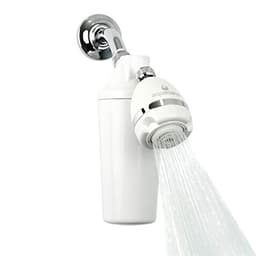
Aquasana Shower Filter with Chrome Handheld Wand
Aquasana · AQ-4100 (handheld wand configuration) · best for chlorine, at one outlet, this afternoon
NSF/ANSI 177 certified for over 90% chlorine reduction across 10,000 gallons, fitted in five minutes with no tools.
A shower filter is the cheap, fast, reversible answer to a specific problem: chlorine in the water at the one outlet where you stand in it for ten minutes.
Aquasana publishes “independently tested to NSF/ANSI Standard 177 to reduce over 90% of chlorine for 10,000 gallons or up to 6 months” using “patented Copper-Zinc (KDF) media and coconut shell carbon”. It attaches to the existing shower pipe.
Renter-Safe Install Rating
- Drilling
- None
- Tools
- Hands only
- Time to fit
- Not published
- Power
- None
- Reversible on move-out
- Fully
Why: The filter body screws onto the existing shower arm between the arm and the head. Unscrew it on move-out day and the original head goes straight back.
Read from published documentation, not from fitting one. Aquasana, Shower Filter with Chrome Handheld Wand (AQ-4100). How the verdict is derived: renter-safe ratings explained.
What’s wrong with it
It treats one outlet, and it commits you to two cartridges a year for as long as you own it.
What we can’t tell you
Aquasana publishes the cartridge interval but not a price, so the monthly cost is yours to work out.
Published specifications
| Certified reduction | “Independently tested to NSF/ANSI Standard 177 to reduce over 90% of chlorine for 10,000 gallons or up to 6 months” |
|---|---|
| Filter media | “Patented Copper-Zinc (KDF) media and coconut shell carbon” |
| Operating pressure | “30-80 psi” |
| Maximum temperature | “115°F” |
| Optimum flow rate | “2.5 gallons per minute” |
| Included | Chrome handheld wand with three settings — Tropical Rain, Massage, Combination |
| Fitting | “All shower filter options quickly attach to your existing shower pipe”; compatible with heads “up to 4.5″ in diameter” on standard 1/2-inch connections |
| Cartridge interval | “The filter should be changed every 10,000 gallons” |
| Warranty | “1-Year Limited Warranty and a 90-Day Satisfaction Guarantee” |
Source: Aquasana, Shower Filter with Chrome Handheld Wand (AQ-4100)
#ad Price $79.99 as of October 18, 2026. Prices change; Amazon’s listing is the one that counts. How we’re funded.
2. The closest thing to both
Culligan Wall-Mount Filtered Shower Head
Culligan · WSH-C125 · best for chlorine plus some scale reduction, in one part
NSF 177 certified for chlorine, and published as reducing scale as well — which is a narrower claim than softening, and correctly so.
Culligan publishes that its KDF filter “reduces chlorine & scale”, certified to NSF 177 for the chlorine, with a six-month or 10,000-gallon cartridge and no tools to fit.
It is worth noticing what Culligan does not say. It does not say “softens”, because it does not perform ion exchange. Reducing scale and removing hardness are different claims, and a manufacturer that keeps them separate is telling you something useful.
Renter-Safe Install Rating
- Drilling
- None
- Tools
- Hands only
- Time to fit
- Not published
- Power
- None
- Reversible on move-out
- Fully
Why: Culligan publishes “no tools required” for fitting it to a standard 1/2″ shower arm. One threaded joint, nothing in a wall.
Read from published documentation, not from fitting one. Culligan WSH-C125 wall-mount filtered shower head, published product data (Fresh Water Systems listing). How the verdict is derived: renter-safe ratings explained.
What’s wrong with it
The scale reduction is unquantified — Culligan publishes no percentage for it.
What we can’t tell you
No published operating pressure or temperature range in the data we could reach.
Published specifications
| Flow rate | “maximum flow rate of 2.5 gpm as required by ASME standards” |
|---|---|
| Filter capacity | “KDF Filter Capacity of 6 months or 10,000 gallons” |
| Certification | “Certified to meet NSF standard 177 for filtered showerhead systems” |
| Spray settings | Five — full body, soft rain spray, invigorating pulse, full body spray/rain combo, full body spray/pulse combo |
| Connection | “installs onto standard 1/2″ IPS shower arm” |
| Installation | “Easy to install - no tools required” |
| Cartridge included | “One Culligan WHR-140 filter included” |
| Warranty | “5-year limited warranty” |
#ad We have no verified live price for this one right now, so we are not showing a number. How we’re funded.
3. The no-consumables option
High Sierra Classic Fixed Showerhead (FCS-100)
High Sierra Showerheads · FCS-100-CH · best for hardness, without a softener or a cartridge
If hardness is the problem and a softener is not an option, a never-clog metal head is the cheapest thing that survives it.
There is a third answer that neither side of this comparison offers: change nothing about the water and buy hardware that copes with it.
High Sierra publishes a single-nozzle design in “solid lead-free and corrosion resistant metal”, backed by a never-clog guarantee that is “void if the mesh screen is removed”. No cartridges, no plumbing, no consumables.
For a renter with hard water and no possibility of a softener, this is frequently the most sensible money in the whole category.
Renter-Safe Install Rating
- Drilling
- None
- Tools
- One wrench
- Time to fit
- Not published
- Power
- None
- Reversible on move-out
- Fully
Why: It threads onto the existing 1/2″ shower arm and nothing else is touched. Keep the old head in a drawer, screw it back on the day you move, and the bathroom is exactly as you found it.
Read from published documentation, not from fitting one. High Sierra Showerheads, Classic Fixed Showerhead FCS-100-CH. How the verdict is derived: renter-safe ratings explained.
What it costs to run — Water
- Flow rate
- 1.25 GPM (the lowest published option)
- Shower length
- 8 minutes
- Showers
- 365 a year
1.25 GPM x 8 min x 365 = 3,650 gallons a year, against 7,300 for a 2.5 GPM head
About 3,650 gallons a year saved against a full-flow head
Arithmetic on published specifications, not a measurement. Rate source: High Sierra Showerheads, Classic Fixed Showerhead product page (published flow-rate options).
What’s wrong with it
It treats nothing. Your water is exactly as hard as it was; the head just survives it.
What we can’t tell you
No published particle rating for the mesh screen.
Published specifications
| Flow rate options | 1.25 GPM (“Saves up to 50% water and the energy to heat it”) through 2.5 GPM (“Maximum flow rate per shower head allowed nationally by the Federal Government”) |
|---|---|
| Nozzle design | A single nozzle that works “just like nature does, by colliding water to create a rain-like cascade of large, heavy, high-energy droplets” |
| Material | “Solid lead-free and corrosion resistant metal construction” |
| Thread | “Connects to shower arms, extensions, filters, etc with universal 1/2″ - 14 NPS or NPT male threads size” |
| Certification | “Independently tested and certified to WaterSense and WaterMark” |
| Guarantee | “The NEVER-CLOG GUARANTEE is void if the mesh screen is removed” |
| Made in | “Engineered and built in the USA” |
| Tools supplied | A wrench is supplied with the showerhead |
Source: High Sierra Showerheads, Classic Fixed Showerhead FCS-100-CH
#ad We have no verified live price for this one right now, so we are not showing a number. How we’re funded.
Where to buy
Everything recommended on this page, in one place. Each link is an Amazon Associates link — we earn a commission at no extra cost to you, and it never decides a pick.
- $79.99View on Amazon
Aquasana Shower Filter with Chrome Handheld Wand
Aquasana · AQ-4100 (handheld wand configuration) · Renter verdict: Safe
- Check price on Amazon
Culligan Wall-Mount Filtered Shower Head
Culligan · WSH-C125 · Renter verdict: Safe
- Check price on Amazon
High Sierra Classic Fixed Showerhead (FCS-100)
High Sierra Showerheads · FCS-100-CH · Renter verdict: Safe
#ad Prices are not shown because we only publish figures we have verified on the day. How we’re funded.
Questions people actually ask
shower head filter vs water softener
A shower filter reduces chlorine at one outlet, certified to NSF/ANSI 177, and installs in five minutes. A softener removes dissolved calcium and magnesium from the whole house by ion exchange and needs plumbing into the main. Only the softener addresses hardness.
water softener vs shower head filter
Not alternatives. Softeners remove hardness and leave chlorine untouched; filters reduce chlorine and leave hardness untouched. Households with both problems frequently have both products.
filtered shower head vs water softener
The same comparison. If your symptom is a chlorine smell, buy the filter. If it is white crust and shampoo that will not lather, only a softener fixes the cause — and if that is not possible, buy hardware that copes.
Sources
Read next
Back to Shower Water Filtration.