

Best overall showerhead
The best shower heads for a fifteen-minute swap
Five shower heads ranked on published flow rate, nozzle design and install reality — plus the one we would not buy.
Top pick: High Sierra Classic Fixed Showerhead (FCS-100)
A showerhead is the single best return on a Saturday morning in the whole house. It is one threaded joint, it costs less than dinner, and it changes the part of the day you notice most.
The short version
Best overall showerhead
Five shower heads ranked on published flow rate, nozzle design and install reality — plus the one we would not buy.
Top pick: High Sierra Classic Fixed Showerhead (FCS-100)

Best handheld
Handhelds and two-in-ones ranked on published flow rate, hose and docking — nothing drilled, nothing left behind.
Top pick: Moen Engage Magnetix Handheld Shower, 5.5″ head

Best for low water pressure
Full-flow heads that make the most of weak pressure, plus the descale that fixes it for free about half the time.
Top pick: High Sierra Classic Fixed Showerhead (FCS-100)

Best water-saving showerhead
Low-flow heads with the yearly gallons calculated from published GPM — and the one whose saving is not worth having.
Top pick: High Sierra Classic Fixed Showerhead (FCS-100)

Best rain-style head
Rain-style heads that fit an existing shower arm, ranked on published flow rate and droplet design.
Top pick: High Sierra Half Dome Showerhead (HDFCS-100)

Best all-metal head
Heads whose makers publish a real material, and the one whose maker does not — plus when metal is worth paying for.
Top pick: High Sierra Classic Fixed Showerhead (FCS-100)

Head to head
The rain-versus-handheld decision settled in the first paragraph, then justified — plus the two-in-one that dodges it.
Top pick: Moen Engage Magnetix Handheld Shower, 5.5″ head

How to
Five steps, one adjustable wrench, fifteen minutes — including the tape direction almost everyone gets backwards.
Top pick: High Sierra Classic Fixed Showerhead (FCS-100)

How to
The vinegar-bag method, how long to leave it, and the two finishes you should not do this to.
Top pick: Delta In2ition Two-in-One Shower, 2.5 GPM

Plain English
The pipe between the wall and the head — what it does, why height and reach are its job, and when to swap it.
Top pick: High Sierra Classic Fixed Showerhead (FCS-100)
Plain English
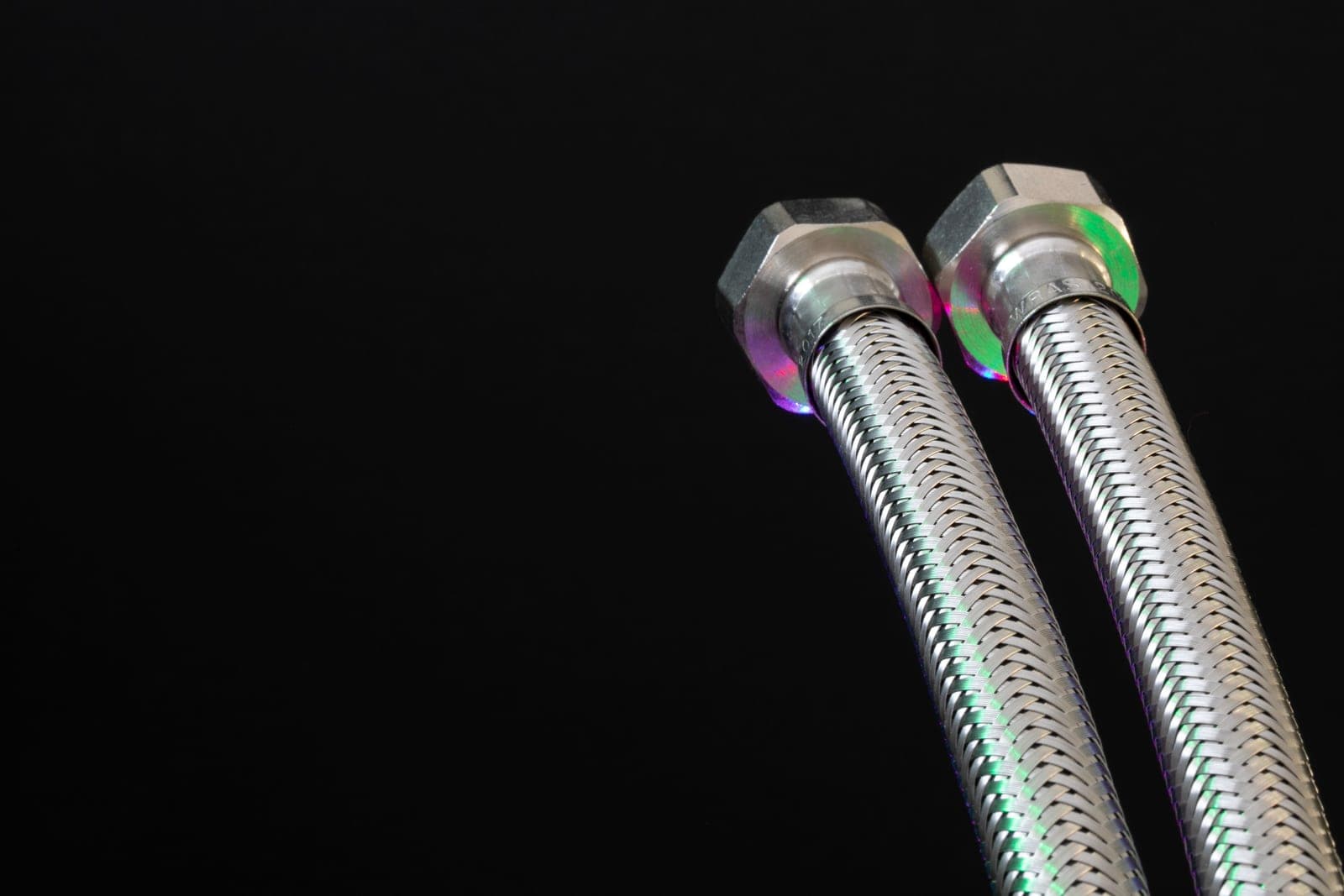
Nearly all US handheld hoses share a 1/2-inch thread — the exceptions, and how to check yours in thirty seconds.
Top pick: Moen Engage Magnetix Handheld Shower, 3.5″ head

Plain English
Gallons per minute explained: what the number governs, what it cannot tell you, and which figure to buy.
Top pick: High Sierra Classic Fixed Showerhead (FCS-100)

Plain English
What a tub spout does, the two mounting types, and why a failing diverter steals your shower pressure.
Top pick: Moen Engage Magnetix Handheld Shower, 5.5″ head

How to
The escalation sequence for a seized head — and the single moment you must stop and reassess.
Top pick: High Sierra Classic Fixed Showerhead (FCS-100)
Best dual shower head
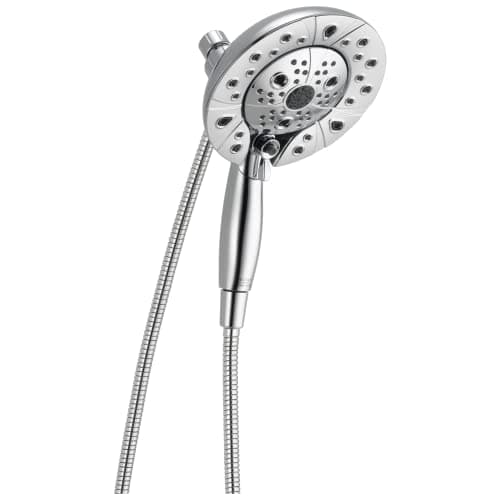
Two-in-one shower systems compared on published flow rate, hose length and docking — plus what dual costs you.
Top pick: Delta In2ition Two-in-One Shower, 1.75 GPM

How to
The five causes of a weak shower, checked in order of cost, and what a head can and cannot change.
Top pick: High Sierra Classic Fixed Showerhead (FCS-100)

Plain English
What the restrictor is, why removing it usually disappoints, and the two legal alternatives that work.
Top pick: High Sierra Classic Fixed Showerhead (FCS-100)

How to
Diagnosing a leak by where it drips, the PTFE tape fix, and the one leak no head replacement will solve.
Top pick: High Sierra Classic Fixed Showerhead (FCS-100)
Plain English
What each named spray setting actually does mechanically, and why more settings is not a better shower.
Top pick: Moen Engage Magnetix Handheld Shower, 5.5″ head

Best rental shower head
Shower heads chosen for rentals: one threaded joint, no drilling, fully reversible, and built for weak building pressure.
Top pick: High Sierra Classic Fixed Showerhead (FCS-100)

Best matte black head
Matte black heads from makers that publish the finish, plus how the coating behaves against limescale and cleaning.
Top pick: High Sierra Classic Fixed Showerhead (FCS-100)
Best head for long hair
Why rain heads rinse badly, what velocity has to do with conditioner, and the heads that actually clear thick hair.
Top pick: Delta In2ition Two-in-One Shower, 2.5 GPM

Best head for small showers
Compact heads for narrow cubicles and low ceilings, ranked on published face size and projection.
Top pick: High Sierra Classic Fixed Showerhead (FCS-100)

Head to head
Moen Engage against Delta In2ition on format, docking, spray settings, hose, flow rate and warranty.
Top pick: Delta In2ition Two-in-One Shower, 1.75 GPM
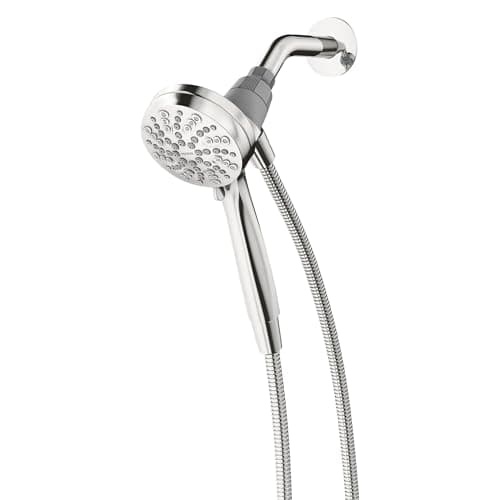
Best head for seniors
Heads chosen for seated showering, one-handed docking and flow control, plus the limits of what a head can fix.
Top pick: Moen Engage Magnetix Handheld Shower, 3.5″ head

Best high-pressure head
Heads ranked on how they concentrate a federally capped flow — nozzle design, published flow rate and spray behavior.
Top pick: High Sierra Classic Fixed Showerhead (FCS-100)

Head to head
The difference between a waterfall sheet and a rainfall spread, and which survives modest water pressure.
Top pick: High Sierra Half Dome Showerhead (HDFCS-100)

Worth it?
What a shower panel actually requires, why flow rate limits it, and the renter-safe alternative.
Top pick: Delta In2ition Two-in-One Shower, 1.75 GPM

Plain English
How a thermostatic valve holds temperature, why it is behind the wall, and the renter-safe workarounds.
Top pick: High Sierra Classic Fixed Showerhead with Trickle Valve (FCS-200)

How to
Three ways to gain height on a shower head, all reversible, and what each one costs in stability.
Top pick: Delta In2ition Two-in-One Shower, 2.5 GPM

Plain English
Why no maker publishes a service life, the four real end-of-life signals, and what to try first.
Top pick: High Sierra Classic Fixed Showerhead (FCS-100)

Best tub spout
Diverter tub spouts matched to the pipe behind the wall: connection type, pipe length, spout length and warranty.
Top pick: Diverter Tub Spout, Chrome
Best shower upgrade
A two-in-one head, a water-saving head, a handheld, a certified filter, a tension caddy, a shower mirror and a tub mat, with the upgrade to skip.
Top pick: Delta In2ition Two-in-One Shower, 1.75 GPM

What it costs
What a shower head swap costs in parts and tools, and the water a lower-flow head saves, worked from published GPM figures.
Top pick: Moen Engage Magnetix Handheld Shower, 3.5″ head

How to
Diagnose a failed tub spout diverter, identify slip-on or threaded, and replace the spout using the maker's published steps.
Top pick: Tub Spout, Pull-Up Diverter, Chrome (Slip-On)
Best bathtub upgrade
A handheld, a non-slip mat, a grab bar, a diverter spout, a liner, a fast-drying floor mat and a towel warmer — plus the tub upgrade to skip.
Top pick: Moen Engage Magnetix Handheld Shower, 3.5″ head

Head to head
A combined fixed-plus-handheld unit against a standalone handheld: flow rate, hose, docking and warranty compared.
Top pick: Delta In2ition Two-in-One Shower, 1.75 GPM
Head to head
1.75 GPM against 2.5 GPM on the same model: the water saved, what WaterSense tests, and who should stay at full flow.
Top pick: Delta In2ition Two-in-One Shower, 1.75 GPM
Best family shower head
What a shared family shower needs — reach, durability, fast rinsing — and three heads that deliver it.
Top pick: Delta In2ition Two-in-One Shower, 1.75 GPM
Best tub-shower combo head
What a shower over a tub needs — a working diverter and reach to the tub floor — with three parts that deliver it.
Top pick: Delta In2ition Two-in-One Shower, 1.75 GPM
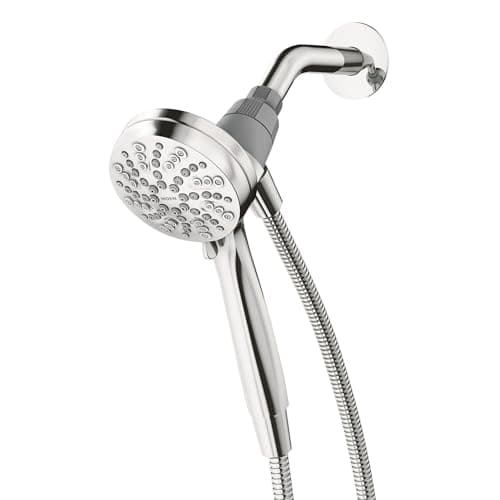
Best shower head under $50
Four shower heads under $50 judged on published flow rate, spray count and warranty, with the live price on every one.
Top pick: Moen Engage Magnetix Handheld Shower, 1.75 GPM
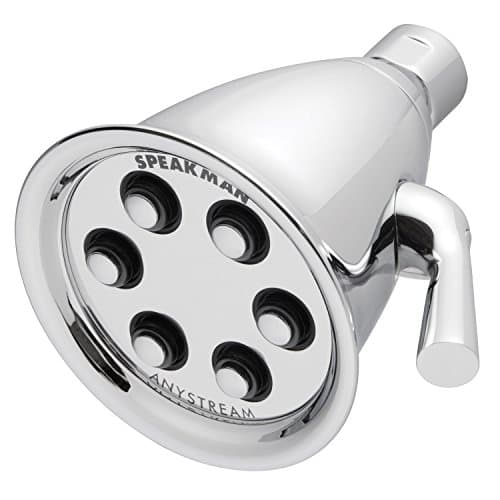
Best fixed shower head
Four wall-mounted fixed shower heads compared on published spray count, flow rate, material and warranty — no hoses, no handhelds.
Top pick: Speakman Icon Anystream Shower Head, 2.0 GPM

How to
The four published differences between a hotel shower and a home one, and the fittings that close each gap in an afternoon.
Top pick: Speakman Hotel Shower Head, 2.0 GPM
There are only two variables that matter, and neither of them is the price. The first is flow rate, published in gallons per minute and legally capped in the United States at 2.5 GPM. The second is what the head does with that water on the way out.
Flow rate is easy to check because it is regulated: every head sold here publishes a GPM figure, and you can read it before you buy. What is less obvious is that a lower number is not automatically a worse shower. High Sierra publishes options from 1.25 GPM up to the full 2.5, and describes its single-nozzle design as working “just like nature does, by colliding water to create a rain-like cascade of large, heavy, high-energy droplets”. That is the whole trick of a good low-flow head — fewer, bigger, faster droplets rather than a wide mist of small ones. A badly designed 2.5 GPM head can feel weaker than a well designed 1.5.
The second variable is spray engineering, and this is where the marketing lives. Delta calls its version H2Okinetic and publishes that it “sculpts water into unique wave patterns”; Moen sells six named spray functions on the Engage. These are real differences in nozzle geometry, but they are also the least checkable claims in the category. We quote what the manufacturer publishes, note the flow rate, and leave the adjectives to them.
Fixed heads screw onto the shower arm and stay there. They are the cheapest, the most reliable, and the least useful for anything other than standing under. If your only job is a better shower, this is the answer and you can stop reading.
Handhelds put the head on a hose with a docking cradle in its place. They cost more, they add a hose to clean, and they solve four problems a fixed head cannot touch: rinsing a dog, washing a small child, cleaning the shower itself, and showering while sitting down. If any of those is a weekly event in your house, the extra money is not really a choice.
Two-in-one systems like Delta’s In2ition are a fixed head with a handheld that docks magnetically into it. You get both, one threaded joint, and a slightly bulkier profile. Delta publishes the In2ition at both 1.75 GPM and 2.5 GPM depending on the model number, which is exactly the sort of detail that gets lost when a listing just says “In2ition”.
Every head on this hub scores Safe on our Renter-Safe Install Rating, and they all score it for the same reason: a showerhead is one threaded joint on a pipe that already exists. Nothing is drilled. Nothing is cut. There are no anchors in tile and no holes to fill.
The one piece of advice worth more than any product recommendation: keep the head you took off. Put it in a bag, put the bag in the back of a cupboard, and on move-out day spend five minutes putting it back. A landlord who never learns you changed the shower cannot object to it, and the head you bought comes with you to the next place. That is the entire renter strategy for this category, and it costs nothing.
People blame the head for water pressure. Sometimes that is right — a clogged head genuinely does throttle flow, and a descale often fixes it for the price of a bottle of vinegar. But pressure at the wall is set by your building, not by the head, and a head cannot create pressure it is not given. What a well-chosen head does is spend the pressure you have more cleverly, by pushing it through fewer, better nozzles.
If your water is hard, the head is also not the whole story. Scale builds inside nozzles and inside the arm, and the fix belongs in shower water filtration rather than in a new head every eighteen months.
We have not stood under any of these. Nobody here has measured a spray pattern, timed a heat-up, or held a pressure gauge to a wall. What we have done is read the published specification for each head, convert its flow rate into gallons a year at a realistic eight-minute shower, and check what the manufacturer will actually commit to in writing. Where a figure is not published — hose length on the Moen Engage, for instance — the page says so rather than guessing.
That is the deal, and it is set out in full on how we research.
The shower arm is the curved pipe that comes out of the wall and holds the showerhead. It is a separate part from the head, it threads into the wall at one end and into the head at the other, and swapping it changes the height and reach of your shower without touching the plumbing behind the tile.
Almost. Handheld shower hoses in the United States use a 1/2-inch connection at both ends, so most hoses fit most handhelds. The exceptions are proprietary systems where the manufacturer has used a non-standard fitting, and hoses sold for European or Australian markets.
Unscrew the old head anticlockwise, clean the old tape off the threads on the shower arm, wrap fresh PTFE tape clockwise around those threads, then screw the new head on hand-tight and give it a quarter turn with a wrench. It takes about fifteen minutes and needs one adjustable wrench.