How to remove a shower head that will not budge
Almost every stuck showerhead comes off with patience and vinegar. The thing that turns a fifteen-minute job into a repair is force applied in the wrong place.
By Sawyer V. · · How we research
The short answer
We earn a commission if you buy through the links on this page, at no extra cost to you. It does not change which products we pick or what we say about them — here is exactly how that works.
Quick picks
Tap any row for the full write-up. Prices are checked against Amazon rather than remembered — where we have no verified figure the button says so.
| # | Product | Best for | Renter | Price |
|---|---|---|---|---|
| 1 | No photo yet High Sierra Classic Fixed Showerhead (FCS-100) Solid metal, universal 1/2-inch thread, a wrench in the box — and High Sierra publishes that it needs no thread tape at all. | Not repeating this in five years | Safe | |
| 2 |  Delta In2ition Two-in-One Shower, 1.75 GPM Since the hard part is already done, this is the swap that turns one fitting into a fixed head plus a handheld. | Getting a handheld out of the same struggle | Safe |
Why they seize in the first place
Two mechanisms, and knowing which you are dealing with changes the approach.
Scale. The usual culprit. Hard water deposits mineral inside the threaded joint, and over years it effectively cements the two parts together. This is why vinegar works: acetic acid dissolves calcium carbonate, and the joint releases.
Galvanic corrosion. Less common and more stubborn. When two dissimilar metals sit in contact in a wet environment, one corrodes preferentially and the products of that reaction bind the joint. Heat helps here more than vinegar does.
A third contributor is simply overtightening at the last install. A head cranked on with a long wrench, plus five years of scale, is a considerably harder problem than one fitted hand-tight plus a quarter turn.
The two-wrench technique, and why it is not optional
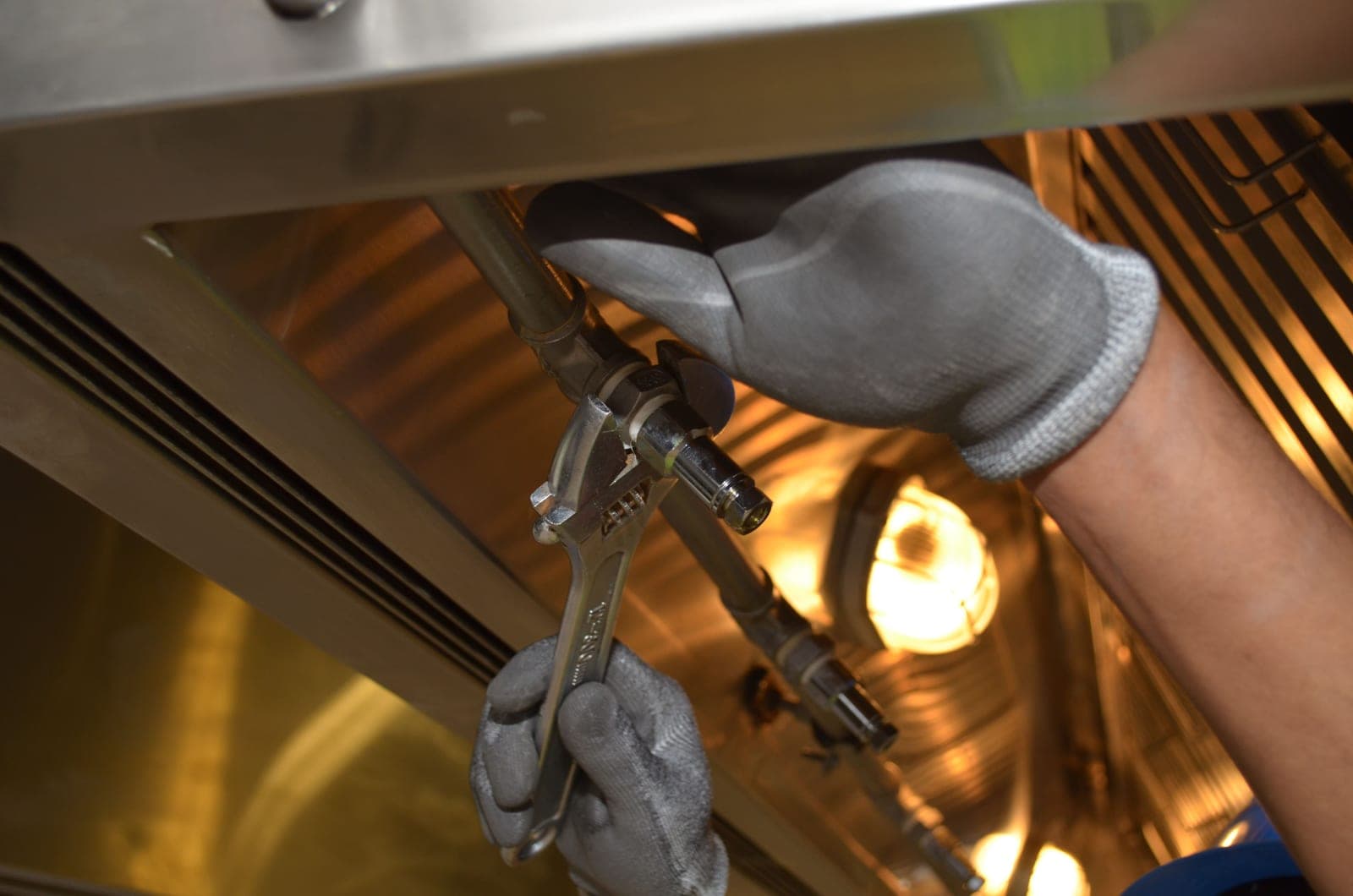
Everything about doing this safely comes down to one idea: the force must stay between the head and the arm, and must never reach the wall.
Behind your tile, the shower arm threads into a drop-ear elbow fixed to a stud. That joint was sealed once, during construction, and it is not designed to be worked loose. If you turn the head with nothing holding the arm, every bit of torque you apply travels straight into that hidden joint.
So: one wrench on the arm, close to the wall, holding it absolutely still. One wrench on the head, turning. Cloths under both so you do not chew the finish. If you only own one wrench, a strap wrench or even a firm cloth-wrapped hand on the arm is far better than nothing.
Escalate in this order
1. Steady pressure, two wrenches. Most heads give up here. Steady beats sudden — a sharp jerk is what snaps things.
2. Vinegar, one hour. Cloth soaked in white vinegar around the joint, plastic bag over it so it does not dry. This dissolves the scale that is doing the welding, and it solves the majority of genuinely stuck heads.
3. Vinegar, overnight. Only on chrome or stainless. On brass, gold, matte black or oil-rubbed bronze, an hour is the limit — acid will dull those finishes permanently, and you would be trading a stuck head for a ruined arm.
4. Gentle heat. A hairdryer on the collar for two minutes. Metal expands, the joint loosens. Never a naked flame: there is timber and possibly wiring in that wall cavity, and a torch near a wall void is how a small job becomes a fire.
5. Penetrating oil. A last resort before stopping. Apply at the joint, leave for an hour, try again. Clean the threads thoroughly afterwards, because oil residue interferes with a new seal.
The moment to stop
If the arm rotates inside the wall, stop immediately.
This is the one non-negotiable in the whole guide. A turning arm means the hidden joint is moving, and that joint is sealed with thread compound applied during construction. Once it moves, it may leak — inside the wall, invisibly, until you notice a stain on a ceiling below.
If it happens: stop turning, gently tighten the arm back clockwise to where it was, and leave it. If you rent, this is a maintenance request. If you own, it is a plumber’s hour and much cheaper than the alternative.
The same logic applies to the shower arm generally — the arm explainer covers what is behind that wall flange and why it deserves care.
Once it is off
Scrub the arm threads completely bare with an old toothbrush — every scrap of old tape, every trace of scale. This is the single most skipped step and the most common reason a brand-new head drips at the joint.
Then inspect the threads. If they are crushed, stripped or badly corroded, replacing the arm is a sensible small job while everything is already apart, and arms are inexpensive.
Fit the new head hand-tight plus about a quarter turn — no more. You have just spent an hour learning what overtightening costs the next person, who may well be you. The full fitting method is here.
Preventing the repeat
Do not overtighten. The seal comes from the tape or the washer, not from force.
Descale periodically. Every few months in hard water — the vinegar-bag method keeps the nozzles clear and slows deposition at the joint too.
Consider what happens to the water before it arrives. If your water is hard enough to weld a joint in five years, it is also blocking your nozzles and coating your glass. The hard-water page covers hardware that copes.
Every pick in full
2 we would buy. Each carries its Renter-Safe Install Rating, the published specs behind it, and the honest gap in what we know.
1. Easiest replacement to fit
High Sierra Classic Fixed Showerhead (FCS-100)
High Sierra Showerheads · FCS-100-CH · best for not repeating this in five years
Solid metal, universal 1/2-inch thread, a wrench in the box — and High Sierra publishes that it needs no thread tape at all.
Having fought a seized head off, the sensible thing is to fit one that will come off next time. The High Sierra Classic publishes “solid lead-free and corrosion resistant metal construction” and a universal “1/2″ - 14 NPS or NPT” thread, with a wrench supplied.
The detail worth noticing is that High Sierra publishes “No teflon tape required”. Less tape in the joint means less to harden and bond over the years, which is a small thing that makes future removal easier.
Renter-Safe Install Rating
- Drilling
- None
- Tools
- One wrench
- Time to fit
- Not published
- Power
- None
- Reversible on move-out
- Fully
Why: It threads onto the existing 1/2″ shower arm and nothing else is touched. Keep the old head in a drawer, screw it back on the day you move, and the bathroom is exactly as you found it.
Read from published documentation, not from fitting one. High Sierra Showerheads, Classic Fixed Showerhead FCS-100-CH. How the verdict is derived: renter-safe ratings explained.
What it costs to run — Water
- Flow rate
- 1.25 GPM (the lowest published option)
- Shower length
- 8 minutes
- Showers
- 365 a year
1.25 GPM x 8 min x 365 = 3,650 gallons a year, against 7,300 for a 2.5 GPM head
About 3,650 gallons a year saved against a full-flow head
Arithmetic on published specifications, not a measurement. Rate source: High Sierra Showerheads, Classic Fixed Showerhead product page (published flow-rate options).
What’s wrong with it
No spray settings at all.
What we can’t tell you
No published torque figure, so 'hand-tight plus a quarter turn' remains a rule of thumb rather than a spec.
Published specifications
| Flow rate options | 1.25 GPM (“Saves up to 50% water and the energy to heat it”) through 2.5 GPM (“Maximum flow rate per shower head allowed nationally by the Federal Government”) |
|---|---|
| Nozzle design | A single nozzle that works “just like nature does, by colliding water to create a rain-like cascade of large, heavy, high-energy droplets” |
| Material | “Solid lead-free and corrosion resistant metal construction” |
| Thread | “Connects to shower arms, extensions, filters, etc with universal 1/2″ - 14 NPS or NPT male threads size” |
| Certification | “Independently tested and certified to WaterSense and WaterMark” |
| Guarantee | “The NEVER-CLOG GUARANTEE is void if the mesh screen is removed” |
| Made in | “Engineered and built in the USA” |
| Tools supplied | A wrench is supplied with the showerhead |
Source: High Sierra Showerheads, Classic Fixed Showerhead FCS-100-CH
#ad We have no verified live price for this one right now, so we are not showing a number. How we’re funded.
2. Best upgrade while you are there
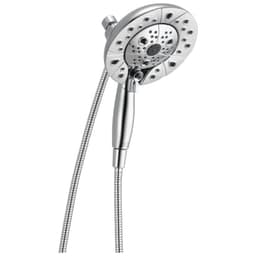
Delta In2ition Two-in-One Shower, 1.75 GPM
Delta · 58480-BL-PK · best for getting a handheld out of the same struggle
Since the hard part is already done, this is the swap that turns one fitting into a fixed head plus a handheld.
The difficult part of this job is removal. Fitting whatever comes next is the easy fifteen minutes, so it is worth asking whether you want the same thing back.
The In2ition gets you a fixed head with a handheld docked inside it for the same single threaded joint. Delta publishes 1.75 GPM at 80 psi, a WaterSense label, five settings and a 60-inch hose.
Renter-Safe Install Rating
- Drilling
- None
- Tools
- One wrench
- Time to fit
- Not published
- Power
- None
- Reversible on move-out
- Fully
Why: The whole assembly hangs off the existing shower arm on one threaded joint. Delta publishes no bracket that needs fixing to tile.
Read from published documentation, not from fitting one. Delta, H2Okinetic In2ition 5-Setting Two-in-One Shower 58480-BL-PK. How the verdict is derived: renter-safe ratings explained.
What it costs to run — Water
- Flow rate
- 1.75 GPM at 80 psi (Delta's published figure)
- Shower length
- 8 minutes
- Showers
- 365 a year
1.75 GPM x 8 min x 365 = 5,110 gallons a year, against 7,300 for a 2.5 GPM head
About 2,190 gallons a year less than a full-flow head
Arithmetic on published specifications, not a measurement. Rate source: Delta, In2ition 58480-BL-PK specifications (1.75 gpm @ 80 psi).
What’s wrong with it
It hangs lower and further from the wall than a plain head — measure before you commit.
What we can’t tell you
No published hose material for this variant.
Published specifications
| Flow rate | “1.75 gpm @ 80 psi, 6.6 L/min @ 552 kPa” |
|---|---|
| Spray settings | Five: “H2OKinetic spray, Full Body spray, Full Spray with Massage, Massaging spray” plus pause |
| Hose | “Includes 60 in. hose” |
| Overall height | “11-4/7″” |
| Technologies | H2Okinetic (“creates wave pattern for enhanced coverage”), In2ition two-in-one, MagnaTite docking |
| Certification | “WaterSense Labeled (uses 20% less water than industry standard)” |
Source: Delta, H2Okinetic In2ition 5-Setting Two-in-One Shower 58480-BL-PK
#ad Price $157.99 as of October 18, 2026. Prices change; Amazon’s listing is the one that counts. How we’re funded.
Where to buy
Everything recommended on this page, in one place. Each link is an Amazon Associates link — we earn a commission at no extra cost to you, and it never decides a pick.
- Check price on Amazon
High Sierra Classic Fixed Showerhead (FCS-100)
High Sierra Showerheads · FCS-100-CH · Renter verdict: Safe
- $157.99View on Amazon
Delta In2ition Two-in-One Shower, 1.75 GPM
Delta · 58480-BL-PK · Renter verdict: Safe
#ad Prices are not shown because we only publish figures we have verified on the day. How we’re funded.
Questions people actually ask
shower head how to open
Hold the shower arm still with a second wrench and turn the head anticlockwise, with cloths protecting both finishes. If it resists, soak the joint in white vinegar for an hour to dissolve the scale that is welding the threads, then try again.
how do you remove a stuck shower head without a wrench
A rubber jar opener or a folded cloth for grip will often do it on a moderately stiff joint, but you still need something holding the arm. Without a way to hold the arm still, you are putting force into the pipe inside the wall — which is the one outcome to avoid.
why is my shower head stuck
Usually limescale that has built up inside the threaded joint over years and effectively cemented the parts together. Less often it is galvanic corrosion between dissimilar metals, or simply that the last person overtightened it.
Sources
Read next
Back to Showers & Showerheads.