What is a shower arm, and why does it decide your shower?
The part almost nobody thinks about, which controls the two things people complain about most: how high the water is, and how far out it reaches.
By Sawyer V. · · How we research
The short answer
We earn a commission if you buy through the links on this page, at no extra cost to you. It does not change which products we pick or what we say about them — here is exactly how that works.
Quick picks
Tap any row for the full write-up. Prices are checked against Amazon rather than remembered — where we have no verified figure the button says so.
| # | Product | Best for | Renter | Price |
|---|---|---|---|---|
| 1 | No photo yet High Sierra Classic Fixed Showerhead (FCS-100) Published for a “universal 1/2″ - 14 NPS or NPT male threads size” — the standard almost every American shower arm uses. | Confirming your thread is standard | Safe | |
| 2 |  Moen Engage Magnetix Handheld Shower, 5.5″ head A handheld sidesteps the arm-height problem entirely — take it off the cradle and hold it wherever you like. | Tall people in short showers | Safe |
The three parts, and which one does what
A wall-mounted shower is three components in a row, and it helps enormously to know which one is responsible for what.
The drop-ear elbow lives inside the wall, fixed to a stud, and is where the supply pipe terminates. It is not user-serviceable and getting to it means opening the wall.
The shower arm threads into that elbow and passes through the tile, covered by a decorative flange. It is a plain pipe, it is cheap, and it is replaceable from outside the wall.
The head threads onto the outer end of the arm.
Height and reach are entirely the arm’s doing. No head fixes an arm that is too low or too close to the wall, which is why people who buy three different showerheads and remain unhappy have usually been solving the wrong problem.
The three shapes of arm
Standard S-shaped. Six to eight inches of reach, angled down. What almost every American shower has.
Extended or long. Twelve inches or more of reach, bringing the head further out over the middle of the enclosure. This is the fix for “the water hits the wall rather than me”.
Rise or gooseneck. A tall S-curve that lifts the head considerably higher before angling it down — the fix for a tall person in a house plumbed for someone shorter, and the closest you get to a ceiling rain head without opening a ceiling.
How to tell whether the arm is your problem
Stand in the shower and look up. If the head is at or below the top of your own head, water is landing on your shoulders and not much else — that is a height problem and a gooseneck arm solves it.
If you have to press yourself against the far wall to get under the water, the head is not far enough out. That is a reach problem and an extended arm solves it.
If the water is at a good height and reach and simply feels weak, it is not the arm at all. Try descaling the head, then read the low-pressure page.
Replacing one, and the one real risk
Swapping an arm is the same threaded job as swapping a head, with one important difference: the inner end goes into a fitting you cannot see. Unscrew the old arm anticlockwise, and if the elbow inside the wall turns with it, stop — you are now undoing a joint you cannot reach, and that is the point at which a fifteen-minute job becomes a real repair.
Assuming it comes out cleanly: clean both sets of threads, wrap PTFE tape clockwise on both ends, and thread the new arm in until the curve points where you want it. Do not force it past that point to make it “straight”; the correct final position is wherever it happens to land when it is properly tight.
The method is the same as replacing the head, with more caution and the same tools.
Renters: this one is a maybe
A showerhead is unambiguously reversible and we say so everywhere on this site. An arm is almost as reversible — it threads in and out, nothing is drilled — but it involves a joint inside the wall that you cannot inspect, and if the elbow moves you have a problem that is genuinely a landlord’s.
Our honest advice: change the head freely, and leave the arm alone unless you are confident and the existing arm turns easily. If height is your complaint, a handheld gets you most of the way with none of the risk. The reasoning behind that call is in how the renter-safe ratings are derived.
Every pick in full
2 we would buy. Each carries its Renter-Safe Install Rating, the published specs behind it, and the honest gap in what we know.
1. Fits any standard arm
High Sierra Classic Fixed Showerhead (FCS-100)
High Sierra Showerheads · FCS-100-CH · best for confirming your thread is standard
Published for a “universal 1/2″ - 14 NPS or NPT male threads size” — the standard almost every American shower arm uses.
The reason showerhead shopping is easy in the United States is that the arm thread is effectively standardized. High Sierra states it explicitly: “connects to shower arms, extensions, filters, etc with universal 1/2″ - 14 NPS or NPT male threads size”.
If a head lists that thread — and almost all do — it will fit the arm you have without an adapter. This is also why a filter can sit between the arm and the head: same thread at both ends.
Renter-Safe Install Rating
- Drilling
- None
- Tools
- One wrench
- Time to fit
- Not published
- Power
- None
- Reversible on move-out
- Fully
Why: It threads onto the existing 1/2″ shower arm and nothing else is touched. Keep the old head in a drawer, screw it back on the day you move, and the bathroom is exactly as you found it.
Read from published documentation, not from fitting one. High Sierra Showerheads, Classic Fixed Showerhead FCS-100-CH. How the verdict is derived: renter-safe ratings explained.
What it costs to run — Water
- Flow rate
- 1.25 GPM (the lowest published option)
- Shower length
- 8 minutes
- Showers
- 365 a year
1.25 GPM x 8 min x 365 = 3,650 gallons a year, against 7,300 for a 2.5 GPM head
About 3,650 gallons a year saved against a full-flow head
Arithmetic on published specifications, not a measurement. Rate source: High Sierra Showerheads, Classic Fixed Showerhead product page (published flow-rate options).
What’s wrong with it
A universal thread does not solve a physical clash. A very large head on a short arm can still end up against the wall.
What we can’t tell you
High Sierra does not publish a maximum head weight for a standard arm, which matters for heavy metal heads on old arms.
Published specifications
| Flow rate options | 1.25 GPM (“Saves up to 50% water and the energy to heat it”) through 2.5 GPM (“Maximum flow rate per shower head allowed nationally by the Federal Government”) |
|---|---|
| Nozzle design | A single nozzle that works “just like nature does, by colliding water to create a rain-like cascade of large, heavy, high-energy droplets” |
| Material | “Solid lead-free and corrosion resistant metal construction” |
| Thread | “Connects to shower arms, extensions, filters, etc with universal 1/2″ - 14 NPS or NPT male threads size” |
| Certification | “Independently tested and certified to WaterSense and WaterMark” |
| Guarantee | “The NEVER-CLOG GUARANTEE is void if the mesh screen is removed” |
| Made in | “Engineered and built in the USA” |
| Tools supplied | A wrench is supplied with the showerhead |
Source: High Sierra Showerheads, Classic Fixed Showerhead FCS-100-CH
#ad We have no verified live price for this one right now, so we are not showing a number. How we’re funded.
2. Best if the arm is too low
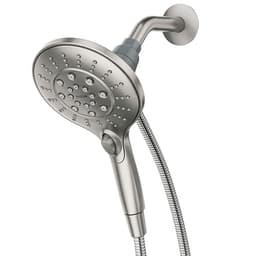
Moen Engage Magnetix Handheld Shower, 5.5″ head
Moen · 26112 · best for tall people in short showers
A handheld sidesteps the arm-height problem entirely — take it off the cradle and hold it wherever you like.
If your arm is mounted too low and you would rather not touch the wall fitting, a handheld is the cheapest workaround. The cradle goes where the head was, and the head itself comes off the cradle whenever the fixed height is not working for you.
Moen publishes a 1/2″ IPS connection, so it fits the same standard arm, and the Magnetix dock means putting it back is one-handed.
Renter-Safe Install Rating
- Drilling
- None
- Tools
- One wrench
- Time to fit
- Not published
- Power
- None
- Reversible on move-out
- Fully
Why: The docking cradle screws onto the shower arm in place of the old head, so the magnet does the holding and the wall is never touched.
Read from published documentation, not from fitting one. Moen, Engage Six-Function 5 1/2″ Diameter Spray Head Handheld Shower (26112). How the verdict is derived: renter-safe ratings explained.
What’s wrong with it
It is a workaround. Docked in the cradle, the head is still at the arm's height.
What we can’t tell you
Moen does not publish the hose length for this model, which is exactly the number you would want if the plan is to hold it higher.
Published specifications
| Flow rate | “2.5 Gpm (9.5 L/Min) Max.” |
|---|---|
| Spray functions | Six — “Wide Coverage; Intensify; Downpour; Relaxing Massage; Massage; Rinse” |
| Head diameter | “5.5″ Diameter Spray Head” |
| Hose | Includes “a kink-free metal hose” (length not published) |
| Connection | “1/2″”, “Ips” type |
| Magnetix docking | “easily detach and reattach your handheld showerhead” and it “always docks facing forward to avoid exterior splashing” |
| Warranty | “Backed by Moen’s Limited Lifetime Warranty” |
Source: Moen, Engage Six-Function 5 1/2″ Diameter Spray Head Handheld Shower (26112)
#ad Price $70.00 as of October 18, 2026. Prices change; Amazon’s listing is the one that counts. How we’re funded.
Where to buy
Everything recommended on this page, in one place. Each link is an Amazon Associates link — we earn a commission at no extra cost to you, and it never decides a pick.
- Check price on Amazon
High Sierra Classic Fixed Showerhead (FCS-100)
High Sierra Showerheads · FCS-100-CH · Renter verdict: Safe
- $70.00View on Amazon
Moen Engage Magnetix Handheld Shower, 5.5″ head
Moen · 26112 · Renter verdict: Safe
#ad Prices are not shown because we only publish figures we have verified on the day. How we’re funded.
Questions people actually ask
what is a shower arm
The short curved pipe between the wall and the showerhead. It threads into a fitting inside the wall at one end and into the head at the other, and it is what determines the height and reach of your shower.
what to use for tub spout
A tub spout is the bath's equivalent of a shower arm and it is not interchangeable — spouts either slide onto a copper stub and lock with a set screw, or thread onto a nipple. Check which yours is before buying, because the two are not compatible.
how to measure a shower arm
Measure the horizontal distance from the wall face to the center of the head connection — that is the reach — and the vertical rise from where it leaves the wall. Those two numbers, not the overall pipe length, are what determine where the water lands.
Sources
Read next
Back to Showers & Showerheads.