The best water-saving shower heads, with the gallons worked out
Every head here publishes its flow rate, so the saving is arithmetic rather than a claim. Here is what each one costs you in gallons a year.
By Sawyer V. · · How we research
The short answer
We earn a commission if you buy through the links on this page, at no extra cost to you. It does not change which products we pick or what we say about them — here is exactly how that works.
Quick picks
Tap any row for the full write-up. Prices are checked against Amazon rather than remembered — where we have no verified figure the button says so.
| # | Product | Best for | Renter | Price |
|---|---|---|---|---|
| 1 | No photo yet High Sierra Classic Fixed Showerhead (FCS-100) Published from 1.25 GPM — about 3,650 gallons a year, half a full-flow head, and it does not feel like a punishment. | Halving your shower water without hating the shower | Safe | |
| 2 |  Delta In2ition Two-in-One Shower, 1.75 GPM 1.75 GPM and WaterSense-labeled — about 2,190 gallons a year saved, with a handheld hidden inside the fixed head. | Saving water without giving up the handheld | Safe | |
| 3 | No photo yet High Sierra Classic Fixed Showerhead with Trickle Valve (FCS-200) The trickle valve saves water the restrictor cannot — minutes of running water removed from every shower, at whatever flow rate you choose. | People who lather for a long time | Safe | |
| — | No photo yet Culligan Wall-Mount Filtered Shower Head A good filter and a poor water-saver: published at the full ASME maximum of 2.5 GPM, which is the number every other head here is measured against. | Skip this one | Safe | No buy link |
The sum, so you can redo it with your own numbers
Everything on this page comes from one calculation, and it is deliberately simple enough to check on a phone:
GPM × minutes per shower × showers per year = gallons per year.
We use eight minutes and 365 showers throughout, which is a defensible middle rather than a flattering one. On those inputs a 2.5 GPM head uses about 7,300 gallons a year; 1.75 GPM uses about 5,110; 1.25 GPM uses about 3,650. Change the minutes to match your own household and the ranking does not move, only the size of the gap.
Notice what the sum does not include: a dollar figure. Water is billed differently in every municipality in America and we are not going to invent an average and dress it up as your bill. Gallons are the honest unit, and you can multiply by your own rate in ten seconds.
The hot water is the bigger number
The gallons above are only half the saving. Most of the water in a shower is hot, and heating water is one of the largest energy uses in a home. High Sierra puts it plainly on its own product page: 1.25 GPM “saves up to 50% water and the energy to heat it”.
We are not going to convert that into dollars either, and here is the honest reason: doing it properly needs your water heater’s efficiency, your incoming water temperature, your shower temperature and your fuel price, and any figure that skips those is a number chosen to look impressive. The direction is certain and the magnitude depends on your house.
Why some low-flow heads feel awful and some do not
Low-flow got its bad reputation honestly. Early restricted heads were ordinary heads with a washer jammed in the inlet, which reduced the volume without changing anything about how it was delivered. The result was fifty weak dribbles instead of fifty strong ones.
Modern low-flow heads that work do something different: they change the nozzle geometry so the reduced volume comes out fast and in large drops. High Sierra uses one big nozzle; Delta’s H2Okinetic is published as sculpting water into “unique wave patterns”. Both are attempts at the same insight, which is that droplet size and velocity decide how a shower feels far more than volume does.
This is exactly what the WaterSense label is testing. It is not just a flow limit — it also requires a minimum spray performance, which is why a WaterSense head is a safer low-flow purchase than an uncertified one at the same GPM.
The saving nobody counts: turning it off
Two minutes of lathering under a running 2.5 GPM head is five gallons. Every day, that is about 1,800 gallons a year — roughly the same as the entire difference between a 2.5 GPM head and a 1.75 GPM one, and you did not have to compromise on the shower at all.
That is the case for a trickle valve, and it is why the High Sierra Classic 200 is on this page despite having identical published flow rates to the model above it. The lever is the feature.
What we cannot tell you
We have not measured a single one of these. Every gallon figure above is arithmetic on the manufacturer’s own published GPM at 80 psi, and real bathrooms are not at 80 psi. The flow rates are regulated and reliably published, which is why this is one of the few categories where arithmetic gets you a genuinely useful answer — but it is arithmetic, not a measurement, and we would rather label it correctly.
Every pick in full
3 we would buy, and one we would not. Each carries its Renter-Safe Install Rating, the published specs behind it, and the honest gap in what we know.
1. Biggest saving
High Sierra Classic Fixed Showerhead (FCS-100)
High Sierra Showerheads · FCS-100-CH · best for halving your shower water without hating the shower
Published from 1.25 GPM — about 3,650 gallons a year, half a full-flow head, and it does not feel like a punishment.
High Sierra publishes 1.25 GPM as its lowest option and describes it plainly: “Saves up to 50% water and the energy to heat it”. That second half is the part people forget. Most of the water in a shower is hot, so halving the flow halves a heating bill as well as a water bill.
The reason this works where other low-flow heads fail is the single nozzle. Spread 1.25 GPM across fifty openings and you get a mist; put it through one and you get a column of heavy droplets. High Sierra’s own description — colliding water to produce “large, heavy, high-energy droplets” — is a fair account of why the number on the box and the feeling in the shower can disagree.
It is independently certified to WaterSense, which is the label that means the flow claim has been tested rather than asserted, and it is solid metal rather than plated plastic.
Renter-Safe Install Rating
- Drilling
- None
- Tools
- One wrench
- Time to fit
- Not published
- Power
- None
- Reversible on move-out
- Fully
Why: It threads onto the existing 1/2″ shower arm and nothing else is touched. Keep the old head in a drawer, screw it back on the day you move, and the bathroom is exactly as you found it.
Read from published documentation, not from fitting one. High Sierra Showerheads, Classic Fixed Showerhead FCS-100-CH. How the verdict is derived: renter-safe ratings explained.
What it costs to run — Water
- Flow rate
- 1.25 GPM (the lowest published option)
- Shower length
- 8 minutes
- Showers
- 365 a year
1.25 GPM x 8 min x 365 = 3,650 gallons a year, against 7,300 for a 2.5 GPM head
About 3,650 gallons a year saved against a full-flow head
Arithmetic on published specifications, not a measurement. Rate source: High Sierra Showerheads, Classic Fixed Showerhead product page (published flow-rate options).
What’s wrong with it
1.25 GPM is genuinely low, and in a building with weak pressure it will be too low. If your shower is already disappointing, this is the wrong page and the wrong head.
What we can’t tell you
High Sierra publishes the flow rates but no comparative spray-force data, so we cannot show you numerically how 1.25 GPM through one nozzle compares with 2.5 through many.
Published specifications
| Flow rate options | 1.25 GPM (“Saves up to 50% water and the energy to heat it”) through 2.5 GPM (“Maximum flow rate per shower head allowed nationally by the Federal Government”) |
|---|---|
| Nozzle design | A single nozzle that works “just like nature does, by colliding water to create a rain-like cascade of large, heavy, high-energy droplets” |
| Material | “Solid lead-free and corrosion resistant metal construction” |
| Thread | “Connects to shower arms, extensions, filters, etc with universal 1/2″ - 14 NPS or NPT male threads size” |
| Certification | “Independently tested and certified to WaterSense and WaterMark” |
| Guarantee | “The NEVER-CLOG GUARANTEE is void if the mesh screen is removed” |
| Made in | “Engineered and built in the USA” |
| Tools supplied | A wrench is supplied with the showerhead |
Source: High Sierra Showerheads, Classic Fixed Showerhead FCS-100-CH
#ad We have no verified live price for this one right now, so we are not showing a number. How we’re funded.
2. Best WaterSense two-in-one
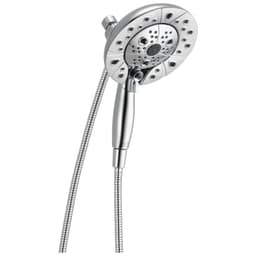
Delta In2ition Two-in-One Shower, 1.75 GPM
Delta · 58480-BL-PK · best for saving water without giving up the handheld
1.75 GPM and WaterSense-labeled — about 2,190 gallons a year saved, with a handheld hidden inside the fixed head.
WaterSense is a meaningful label rather than a marketing badge: it certifies both flow and performance, so a labeled head has been checked to deliver an acceptable shower at the reduced rate. Delta publishes this one as “WaterSense Labeled (uses 20% less water than industry standard)” at “1.75 gpm @ 80 psi”.
The saving works out at about 5,110 gallons a year against 7,300 for a full-flow head, on the same eight-minute daily shower. You keep the fixed head, you keep the handheld, and the whole thing is still one threaded joint on the shower arm.
This is the pick for households that want a lower number without an argument about it. 1.75 GPM is a compromise almost nobody notices; 1.25 is a decision some people regret.
Renter-Safe Install Rating
- Drilling
- None
- Tools
- One wrench
- Time to fit
- Not published
- Power
- None
- Reversible on move-out
- Fully
Why: The whole assembly hangs off the existing shower arm on one threaded joint. Delta publishes no bracket that needs fixing to tile.
Read from published documentation, not from fitting one. Delta, H2Okinetic In2ition 5-Setting Two-in-One Shower 58480-BL-PK. How the verdict is derived: renter-safe ratings explained.
What it costs to run — Water
- Flow rate
- 1.75 GPM at 80 psi (Delta's published figure)
- Shower length
- 8 minutes
- Showers
- 365 a year
1.75 GPM x 8 min x 365 = 5,110 gallons a year, against 7,300 for a 2.5 GPM head
About 2,190 gallons a year less than a full-flow head
Arithmetic on published specifications, not a measurement. Rate source: Delta, In2ition 58480-BL-PK specifications (1.75 gpm @ 80 psi).
What’s wrong with it
It saves less than half what the 1.25 GPM High Sierra does, and it is a physically bulky head for a small enclosure.
What we can’t tell you
Delta publishes flow at 80 psi and no figures for the handheld and fixed head running together, which is the mode that uses the most water.
Published specifications
| Flow rate | “1.75 gpm @ 80 psi, 6.6 L/min @ 552 kPa” |
|---|---|
| Spray settings | Five: “H2OKinetic spray, Full Body spray, Full Spray with Massage, Massaging spray” plus pause |
| Hose | “Includes 60 in. hose” |
| Overall height | “11-4/7″” |
| Technologies | H2Okinetic (“creates wave pattern for enhanced coverage”), In2ition two-in-one, MagnaTite docking |
| Certification | “WaterSense Labeled (uses 20% less water than industry standard)” |
Source: Delta, H2Okinetic In2ition 5-Setting Two-in-One Shower 58480-BL-PK
#ad Price $157.99 as of October 19, 2026. Prices change; Amazon’s listing is the one that counts. How we’re funded.
3. Best saving you control
High Sierra Classic Fixed Showerhead with Trickle Valve (FCS-200)
High Sierra Showerheads · FCS-200-CH · best for people who lather for a long time
The trickle valve saves water the restrictor cannot — minutes of running water removed from every shower, at whatever flow rate you choose.
Every other head on this page saves water by giving you less of it, all the time. This one gives you a lever that cuts the flow to a trickle while you shampoo, and then restores the exact temperature you had.
For anyone who spends two or three minutes of a shower not actually rinsing, that is a larger saving than any restrictor. Two minutes of a 2.5 GPM head is five gallons; over a year, roughly 1,800 gallons, and you never once had a weaker shower.
Combine it with a lower flow rate and the effects stack. High Sierra publishes the same 1.25–2.5 GPM range on this variant as on the standard Classic.
Renter-Safe Install Rating
- Drilling
- None
- Tools
- One wrench
- Time to fit
- Not published
- Power
- None
- Reversible on move-out
- Fully
Why: Identical fitting to the FCS-100 — one threaded joint on the shower arm, no fixings in any surface.
Read from published documentation, not from fitting one. High Sierra Showerheads, Classic fixed showerhead range (FCS-200 with trickle valve). How the verdict is derived: renter-safe ratings explained.
What’s wrong with it
It only works if you actually use it. A trickle valve saves nothing at all for the very common shower where the water runs from start to finish.
What we can’t tell you
High Sierra does not publish the flow rate in the trickle position, so the saving above is calculated from the flow being off rather than from a published trickle figure.
Published specifications
| Variant | The FCS-100 with a trickle (shut-off) valve added |
|---|---|
| Flow rate options | Same published range as the FCS-100: 1.25 GPM through 2.5 GPM |
| Material | “Solid lead-free and corrosion resistant metal construction” |
| Thread | Universal 1/2″ - 14 NPS or NPT male thread |
| Trickle valve | Lever on the head that cuts the flow to a trickle without touching the mixer |
| Finishes published | Chrome, brushed nickel, oil rubbed bronze, polished brass, matte black |
Source: High Sierra Showerheads, Classic fixed showerhead range (FCS-200 with trickle valve)
#ad We have no verified live price for this one right now, so we are not showing a number. How we’re funded.
The one to skip
Culligan Wall-Mount Filtered Shower Head
Culligan · WSH-C125 · best for chlorine, not water saving
A good filter and a poor water-saver: published at the full ASME maximum of 2.5 GPM, which is the number every other head here is measured against.
The WSH-C125 is a genuinely useful product and we recommend it elsewhere on this site. It does not belong in a water-saving roundup, and the reason is that Culligan publishes it at a “maximum flow rate of 2.5 gpm as required by ASME standards” — the legal ceiling, not a saving.
Filtered heads and low-flow heads are solving different problems, and filtration is the harder one to combine with a low flow rate: forcing water through a cartridge costs pressure, so filter manufacturers tend to start from the maximum permitted flow rather than below it.
If your priority is chlorine, buy it — see the filter picks. If your priority is water, buy one of the three above.
Renter-Safe Install Rating
- Drilling
- None
- Tools
- Hands only
- Time to fit
- Not published
- Power
- None
- Reversible on move-out
- Fully
Why: Culligan publishes “no tools required” for fitting it to a standard 1/2″ shower arm. One threaded joint, nothing in a wall.
Read from published documentation, not from fitting one. Culligan WSH-C125 wall-mount filtered shower head, published product data (Fresh Water Systems listing). How the verdict is derived: renter-safe ratings explained.
What’s wrong with it
About 7,300 gallons a year, the full-flow baseline. Against the 1.25 GPM High Sierra that is roughly 3,650 gallons a year of difference.
What we can’t tell you
Culligan does not publish how much pressure the cartridge costs as it loads with sediment, so we cannot tell you what the effective flow is at month five of a six-month cartridge.
Published specifications
| Flow rate | “maximum flow rate of 2.5 gpm as required by ASME standards” |
|---|---|
| Filter capacity | “KDF Filter Capacity of 6 months or 10,000 gallons” |
| Certification | “Certified to meet NSF standard 177 for filtered showerhead systems” |
| Spray settings | Five — full body, soft rain spray, invigorating pulse, full body spray/rain combo, full body spray/pulse combo |
| Connection | “installs onto standard 1/2″ IPS shower arm” |
| Installation | “Easy to install - no tools required” |
| Cartridge included | “One Culligan WHR-140 filter included” |
| Warranty | “5-year limited warranty” |
There is no buy button on this one. It is easy enough to find if you want it anyway — we would rather point you at something that is still on the wall in a year.
Where to buy
Everything recommended on this page, in one place. Each link is an Amazon Associates link — we earn a commission at no extra cost to you, and it never decides a pick.
- Check price on Amazon
High Sierra Classic Fixed Showerhead (FCS-100)
High Sierra Showerheads · FCS-100-CH · Renter verdict: Safe
- $157.99View on Amazon
Delta In2ition Two-in-One Shower, 1.75 GPM
Delta · 58480-BL-PK · Renter verdict: Safe
- Check price on Amazon
High Sierra Classic Fixed Showerhead with Trickle Valve (FCS-200)
High Sierra Showerheads · FCS-200-CH · Renter verdict: Safe
#ad Prices are not shown because we only publish figures we have verified on the day. How we’re funded.
Questions people actually ask
what is a low flow shower head
Any head that delivers less than the US federal maximum of 2.5 gallons per minute. In practice the term is used for heads at 2.0 GPM and below, with 1.75 and 1.5 the most common, and 1.25 about as low as a mainstream head goes.
do low flow shower heads work
The well-designed ones do. The trick is nozzle geometry: fewer, larger openings deliver a reduced volume as fast, heavy droplets rather than a fine mist. A WaterSense label is the useful signal, because it certifies spray performance as well as flow rate.
how much water does a shower use
Multiply the head's published GPM by the length of your shower. At eight minutes a day, a 2.5 GPM head uses about 7,300 gallons a year, a 1.75 GPM head about 5,110, and a 1.25 GPM head about 3,650.
Sources
Read next
Back to Showers & Showerheads.