Rain shower head vs handheld: which one should you actually buy?
One of these looks like a hotel. The other cleans the dog, the shower and the toddler. Here is how to pick, and how to avoid picking.
By Sawyer V. · · How we research

The short answer
We earn a commission if you buy through the links on this page, at no extra cost to you. It does not change which products we pick or what we say about them — here is exactly how that works.
Quick picks
Tap any row for the full write-up. Prices are checked against Amazon rather than remembered — where we have no verified figure the button says so.
| # | Product | Best for | Renter | Price |
|---|---|---|---|---|
| 1 |  Moen Engage Magnetix Handheld Shower, 5.5″ head A 5.5-inch handheld that docks magnetically on the existing arm: shower under it, then take it down for everything else. | Doing more than standing still | Safe | |
| 2 |  Delta In2ition Two-in-One Shower, 1.75 GPM A fixed head with a handheld docked inside it, at 1.75 GPM — the two-in-one that makes this comparison unnecessary. | Refusing to choose | Safe | |
| 3 | No photo yet High Sierra Classic Fixed Showerhead (FCS-100) If you truly only ever stand under the water, a single-nozzle fixed head does that one job better than either compromise. | Wanting one excellent thing rather than two adequate ones | Safe |
What “rain shower head” actually means
There are two products sharing the name, and conflating them is why people are disappointed.
A true rain head is mounted in or near the ceiling, pointing straight down, with a large face and low-velocity nozzles. Water falls on you vertically. It is genuinely lovely, and it requires plumbing in the ceiling — which means opening it, which means a renovation, which means it is off the table for a renter and a Saturday.
A “rain-style” head on a standard shower arm is the thing actually sold to most people: a large flat face on the ordinary wall arm, angled down at roughly forty-five degrees. It is a fifteen-minute swap and it is not the same experience. The water arrives at an angle rather than from above, and the large low-velocity face that makes a real rain head feel soft makes a wall-mounted one feel weak — especially if your pressure is not generous.
That is the crux of this whole comparison. The rain head people want is a construction project. The rain head they can buy is a compromise.
The four jobs only a handheld does
A handheld is not simply a fixed head on a hose. It changes what the shower is for.
Rinsing an animal. There is no dignified way to wash a dog under a fixed head. This alone justifies the purchase in a lot of households.
Washing a small child. Being able to direct water away from a face is the difference between a bath and a negotiation.
Cleaning the shower itself. The underrated one. Rinsing cleaner off tile and glass with a handheld takes a fraction of the time and does it properly, which means the shower gets cleaned more often.
Showering seated. If anyone in the house uses a shower seat now or might in future, a handheld is not a preference. Everything else is decoration next to this.
Where the rain-style head genuinely wins
We are not against them, and there are two real arguments in their favor.
The first is coverage. A large face wets more of you at once, which is pleasant on a cold morning and useful if you dislike the sensation of a concentrated jet. Delta publishes H2Okinetic as delivering three times the coverage of a standard head, which is the same instinct engineered differently.
The second is simplicity. No hose, nothing hanging, nothing to descale beyond the face itself. In a small shower a hose is genuinely in the way, and a clean wall-mounted head looks better.
What a rain-style head does not do is compensate for weak pressure. Spreading a limited flow across a wide face is exactly the wrong move when there is not much flow to start with. If your shower is already feeble, read the low-pressure page before you buy anything wide.
Cost, side by side
Both fit identically — one threaded joint on the existing shower arm, one wrench, about fifteen minutes — so the installation cost is the same and it is zero. The purchase prices overlap almost completely, which is why we are not going to pretend one is the budget option.
The only ongoing difference is water, and it follows the flow rate rather than the format. A 2.5 GPM head of either kind uses about 7,300 gallons a year on a daily eight-minute shower; a 1.75 GPM head about 5,110. Handhelds do tend to be sold at the full 2.5 — both Moen Engage models are — while WaterSense-labeled options are easier to find in fixed and two-in-one formats. The full arithmetic is on the water-saving page.
Both are equally fine in a rental
This comparison has no renter angle, which is unusual on this site and worth stating plainly: both formats score Safe on our install rating, because both thread onto the arm that is already there. No drilling, no anchors, nothing to make good.
The only rain option that is not renter-safe is the ceiling-mounted kind, and that is not renter-anything — it is a renovation.
So: which?
If you have a dog, a small child, a shower seat, or a shower you resent cleaning: handheld, and the decision is not close.
If none of those apply and you want the tidiest, simplest good shower: a quality fixed head. Not necessarily a wide one.
If you want both and can live with the bulk: the two-in-one, which is the answer we would give most people if they only asked once.
Every pick in full
3 we would buy. Each carries its Renter-Safe Install Rating, the published specs behind it, and the honest gap in what we know.
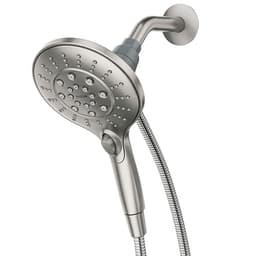
1. The handheld case
Moen Engage Magnetix Handheld Shower, 5.5″ head
Moen · 26112 · best for doing more than standing still
A 5.5-inch handheld that docks magnetically on the existing arm: shower under it, then take it down for everything else.
The argument for a handheld is not that it is a better shower. Docked in its cradle it is roughly as good as a decent fixed head — Moen publishes six spray functions at a 2.5 GPM maximum on a 5.5-inch face, which is normal-showerhead size.
The argument is that it is a better thing to own. Take it out of the cradle and it rinses a dog, washes a child’s hair without a fight, cleans the glass and tile in a quarter of the time, and works for anyone who showers sitting down. A rain head does none of that, ever.
Renter-Safe Install Rating
- Drilling
- None
- Tools
- One wrench
- Time to fit
- Not published
- Power
- None
- Reversible on move-out
- Fully
Why: The docking cradle screws onto the shower arm in place of the old head, so the magnet does the holding and the wall is never touched.
Read from published documentation, not from fitting one. Moen, Engage Six-Function 5 1/2″ Diameter Spray Head Handheld Shower (26112). How the verdict is derived: renter-safe ratings explained.
What’s wrong with it
There is a hose in your shower, and hoses collect scale and look less tidy than a clean wall-mounted head.
What we can’t tell you
Moen does not publish a hose length for this model, so we cannot tell you whether it reaches the floor of a large walk-in.
Published specifications
| Flow rate | “2.5 Gpm (9.5 L/Min) Max.” |
|---|---|
| Spray functions | Six — “Wide Coverage; Intensify; Downpour; Relaxing Massage; Massage; Rinse” |
| Head diameter | “5.5″ Diameter Spray Head” |
| Hose | Includes “a kink-free metal hose” (length not published) |
| Connection | “1/2″”, “Ips” type |
| Magnetix docking | “easily detach and reattach your handheld showerhead” and it “always docks facing forward to avoid exterior splashing” |
| Warranty | “Backed by Moen’s Limited Lifetime Warranty” |
Source: Moen, Engage Six-Function 5 1/2″ Diameter Spray Head Handheld Shower (26112)
#ad Price $70.00 as of October 18, 2026. Prices change; Amazon’s listing is the one that counts. How we’re funded.
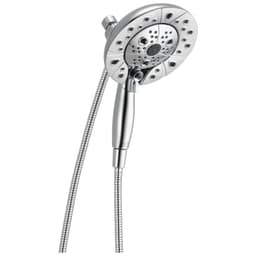
2. The both-at-once case
Delta In2ition Two-in-One Shower, 1.75 GPM
Delta · 58480-BL-PK · best for refusing to choose
A fixed head with a handheld docked inside it, at 1.75 GPM — the two-in-one that makes this comparison unnecessary.
This is the genuinely correct answer for most people, and it is slightly annoying that it is a product rather than an argument. The In2ition is a fixed head you can shower under with a handheld living inside it, and Delta publishes that you can run them simultaneously.
It fits like an ordinary head — one threaded joint on the existing arm — at “1.75 gpm @ 80 psi” with a WaterSense label and a 60-inch hose. You get the fixed-head experience for daily showering and the handheld for everything else, without a second fitting or a plumber.
Renter-Safe Install Rating
- Drilling
- None
- Tools
- One wrench
- Time to fit
- Not published
- Power
- None
- Reversible on move-out
- Fully
Why: The whole assembly hangs off the existing shower arm on one threaded joint. Delta publishes no bracket that needs fixing to tile.
Read from published documentation, not from fitting one. Delta, H2Okinetic In2ition 5-Setting Two-in-One Shower 58480-BL-PK. How the verdict is derived: renter-safe ratings explained.
What it costs to run — Water
- Flow rate
- 1.75 GPM at 80 psi (Delta's published figure)
- Shower length
- 8 minutes
- Showers
- 365 a year
1.75 GPM x 8 min x 365 = 5,110 gallons a year, against 7,300 for a 2.5 GPM head
About 2,190 gallons a year less than a full-flow head
Arithmetic on published specifications, not a measurement. Rate source: Delta, In2ition 58480-BL-PK specifications (1.75 gpm @ 80 psi).
What’s wrong with it
It is chunky. Two heads in one housing hangs lower and further out than either alone, which is a real problem in a small enclosure with a low arm.
What we can’t tell you
Delta does not publish a combined flow figure for running the fixed head and handheld together, which is the mode most likely to overwhelm weak pressure.
Published specifications
| Flow rate | “1.75 gpm @ 80 psi, 6.6 L/min @ 552 kPa” |
|---|---|
| Spray settings | Five: “H2OKinetic spray, Full Body spray, Full Spray with Massage, Massaging spray” plus pause |
| Hose | “Includes 60 in. hose” |
| Overall height | “11-4/7″” |
| Technologies | H2Okinetic (“creates wave pattern for enhanced coverage”), In2ition two-in-one, MagnaTite docking |
| Certification | “WaterSense Labeled (uses 20% less water than industry standard)” |
Source: Delta, H2Okinetic In2ition 5-Setting Two-in-One Shower 58480-BL-PK
#ad Price $157.99 as of October 18, 2026. Prices change; Amazon’s listing is the one that counts. How we’re funded.
3. The simple case
High Sierra Classic Fixed Showerhead (FCS-100)
High Sierra Showerheads · FCS-100-CH · best for wanting one excellent thing rather than two adequate ones
If you truly only ever stand under the water, a single-nozzle fixed head does that one job better than either compromise.
There is an honest third answer that neither side of this comparison likes: buy a plain fixed head, spend the money on quality rather than features, and keep the shower simple.
High Sierra’s Classic has no hose, no settings and no moving parts. It is solid metal, published from 1.25 to 2.5 GPM, and it delivers what the company describes as “large, heavy, high-energy droplets”. If nobody in your house has a dog, a toddler or a mobility need, this is the least complicated good shower you can buy.
Renter-Safe Install Rating
- Drilling
- None
- Tools
- One wrench
- Time to fit
- Not published
- Power
- None
- Reversible on move-out
- Fully
Why: It threads onto the existing 1/2″ shower arm and nothing else is touched. Keep the old head in a drawer, screw it back on the day you move, and the bathroom is exactly as you found it.
Read from published documentation, not from fitting one. High Sierra Showerheads, Classic Fixed Showerhead FCS-100-CH. How the verdict is derived: renter-safe ratings explained.
What it costs to run — Water
- Flow rate
- 1.25 GPM (the lowest published option)
- Shower length
- 8 minutes
- Showers
- 365 a year
1.25 GPM x 8 min x 365 = 3,650 gallons a year, against 7,300 for a 2.5 GPM head
About 3,650 gallons a year saved against a full-flow head
Arithmetic on published specifications, not a measurement. Rate source: High Sierra Showerheads, Classic Fixed Showerhead product page (published flow-rate options).
What’s wrong with it
It does exactly one thing. If your circumstances change — a puppy, a baby, an injury — you will be buying again.
What we can’t tell you
High Sierra publishes no spray-force comparison against a rain-style head, so we cannot quantify the difference in feel.
Published specifications
| Flow rate options | 1.25 GPM (“Saves up to 50% water and the energy to heat it”) through 2.5 GPM (“Maximum flow rate per shower head allowed nationally by the Federal Government”) |
|---|---|
| Nozzle design | A single nozzle that works “just like nature does, by colliding water to create a rain-like cascade of large, heavy, high-energy droplets” |
| Material | “Solid lead-free and corrosion resistant metal construction” |
| Thread | “Connects to shower arms, extensions, filters, etc with universal 1/2″ - 14 NPS or NPT male threads size” |
| Certification | “Independently tested and certified to WaterSense and WaterMark” |
| Guarantee | “The NEVER-CLOG GUARANTEE is void if the mesh screen is removed” |
| Made in | “Engineered and built in the USA” |
| Tools supplied | A wrench is supplied with the showerhead |
Source: High Sierra Showerheads, Classic Fixed Showerhead FCS-100-CH
#ad We have no verified live price for this one right now, so we are not showing a number. How we’re funded.
Where to buy
Everything recommended on this page, in one place. Each link is an Amazon Associates link — we earn a commission at no extra cost to you, and it never decides a pick.
- $70.00View on Amazon
Moen Engage Magnetix Handheld Shower, 5.5″ head
Moen · 26112 · Renter verdict: Safe
- $157.99View on Amazon
Delta In2ition Two-in-One Shower, 1.75 GPM
Delta · 58480-BL-PK · Renter verdict: Safe
- Check price on Amazon
High Sierra Classic Fixed Showerhead (FCS-100)
High Sierra Showerheads · FCS-100-CH · Renter verdict: Safe
#ad Prices are not shown because we only publish figures we have verified on the day. How we’re funded.
Questions people actually ask
is rain shower head worth it
A ceiling-mounted one is genuinely lovely and requires opening a ceiling, so it belongs to a renovation rather than a Saturday. A rain-style head on a standard wall arm is a fifteen-minute swap but sprays at an angle rather than from above, and its wide low-velocity face feels weak if your pressure is modest.
rain shower head vs regular
A rain-style head has a larger face and lower-velocity nozzles, so it covers more of you but lands more gently. A regular head concentrates the same flow through fewer openings, which feels stronger. Neither changes your water pressure — they just spend it differently.
handheld shower head vs fixed
Docked in its cradle a good handheld is about as pleasant as a fixed head. Out of the cradle it does four things a fixed head cannot: rinse an animal, wash a small child, clean the shower, and work for someone showering seated.
are rain shower heads worth it
For coverage and looks, yes. For pressure, no — spreading a limited flow across a wide face is the wrong move when flow is what you are short of. Check your pressure situation before you buy anything wide.
Sources
Read next
Back to Showers & Showerheads.