Do shower filters actually work?
For the one thing they are certified to do, yes, and it is independently tested. For most of what they are marketed to do, nobody has shown it.
By Sawyer V. · · How we research

The short answer
We earn a commission if you buy through the links on this page, at no extra cost to you. It does not change which products we pick or what we say about them — here is exactly how that works.
Quick picks
Tap any row for the full write-up. Prices are checked against Amazon rather than remembered — where we have no verified figure the button says so.
| # | Product | Best for | Renter | Price |
|---|---|---|---|---|
| 1 |  Aquasana Shower Filter with Chrome Handheld Wand Over 90% chlorine reduction for 10,000 gallons, independently tested to NSF/ANSI 177 — the strongest evidence available in this category. | A claim somebody checked | Safe | |
| 2 | No photo yet Culligan Wall-Mount Filtered Shower Head NSF 177 certified with the same 10,000-gallon interval, in a filtered showerhead rather than an inline cartridge. | Certification in an all-in-one head | Safe | |
| 3 | No photo yet High Sierra Classic Fixed Showerhead (FCS-100) If a filter would not help your actual complaint, a good metal head with a never-clog guarantee and no consumables is the better spend. | When your problem was never chlorine | Safe |
What is actually proven
Chlorine reduction is proven, for certified products, to a real standard.
NSF/ANSI Standard 177 is an American National Standard written specifically for shower filtration. Certification requires an accredited laboratory to test the product at a stated flow rate, measure free available chlorine before and after, and demonstrate that reduction is sustained across the cartridge’s full claimed capacity — not just on the first gallon.
Both Aquasana and Culligan publish certification to it, with the same 10,000-gallon or six-month interval. That is about as strong an evidence base as anything in a domestic bathroom gets.
What is claimed but not certified
Everything else in the marketing for this category. Softer skin. Shinier hair. Less irritation. Reduction of a long list of contaminants at impressive percentages.
Some of it may be true. Chlorine is a reactive oxidizer and reducing exposure is not implausible as a comfort matter. But plausible and demonstrated are different words, and the difference is exactly what a certification exists to mark.
Our rule, set out in how we research: we do not assert a health or cosmetic benefit in our own voice. We tell you what the certification measures — chlorine, in gallons, to a stated percentage — and let you decide what that is worth to you.
Where filters straightforwardly do not work
Hardness. Requires ion exchange. A cartridge on a shower arm does not do it, and NSF 177 does not cover it. Culligan’s careful phrasing — “reduces chlorine & scale” rather than “softens” — is a manufacturer being precise where its marketing department could have been vague.
Chloramine. Some utilities use chloramine instead of free chlorine. It is chemically more stable and harder to remove, and NSF 177 tests free chlorine. If your utility uses chloramine — their annual water report will say — a standard shower filter is a weaker proposition and no certification covers the case.
Anything, once the cartridge is spent. Both products publish 10,000 gallons. Past that you have a flow restriction that reduces nothing. A filter you stop maintaining is worse than no filter, and this is the most common way people end up with a product that genuinely does not work.
Temperature: the caveat worth knowing
Aquasana publishes a maximum temperature of “115°F” and an operating pressure range of “30-80 psi”.
115°F is above a comfortable shower but not by a wide margin, and it is a real specification rather than a formality: carbon adsorption is temperature-dependent, and hot water can release previously captured compounds. A very hot shower is outside the conditions the certification was tested under.
This is another quiet mark in Aquasana’s favor, incidentally. Publishing an operating limit is a manufacturer telling you where its product stops working, which is not something marketing departments enjoy.
Is it worth it?
Buy one if your water genuinely smells of chlorine. The reduction is real, certified and measurable, the units are inexpensive, and it is a five-minute fitting.
Do not buy one if your problem is white crust and poor lather. That is hardness, and a filter will not touch it. Buy a head that copes instead.
Think carefully if you are buying it for skin or hair. Those claims are the ones running furthest ahead of the evidence, and we are not going to repeat them.
And whatever you decide, cost it as a subscription. Two cartridges a year, forever, is the real purchase — and a filter that is not maintained is a filter that genuinely does not work.
Every pick in full
3 we would buy. Each carries its Renter-Safe Install Rating, the published specs behind it, and the honest gap in what we know.
1. The certified case
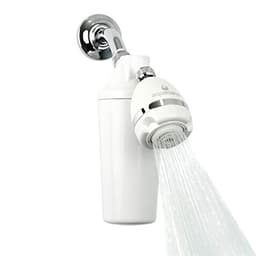
Aquasana Shower Filter with Chrome Handheld Wand
Aquasana · AQ-4100 (handheld wand configuration) · best for a claim somebody checked
Over 90% chlorine reduction for 10,000 gallons, independently tested to NSF/ANSI 177 — the strongest evidence available in this category.
The reason we can answer “yes” to the chlorine question at all is that this certification exists. Aquasana publishes “independently tested to NSF/ANSI Standard 177 to reduce over 90% of chlorine for 10,000 gallons or up to 6 months”.
Note what is doing the work in that sentence: independently tested, a named standard, a percentage, and a volume. Take any of those away and it becomes a marketing claim.
Renter-Safe Install Rating
- Drilling
- None
- Tools
- Hands only
- Time to fit
- Not published
- Power
- None
- Reversible on move-out
- Fully
Why: The filter body screws onto the existing shower arm between the arm and the head. Unscrew it on move-out day and the original head goes straight back.
Read from published documentation, not from fitting one. Aquasana, Shower Filter with Chrome Handheld Wand (AQ-4100). How the verdict is derived: renter-safe ratings explained.
What’s wrong with it
Certified for chlorine only. Everything else in the marketing is uncertified.
What we can’t tell you
No published cartridge price, so the ongoing cost is yours to establish.
Published specifications
| Certified reduction | “Independently tested to NSF/ANSI Standard 177 to reduce over 90% of chlorine for 10,000 gallons or up to 6 months” |
|---|---|
| Filter media | “Patented Copper-Zinc (KDF) media and coconut shell carbon” |
| Operating pressure | “30-80 psi” |
| Maximum temperature | “115°F” |
| Optimum flow rate | “2.5 gallons per minute” |
| Included | Chrome handheld wand with three settings — Tropical Rain, Massage, Combination |
| Fitting | “All shower filter options quickly attach to your existing shower pipe”; compatible with heads “up to 4.5″ in diameter” on standard 1/2-inch connections |
| Cartridge interval | “The filter should be changed every 10,000 gallons” |
| Warranty | “1-Year Limited Warranty and a 90-Day Satisfaction Guarantee” |
Source: Aquasana, Shower Filter with Chrome Handheld Wand (AQ-4100)
#ad Price $79.99 as of October 19, 2026. Prices change; Amazon’s listing is the one that counts. How we’re funded.
2. The other certified option
Culligan Wall-Mount Filtered Shower Head
Culligan · WSH-C125 · best for certification in an all-in-one head
NSF 177 certified with the same 10,000-gallon interval, in a filtered showerhead rather than an inline cartridge.
Culligan publishes “certified to meet NSF standard 177 for filtered showerhead systems” with a “KDF Filter Capacity of 6 months or 10,000 gallons” and a five-year limited warranty on the unit.
Two independent products converging on the same certified interval is a useful signal about what this technology can actually sustain.
Renter-Safe Install Rating
- Drilling
- None
- Tools
- Hands only
- Time to fit
- Not published
- Power
- None
- Reversible on move-out
- Fully
Why: Culligan publishes “no tools required” for fitting it to a standard 1/2″ shower arm. One threaded joint, nothing in a wall.
Read from published documentation, not from fitting one. Culligan WSH-C125 wall-mount filtered shower head, published product data (Fresh Water Systems listing). How the verdict is derived: renter-safe ratings explained.
What’s wrong with it
You are buying Culligan's showerhead as well as its filter.
What we can’t tell you
No published operating pressure or temperature range in the data we could reach.
Published specifications
| Flow rate | “maximum flow rate of 2.5 gpm as required by ASME standards” |
|---|---|
| Filter capacity | “KDF Filter Capacity of 6 months or 10,000 gallons” |
| Certification | “Certified to meet NSF standard 177 for filtered showerhead systems” |
| Spray settings | Five — full body, soft rain spray, invigorating pulse, full body spray/rain combo, full body spray/pulse combo |
| Connection | “installs onto standard 1/2″ IPS shower arm” |
| Installation | “Easy to install - no tools required” |
| Cartridge included | “One Culligan WHR-140 filter included” |
| Warranty | “5-year limited warranty” |
#ad We have no verified live price for this one right now, so we are not showing a number. How we’re funded.
3. The no-filter alternative
High Sierra Classic Fixed Showerhead (FCS-100)
High Sierra Showerheads · FCS-100-CH · best for when your problem was never chlorine
If a filter would not help your actual complaint, a good metal head with a never-clog guarantee and no consumables is the better spend.
A meaningful share of people buying shower filters are trying to solve hardness, and a filter will not do it. If your symptoms are white crust and poor lather rather than a chlorine smell, this is the more useful purchase.
High Sierra publishes solid metal construction, a single-nozzle design and a never-clog guarantee — with the honest caveat that it is “void if the mesh screen is removed”. No cartridges, ever.
Renter-Safe Install Rating
- Drilling
- None
- Tools
- One wrench
- Time to fit
- Not published
- Power
- None
- Reversible on move-out
- Fully
Why: It threads onto the existing 1/2″ shower arm and nothing else is touched. Keep the old head in a drawer, screw it back on the day you move, and the bathroom is exactly as you found it.
Read from published documentation, not from fitting one. High Sierra Showerheads, Classic Fixed Showerhead FCS-100-CH. How the verdict is derived: renter-safe ratings explained.
What it costs to run — Water
- Flow rate
- 1.25 GPM (the lowest published option)
- Shower length
- 8 minutes
- Showers
- 365 a year
1.25 GPM x 8 min x 365 = 3,650 gallons a year, against 7,300 for a 2.5 GPM head
About 3,650 gallons a year saved against a full-flow head
Arithmetic on published specifications, not a measurement. Rate source: High Sierra Showerheads, Classic Fixed Showerhead product page (published flow-rate options).
What’s wrong with it
It filters nothing. It is hardware that copes, not water treatment.
What we can’t tell you
No published particle rating for the mesh screen.
Published specifications
| Flow rate options | 1.25 GPM (“Saves up to 50% water and the energy to heat it”) through 2.5 GPM (“Maximum flow rate per shower head allowed nationally by the Federal Government”) |
|---|---|
| Nozzle design | A single nozzle that works “just like nature does, by colliding water to create a rain-like cascade of large, heavy, high-energy droplets” |
| Material | “Solid lead-free and corrosion resistant metal construction” |
| Thread | “Connects to shower arms, extensions, filters, etc with universal 1/2″ - 14 NPS or NPT male threads size” |
| Certification | “Independently tested and certified to WaterSense and WaterMark” |
| Guarantee | “The NEVER-CLOG GUARANTEE is void if the mesh screen is removed” |
| Made in | “Engineered and built in the USA” |
| Tools supplied | A wrench is supplied with the showerhead |
Source: High Sierra Showerheads, Classic Fixed Showerhead FCS-100-CH
#ad We have no verified live price for this one right now, so we are not showing a number. How we’re funded.
Where to buy
Everything recommended on this page, in one place. Each link is an Amazon Associates link — we earn a commission at no extra cost to you, and it never decides a pick.
- $79.99View on Amazon
Aquasana Shower Filter with Chrome Handheld Wand
Aquasana · AQ-4100 (handheld wand configuration) · Renter verdict: Safe
- Check price on Amazon
Culligan Wall-Mount Filtered Shower Head
Culligan · WSH-C125 · Renter verdict: Safe
- Check price on Amazon
High Sierra Classic Fixed Showerhead (FCS-100)
High Sierra Showerheads · FCS-100-CH · Renter verdict: Safe
#ad Prices are not shown because we only publish figures we have verified on the day. How we’re funded.
Questions people actually ask
filtered shower head is it worth it
If your water smells of chlorine, yes — certified filters demonstrably reduce it and the units are cheap. If your problem is hardness, no: NSF/ANSI 177 is a chlorine standard and no shower filter removes dissolved calcium and magnesium.
shower head filter reviews
Be careful what you are reading. Most of this category makes uncertified percentage claims. The useful signal is NSF/ANSI 177 certification, which means an accredited laboratory tested chlorine reduction across the cartridge's full claimed life.
filtered shower head vs regular
A filtered head adds a cartridge that reduces chlorine and a cartridge cost roughly every six months. A regular head does not treat the water at all. If chlorine is not your complaint, the regular head is the better purchase.
Sources
Read next
Back to Shower Water Filtration.