Do shower filters help hair and skin?
This is a medical-adjacent question with an enormous amount of confident marketing attached to it. Here is what is certified and what is not.
By Sawyer V. · · How we research

The short answer
We earn a commission if you buy through the links on this page, at no extra cost to you. It does not change which products we pick or what we say about them — here is exactly how that works.
Quick picks
Tap any row for the full write-up. Prices are checked against Amazon rather than remembered — where we have no verified figure the button says so.
| # | Product | Best for | Renter | Price |
|---|---|---|---|---|
| 1 |  Aquasana Shower Filter with Chrome Handheld Wand NSF/ANSI 177 certified for over 90% chlorine reduction “for 10,000 gallons or up to 6 months” — a certified duration, not a moment. | The claim that is actually verified | Safe | |
| 2 | No photo yet Culligan Wall-Mount Filtered Shower Head NSF 177 certified with a published “KDF Filter Capacity of 6 months or 10,000 gallons”, installed with no tools. | One object instead of two | Safe |
What is actually certified
There is one independent standard in this category and it is worth knowing precisely what it covers.
NSF/ANSI Standard 177 is written specifically for shower filtration, and it tests a single thing: free available chlorine reduction. Aquasana publishes certification “to reduce over 90% of chlorine for 10,000 gallons or up to 6 months”; Culligan publishes NSF 177 certification with the same interval.
That is the whole of the verified claim. Not hardness, not heavy metals, not fluoride, not bacteria, and certainly not any outcome for your body. A certified filter removes most of the chlorine and has been independently tested to keep doing so across the cartridge’s life.
Everything beyond that sentence is inference, and most marketing in this category is built on the inference rather than the sentence. The standard is worth understanding in full.
Why we will not tell you it fixes dry skin
This site has a rule: we do not assert health claims in our own voice. It applies here more than anywhere.
The mechanism people describe is plausible on its face. Chlorine is an oxidizing agent, and oxidizing agents can affect the lipids that make up the skin barrier and the proteins in hair. That is chemistry, and it is real.
What does not follow automatically is that domestic tap water concentrations, for the minutes a day you are in a shower, produce a clinically meaningful effect — or that removing 90% of it produces a noticeable improvement in any particular person.
We have no certified evidence for that step, and neither manufacturer claims it in the certification. Aquasana and Culligan both certify chlorine reduction. Neither certifies an outcome for hair or skin, because that is not what NSF 177 measures.
If you have a persistent skin condition, a dermatologist is the right person to ask. That is not a dodge; it is the difference between a filter that might help and a diagnosis that will.
The most common confusion: chlorine is not hardness
A great many people buy a shower filter for a problem it cannot address, and the two words get used interchangeably in a way that costs money.
Chlorine is a disinfectant added at the treatment works. It is what a shower filter removes, and it is what gives water a swimming-pool smell.
Hardness is dissolved calcium and magnesium picked up from the ground. It is what leaves white deposits on glass, blocks showerhead nozzles and makes shampoo hard to lather.
No shower filter removes hardness. Removing it requires ion exchange in a whole-house softener, which is a plumbing installation and not a rental proposition. The full distinction is here.
If your complaint is that shampoo will not lather, or that everything in the bathroom develops a white film, that is hardness and a filter will disappoint you.
What a filter definitely does
Three things we are comfortable stating plainly.
It removes the smell. Chlorine is detectable by nose at low concentrations, and over 90% less of it is a noticeable difference. This one you will observe on day one.
It is certified, which is rare here. Most bathroom products have no independent standard at all. NSF 177 is a genuine third-party test with a published scope, and both filters we cover hold it.
It is completely reversible. Both rate Safe on our install rating. It threads onto the existing shower arm and comes off the same way.
What we cannot tell you
Whether it will help your hair. No certified evidence, no manufacturer claim under the standard, no measurement we can point to.
Whether it will help your skin. Same.
Whether it affects color-treated hair. Frequently claimed, and not covered by NSF 177 or by any published test we could find.
How much chlorine is in your water. This varies by utility and by season. Your water supplier publishes an annual quality report, and that is the only source for your actual figure.
How to decide sensibly
Can you smell chlorine in your shower? If yes, a certified filter removes most of it and you will notice. That alone may be worth it.
Is the real problem white deposits and poor lather? That is hardness, and a filter is the wrong product.
Do you have a diagnosed skin condition? Ask a clinician first. A filter is cheap enough to try afterwards and it should not be the first thing you try.
Will you change the cartridge? This decides everything. Both makers publish 10,000 gallons or six months, and a spent cartridge is a flow restriction that removes nothing — strictly worse than no filter. The changing guide is here.
Every pick in full
2 we would buy. Each carries its Renter-Safe Install Rating, the published specs behind it, and the honest gap in what we know.
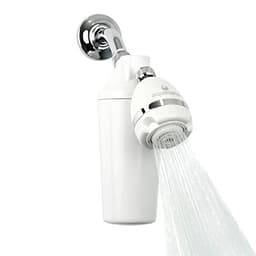
1. Best certified reduction
Aquasana Shower Filter with Chrome Handheld Wand
Aquasana · AQ-4100 (handheld wand configuration) · best for the claim that is actually verified
NSF/ANSI 177 certified for over 90% chlorine reduction “for 10,000 gallons or up to 6 months” — a certified duration, not a moment.
The Aquasana filter publishes the strongest form of the only claim that is actually verified in this category: “independently tested to NSF/ANSI Standard 177 to reduce over 90% of chlorine for 10,000 gallons or up to 6 months”.
Read what that sentence contains and what it does not. It names the standard, quantifies the reduction, and states the duration over which the reduction holds. It says nothing about hair, skin, or any outcome for a person, because NSF 177 does not measure those things.
The media is published as “patented Copper-Zinc (KDF) media and coconut shell carbon” — KDF handles chlorine at shower temperatures where carbon alone falls off, and the carbon handles odor and organic compounds.
It threads onto the existing shower arm ahead of whatever head you already have, so it rates Safe and comes off in a minute.
Renter-Safe Install Rating
- Drilling
- None
- Tools
- Hands only
- Time to fit
- Not published
- Power
- None
- Reversible on move-out
- Fully
Why: The filter body screws onto the existing shower arm between the arm and the head. Unscrew it on move-out day and the original head goes straight back.
Read from published documentation, not from fitting one. Aquasana, Shower Filter with Chrome Handheld Wand (AQ-4100). How the verdict is derived: renter-safe ratings explained.
What’s wrong with it
It reduces chlorine and does nothing about hardness. If your complaint is limescale on the glass, this is not the product.
What we can’t tell you
Aquasana publishes no cartridge price, so there is no cost per month we can verify.
Published specifications
| Certified reduction | “Independently tested to NSF/ANSI Standard 177 to reduce over 90% of chlorine for 10,000 gallons or up to 6 months” |
|---|---|
| Filter media | “Patented Copper-Zinc (KDF) media and coconut shell carbon” |
| Operating pressure | “30-80 psi” |
| Maximum temperature | “115°F” |
| Optimum flow rate | “2.5 gallons per minute” |
| Included | Chrome handheld wand with three settings — Tropical Rain, Massage, Combination |
| Fitting | “All shower filter options quickly attach to your existing shower pipe”; compatible with heads “up to 4.5″ in diameter” on standard 1/2-inch connections |
| Cartridge interval | “The filter should be changed every 10,000 gallons” |
| Warranty | “1-Year Limited Warranty and a 90-Day Satisfaction Guarantee” |
Source: Aquasana, Shower Filter with Chrome Handheld Wand (AQ-4100)
#ad Price $79.99 as of October 18, 2026. Prices change; Amazon’s listing is the one that counts. How we’re funded.
2. Same certification, simpler fitting
Culligan Wall-Mount Filtered Shower Head
Culligan · WSH-C125 · best for one object instead of two
NSF 177 certified with a published “KDF Filter Capacity of 6 months or 10,000 gallons”, installed with no tools.
The Culligan WSH-C125 holds the same certification in a different format: the cartridge lives inside the showerhead rather than in a separate body upstream of it.
Culligan publishes a “KDF Filter Capacity of 6 months or 10,000 gallons”, certified to NSF standard 177, a named replacement cartridge (“One Culligan WHR-140 filter included”) and installation that is “easy to install - no tools required”.
The identical 10,000-gallon interval across two unrelated makers is not a coincidence. It is roughly what a KDF-and-carbon cartridge sustains while still meeting the standard.
Same limitation, stated the same way: chlorine reduction is what is certified. Nothing here addresses hardness.
Renter-Safe Install Rating
- Drilling
- None
- Tools
- Hands only
- Time to fit
- Not published
- Power
- None
- Reversible on move-out
- Fully
Why: Culligan publishes “no tools required” for fitting it to a standard 1/2″ shower arm. One threaded joint, nothing in a wall.
Read from published documentation, not from fitting one. Culligan WSH-C125 wall-mount filtered shower head, published product data (Fresh Water Systems listing). How the verdict is derived: renter-safe ratings explained.
What’s wrong with it
The cartridge is inside Culligan's own head, so you are committed to their showerhead as well as their filter.
What we can’t tell you
Culligan publishes no operating pressure or temperature range on the pages we could reach.
Published specifications
| Flow rate | “maximum flow rate of 2.5 gpm as required by ASME standards” |
|---|---|
| Filter capacity | “KDF Filter Capacity of 6 months or 10,000 gallons” |
| Certification | “Certified to meet NSF standard 177 for filtered showerhead systems” |
| Spray settings | Five — full body, soft rain spray, invigorating pulse, full body spray/rain combo, full body spray/pulse combo |
| Connection | “installs onto standard 1/2″ IPS shower arm” |
| Installation | “Easy to install - no tools required” |
| Cartridge included | “One Culligan WHR-140 filter included” |
| Warranty | “5-year limited warranty” |
#ad We have no verified live price for this one right now, so we are not showing a number. How we’re funded.
Where to buy
Everything recommended on this page, in one place. Each link is an Amazon Associates link — we earn a commission at no extra cost to you, and it never decides a pick.
- $79.99View on Amazon
Aquasana Shower Filter with Chrome Handheld Wand
Aquasana · AQ-4100 (handheld wand configuration) · Renter verdict: Safe
- Check price on Amazon
Culligan Wall-Mount Filtered Shower Head
Culligan · WSH-C125 · Renter verdict: Safe
#ad Prices are not shown because we only publish figures we have verified on the day. How we’re funded.
Questions people actually ask
do shower filters help with dry skin
We will not claim that in our own voice. What is certified is chlorine reduction, tested to NSF/ANSI 177, and neither maker certifies an outcome for skin. The mechanism is plausible; the evidence that it produces a noticeable improvement is not something we can point you to.
do shower filters help hair loss
There is no certified evidence for it and no manufacturer claim under NSF 177, which tests chlorine reduction and nothing else. Hair loss has many causes and a clinician is the right person to ask.
do shower filters remove hard water
No. Chlorine and hardness are different things: chlorine is a disinfectant a filter removes, hardness is dissolved calcium and magnesium that needs ion exchange in a whole-house softener. If your problem is white deposits and poor lather, a filter will disappoint you.
what does a shower filter actually do
It reduces free chlorine, certified to NSF/ANSI 177 at over 90% for 10,000 gallons or six months. The most immediately noticeable effect is that the chlorine smell goes, which you will observe on the first day.
Sources
Read next
Back to Shower Water Filtration.