What does a bidet do?
A short, plain explanation of what the thing actually does — including the parts of the pitch we are not going to repeat.
By Sawyer V. · · How we research
The short answer
We earn a commission if you buy through the links on this page, at no extra cost to you. It does not change which products we pick or what we say about them — here is exactly how that works.
Quick picks
Tap any row for the full write-up. Prices are checked against Amazon rather than remembered — where we have no verified figure the button says so.
| # | Product | Best for | Renter | Price |
|---|---|---|---|---|
| 1 |  TUSHY Classic 3.0 Bidet Attachment A plate under your existing seat, a nozzle that extends and retracts, and a knob to control the pressure. That is the whole product. | Seeing what one actually is | Safe | |
| 2 |  Brondell Swash Thinline T22 Bidet Toilet Seat The same wash, plus warm water, a heated seat and a warm-air dryer — what the category becomes when you add a plug. | Seeing what the ceiling looks like | Ask first |
The mechanism, in one paragraph
A bidet has a nozzle that sits out of the way until you use it. When you turn the control, a valve opens and household water pressure pushes the nozzle out and sprays upward. You control the pressure with a knob or lever, and on some models the angle too. When you turn it off, the nozzle retracts behind a guard, and most models run a rinse over the nozzle itself before and after use — Brondell publishes a self-cleaning cycle that “runs before and after your wash”.
Where the water comes from
This is the question people ask nervously and the answer is reassuring: the same clean, potable water that feeds your sink.
A T-valve is fitted at the toilet’s fill inlet, splitting the supply. One branch continues filling the tank as before; the other feeds the bidet. The water goes straight from the supply pipe to the nozzle and has no contact with the bowl, the tank contents, or anything else on the way.
Warm-water models add a second line to the hot supply under your basin, or heat the water on board if they are electric. The two approaches are compared here.
The four things sold under this name
A bidet attachment. A thin plate that goes between the bowl and your existing seat. Cheapest, simplest, and the mainstream of the American market.
A bidet seat. Replaces the seat entirely, which makes room for electronics: heated seat, dryer, on-board water heating.
A handheld sprayer. A hose and trigger mounted beside the toilet, aimed by hand. Common outside the US, and it needs somewhere to hang — which usually means a bracket, which usually means a hole.
A standalone bidet. The traditional separate porcelain fixture next to the toilet. It needs its own plumbing and its own floor space, which makes it a renovation rather than a purchase.
This site covers the first two, because they are the ones a person can fit on a Saturday and remove when they move.
What using one is actually like
The first time is a surprise, and everybody says so. Cold water is the part people notice most, and the usual advice — start on the lowest pressure setting — is sound.
The nozzle angle is the thing that decides whether you like it. Fixed-angle models either suit you or they do not, and you cannot know until it is fitted. This is exactly why we rate adjustability highly: TUSHY publishes a “precision nozzle adjuster”, and Brondell publishes a five-position nozzle on the Thinline T22.
Then you dry. Without a warm-air dryer, that means a little paper or a dedicated towel — which is why a bidet reduces paper rather than replacing it for most households.
What we will not tell you
This category makes a lot of health claims. Some of them may be true. The published, independent evidence behind them is considerably thinner than the confidence with which they get repeated, and a large amount of what circulates online traces back to vendor marketing rather than to research.
Our standing rule, set out in how we research, is that we do not assert a health benefit in our own voice. If a bidet is being considered for a medical reason — haemorrhoids, recovery from surgery, a urinary condition — the right person to ask is a clinician, not a site that earns a commission when you buy one.
What we will say without hesitation: it is more comfortable than paper, it is genuinely useful when reaching or wiping is difficult, and it puts less paper into old plumbing. Those are the reasons people keep them.
Every pick in full
2 we would buy. Each carries its Renter-Safe Install Rating, the published specs behind it, and the honest gap in what we know.
1. The simplest version
TUSHY Classic 3.0 Bidet Attachment
TUSHY · Classic 3.0 · best for seeing what one actually is
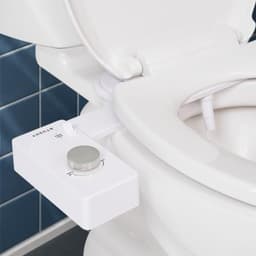
A plate under your existing seat, a nozzle that extends and retracts, and a knob to control the pressure. That is the whole product.
If you want to understand the category, look at the cheapest version of it. TUSHY publishes a “Patented Self Cleaning SmartSpray™ nozzle” that “cleans after every spray and tucks away when not in use”, a knob to choose “from a light to strong stream of clean water”, and “No outlet needed”.
Nozzle, water, control. Everything more expensive adds temperature to those three things rather than changing them.
Renter-Safe Install Rating
- Drilling
- None
- Tools
- Hands only
- Time to fit
- About 9 minutes (TUSHY publishes “8 ½ minutes or less”)
- Power
- None
- Reversible on move-out
- Fully
Why: It sits between the toilet bowl and the existing seat and tees off the tank fill line. Nothing is drilled, nothing is cut, and the original seat goes back on in the same nine minutes it took to fit.
Read from published documentation, not from fitting one. TUSHY, Classic 3.0 bidet attachment product page and FAQ. How the verdict is derived: renter-safe ratings explained.
What’s wrong with it
Cold water — the single biggest difference between this and a premium seat.
What we can’t tell you
No published materials.
Published specifications
| Water | Fresh cold water only — “cleans your butthole with fresh water, the same as your sink or shower” |
|---|---|
| Nozzle | “Patented Self Cleaning SmartSpray™ nozzle” that “cleans after every spray and tucks away when not in use”, with a “precision nozzle adjuster” |
| Control knob | “antimicrobial bamboo or brass knob” |
| Dimensions | “16″L x 9″W x 3.5″H”, “2 lbs” |
| In the box | “TUSHY Classic 3.0 Bidet Attachment. Tank Adapter and Flexible TUSHY hose for an easy install on almost any toilet. TUSHY Classic 3.0 Owner’s Manual. 1-year Limited Warranty.” |
| Install time | “Easy install in 8 ½ minutes or less on most standard toilets” |
| Tools | “you don’t need any plumbing expertise…using a basic screwdriver and the connections included” |
| Power | “No outlet needed” |
| Fit | Fits “95% of toilets, round or elongated”; does not fit French Curve toilets |
| Warranty | “1-year Limited Warranty” |
Source: TUSHY, Classic 3.0 bidet attachment product page and FAQ
#ad Price $129.00 as of October 19, 2026. Prices change; Amazon’s listing is the one that counts. How we’re funded.
2. The full version
Brondell Swash Thinline T22 Bidet Toilet Seat
Brondell · Swash Thinline T22 · best for seeing what the ceiling looks like
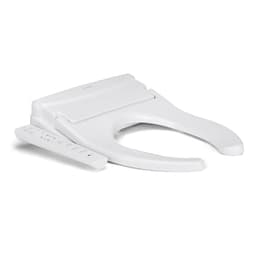
The same wash, plus warm water, a heated seat and a warm-air dryer — what the category becomes when you add a plug.
At the other end, Brondell publishes an “instant ceramic water heater”, a “three-level heated seat”, a “5-level warm air dryer with temperature control” and an “adjustable, 5-position stainless steel nozzle”.
Compare the two lists and the pattern is clear: the extra money buys warmth and adjustment, not a different function.
Renter-Safe Install Rating
- Drilling
- None
- Tools
- Not published
- Time to fit
- Not published
- Power
- Standard outlet — Brondell publishes a 3.9 ft cord
- Reversible on move-out
- Fully
Why: Reversible in the sense that matters — it bolts on where the old seat was and comes off the same way. The published 3.9-foot cord is the shortest on this site, so the outlet has to be genuinely close to the toilet.
Read from published documentation, not from fitting one. Brondell, Swash Thinline T22 bidet toilet seat. How the verdict is derived: renter-safe ratings explained.
What’s wrong with it
It needs an outlet within the published 3.9-foot cord.
What we can’t tell you
No published wattage.
Published specifications
| Profile | “3.9″(H)”, described as “the thinnest in the industry at 99mm” |
|---|---|
| Water heating | “instant ceramic water heater provides endless warm water” |
| Seat | “three-level heated seat” |
| Dryer | “5-level warm air dryer with temperature control” |
| Nozzle | “adjustable, 5-position stainless steel nozzle” with a “hygienic nozzle rinse” that “runs automatically” |
| Controls | “conveniently located side arm controls” with programmable settings |
| Dimensions | Round “19.6″(L) x 15″(W) x 3.9″(H)”; elongated “20.7″(L) x 15″(W) x 3.9″(H)” |
| Weight | 9 lbs round, 9.1 lbs elongated |
| Power | “120V / 60Hz” with a “3.9 ft” cord |
| Warranty | “3-year limited warranty provided by US-based customer service team” |
| Wattage | Not published |
#ad Price $1,632.00 as of October 19, 2026. Prices change; Amazon’s listing is the one that counts. How we’re funded.
Where to buy
Everything recommended on this page, in one place. Each link is an Amazon Associates link — we earn a commission at no extra cost to you, and it never decides a pick.
- $129.00View on Amazon
TUSHY Classic 3.0 Bidet Attachment
TUSHY · Classic 3.0 · Renter verdict: Safe
- $1,632.00View on Amazon
Brondell Swash Thinline T22 Bidet Toilet Seat
Brondell · Swash Thinline T22 · Renter verdict: Ask first
#ad Prices are not shown because we only publish figures we have verified on the day. How we’re funded.
Questions people actually ask
what does a bidet do
It sprays a directed stream of clean water to wash you after using the toilet. Modern versions attach to the toilet you already have — either as a plate under the existing seat or as a replacement seat — and take water from the same clean supply that fills the tank.
does a bidet use toilet water
No. A T-valve splits the clean supply before it reaches the tank, so the bidet's water is the same potable water that feeds your sink and never touches the bowl.
does a bidet hurt
It should not. Every model here has an adjustable pressure control, and the usual advice for a first use is to start at the lowest setting and work up. If a fixed-angle nozzle is uncomfortable for you, a model with an adjustable angle is the fix.
does a bidet help with utis
That is a medical question and we are not going to answer it in our own voice. The published evidence is mixed rather than settled, and a buying guide that earns a commission on bidets is the wrong source for a health answer. Ask a clinician.
Sources
Read next
Back to Bidets & Toilet Seats.