Bathroom exhaust fan vs dehumidifier
Both fight moisture. One gets rid of it in minutes; the other chips away at it for hours. The difference is where the water goes.
By Sawyer V. · · How we research

The short answer
We earn a commission if you buy through the links on this page, at no extra cost to you. It does not change which products we pick or what we say about them — here is exactly how that works.
Quick picks
Tap any row for the full write-up. Prices are checked against Amazon rather than remembered — where we have no verified figure the button says so.
| # | Product | Best for | Renter | Price |
|---|---|---|---|---|
| 1 | No photo yet WhisperCeiling DC Ventilation Fan 50, 80 or 110 CFM, under 0.3 sones at the lower speeds, 4.0 to 16.4 watts, ENERGY STAR certified. | Replacing a weak or noisy fan | Owner-only | |
| 2 |  WhisperSense DC Spot Ventilation Fan A humidity sensor adjustable from 30 to 80% RH, a motion sensor and a 30-second to 60-minute delay timer. | Households where nobody remembers the switch | Owner-only |
Where the water goes
An exhaust fan pulls warm, wet air out of the bathroom and pushes it outdoors through a duct. The moisture leaves the house. It works fastest exactly when you need it: during and just after a shower.
A dehumidifier draws air over a cold coil, condenses the water into a tank or drain, and returns drier air to the room. The water stays in the room until you empty it. ENERGY STAR says its capacity is “usually measured in pints per 24 hours” — which tells you it is built for slow, all-day work, not a five-minute burst of steam.
Shower steam or all-day damp?
If the problem is a fogged mirror and wet walls after showers, it is a ventilation problem, and a fan is the answer. Mirror fog is covered here.
If the room is damp even when nobody has showered — a basement bathroom, a space with no window and no fan — a dehumidifier can help. ENERGY STAR’s sizing for a small or medium space runs from 20 to 30 pints a day for slightly-to-moderately damp conditions, up to 30 to 50 pints for wet ones.
What ENERGY STAR says about running one
Two points from ENERGY STAR are worth knowing. Certified dehumidifiers remove “the same amount of moisture as a similarly sized conventional unit but uses 20% less energy”. And “Doors and windows to the space being dehumidified should be closed while the unit is running”. A bathroom door that is always open is working against it.
Running cost
A fan is cheap to run: Panasonic publishes 4.0 to 16.4 watts for the WhisperCeiling. Twenty minutes at the top figure is about 5.5 watt-hours, a fraction of a cent. We have no dehumidifier with a published bathroom rating in our research, so we will not quote one a running cost.
If you rent
An exhaust fan is Owner-only on our install rating. If your bathroom has one that does not clear the steam, report it as a repair. How to frame the request is here. Until then, run the fan you have longer than feels necessary and leave the door open after the shower so the damp air can disperse.
Every pick in full
2 we would buy. Each carries its Renter-Safe Install Rating, the published specs behind it, and the honest gap in what we know.
1. The fan to buy
WhisperCeiling DC Ventilation Fan
Panasonic · FV-0511VQ1 · best for replacing a weak or noisy fan
50, 80 or 110 CFM, under 0.3 sones at the lower speeds, 4.0 to 16.4 watts, ENERGY STAR certified.
The Panasonic WhisperCeiling DC is our top exhaust fan, and it shows what a fan does well: moving moist air out fast and quietly. The installer sets it to 50, 80 or 110 CFM, and Panasonic publishes below 0.3 sones at 50 and 80 CFM.
It draws 4.0 to 16.4 watts and is ENERGY STAR certified. The full fan picks are here.
Renter-Safe Install Rating
- Drilling
- Required
- Tools
- Not published
- Time to fit
- Not published
- Power
- Hardwired
- Reversible on move-out
- No
Why: A ceiling-mounted fan wired into a branch circuit and connected to a duct run. It is an electrical and structural alteration, not a fitting, and it is not available to a tenant.
Read from published documentation, not from fitting one. Panasonic — WhisperCeiling DC 50-80-110 CFM, published airflow, sones, watts and dimensions. How the verdict is derived: renter-safe ratings explained.
What’s wrong with it
Hardwired and ducted, so it is an electrician's install.
What we can’t tell you
Panasonic publishes no warranty on the product page.
Published specifications
| Airflow | “Pick-A-Flow” speed selector — “50, 80, 110 CFM” |
|---|---|
| Noise | Below 0.3 sones at 50 and 80 CFM, and 0.9 sones at 110 CFM (0.1 in. static pressure) |
| Power draw | “4.0 to 16.4 Watts” depending on speed and static pressure |
| Certification | “ENERGY STAR® Certified”, recognized as “2021 Most Efficient” |
| Duct | Dual duct adapter for 4 in. or 6 in. |
| Grille | 13 in. square |
| Mounting opening | 10-1/2 in. square |
| Weight | 11.0 lbs gross |
| Motor | DC motor with ECM and SmartFlow |
| Bracket | “Single-hinged Flex-Z-Fast® bracket” |
| Warranty | Not published on the product page |
Source: Panasonic — WhisperCeiling DC 50-80-110 CFM, published airflow, sones, watts and dimensions
#ad We have no verified live price for this one right now, so we are not showing a number. How we’re funded.
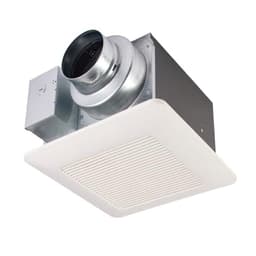
2. The fan that runs itself
WhisperSense DC Spot Ventilation Fan
Panasonic · FV-0511VQC1 · best for households where nobody remembers the switch
A humidity sensor adjustable from 30 to 80% RH, a motion sensor and a 30-second to 60-minute delay timer.
The Panasonic WhisperSense DC fixes the commonest reason a fan does not solve damp: it is not switched on long enough. Panasonic publishes “Variable humidity control from 30-80% relative humidity” and an “Adjustable delay timer from 30 seconds to 60 minutes”.
Renter-Safe Install Rating
- Drilling
- Required
- Tools
- Not published
- Time to fit
- Not published
- Power
- Hardwired
- Reversible on move-out
- No
Why: A hardwired ceiling fan on a duct run. The sensors change when it runs, not how it is installed.
Read from published documentation, not from fitting one. Panasonic — WhisperSense DC 50-80-110 CFM, published humidity range, sensors, sones and watts. How the verdict is derived: renter-safe ratings explained.
What’s wrong with it
More settings to get right at installation.
What we can’t tell you
No warranty on the product page.
Published specifications
| Airflow | “Pick-A-Flow®” selector — 50, 80 or 110 CFM |
|---|---|
| Noise | Below 0.3 sones at all three speeds at 0.1 in. static pressure; 0.4, 0.6 and 0.9 sones at 0.25 in. |
| Power draw | 4.0 to 16.4 watts depending on speed and static pressure |
| Humidity sensor | “Variable humidity control from 30-80% relative humidity” |
| Motion sensor | Included, with “Motion on/Motion off” and “Motion on/Humidity off” modes |
| Delay timer | “Adjustable delay timer from 30 seconds to 60 minutes” |
| Certification | “ENERGY STAR® certified”, awarded “2018 Most Efficient” |
| Duct | 4 in. or 6 in. |
| Grille and opening | 13 in. square grille; 10-1/2 in. square mounting opening |
| Warranty | Not published on the product page |
Source: Panasonic — WhisperSense DC 50-80-110 CFM, published humidity range, sensors, sones and watts
#ad Price $223.99 as of October 18, 2026. Prices change; Amazon’s listing is the one that counts. How we’re funded.
Where to buy
Everything recommended on this page, in one place. Each link is an Amazon Associates link — we earn a commission at no extra cost to you, and it never decides a pick.
- Check price on Amazon
WhisperCeiling DC Ventilation Fan
Panasonic · FV-0511VQ1 · Renter verdict: Owner-only
- $223.99View on Amazon
WhisperSense DC Spot Ventilation Fan
Panasonic · FV-0511VQC1 · Renter verdict: Owner-only
#ad Prices are not shown because we only publish figures we have verified on the day. How we’re funded.
Questions people actually ask
can a dehumidifier replace a bathroom exhaust fan
Not for shower steam. A fan sends wet air outdoors while you shower; a dehumidifier condenses moisture slowly, measured in pints per day, and keeps the water in the room until you empty it.
what size dehumidifier for a bathroom
ENERGY STAR's sizing for small to medium spaces runs from 20 to 30 pints a day for slightly to moderately damp conditions, 25 to 40 for very damp, and 30 to 50 for wet spaces.
does a bathroom exhaust fan remove humidity
Yes, by moving moist air outdoors. Panasonic's WhisperSense adds a humidity sensor adjustable from 30 to 80% relative humidity, so it switches itself on when the room gets steamy.
does a bathroom exhaust fan use a lot of electricity
No. Panasonic publishes 4.0 to 16.4 watts for its WhisperCeiling DC; twenty minutes at the top setting is about 5.5 watt-hours.
Sources
Read next
Back to Fixtures & Fittings.