The best bathroom exhaust fans
The appliance that decides whether your bathroom smells, fogs and grows mold — and the one nobody thinks about until it fails.
By Sawyer V. · · How we research

The short answer
We earn a commission if you buy through the links on this page, at no extra cost to you. It does not change which products we pick or what we say about them — here is exactly how that works.
Quick picks
Tap any row for the full write-up. Prices are checked against Amazon rather than remembered — where we have no verified figure the button says so.
| # | Product | Best for | Renter | Price |
|---|---|---|---|---|
| 1 | No photo yet WhisperCeiling DC Ventilation Fan Published 50/80/110 CFM on a selector, below 0.3 sones at the lower speeds, and 4.0 to 16.4 watts. | One fan that suits almost any bathroom, quietly | Owner-only | |
| — |  WhisperFit DC Ventilation Fan Buy it only if the joist depth forces you to — Panasonic publishes neither a sone value nor a wattage for it. | Skip this one | Owner-only | No buy link |
Start here: this is not a DIY purchase
A bathroom exhaust fan is wired into a branch circuit, mounted into the ceiling structure and connected to a duct that has to terminate outside the building. All three parts have to be right.
Both fans here rate Owner-only on our install rating, and that is not a formality. Electrical work in a wet room is licensed work in many places, and a duct that terminates in a loft rather than outside dumps every shower’s worth of moisture into your roof space. That is how you get a mold problem instead of solving one.
If you rent, this is not available to you. A fan that does not work is a repair your landlord owes you. Report it as a fault rather than asking for an upgrade.
Sizing: CFM, and the rule that actually works
CFM is cubic feet per minute — how much air the fan moves. The widely used rule of thumb for a standard eight-foot ceiling is 1 CFM per square foot of floor area, with a practical minimum of 50 CFM.
So a 5 by 8 foot bathroom is 40 square feet and takes the 50 CFM setting. A 9 by 9 is 81 square feet and wants 80. Anything approaching 110 square feet, or with a higher ceiling, wants 110.
Rooms with a separate enclosed toilet, a jetted tub or a ceiling above eight feet need more than the floor-area rule suggests, because you are moving a bigger volume of air.
This is exactly why the Pick-A-Flow selector is worth having. Sizing rules are approximations, and a fan you can change from 50 to 80 after living with it is more useful than a perfectly calculated fixed one.
Sones, and why the number is small
A sone is a loudness unit, and unlike decibels it is linear: two sones is genuinely twice as loud as one. That makes it unusually easy to compare.
Below 0.5 sones is close to inaudible in normal use. 1.0 is a quiet refrigerator. 2.0 and above is the fan you already have and never switch on.
Panasonic publishing below 0.3 sones at 50 and 80 CFM is the specification that justifies the price of this category, and it matters for a behavioral reason rather than a comfort one: a loud fan does not get used. The best-performing fan in the world clears nothing if it is switched off because it drowns out conversation.
Watch for how the figure is quoted. A single sone rating usually refers to the lowest speed at the most favorable static pressure. Panasonic publishes values at multiple speeds and pressures, which is why we can compare honestly.
The duct is half the installation
A fan is only as good as what it is connected to, and this is where most installations lose their performance.
Diameter matters. Both fans here publish 4 inch adapters, and the WhisperCeiling offers 6 inch. Necking a 110 CFM fan down to a 3 inch duct throttles it, and the published CFM becomes fiction.
Length and bends matter. Every elbow and every foot of flexible duct adds resistance — which is what “static pressure” means in the specifications, and why Panasonic publishes sone and wattage figures at more than one value.
It has to terminate outside. Not the loft, not the soffit cavity, outside. This is the single most common serious fault in a domestic bathroom fan.
It needs a backdraft damper. The WhisperFit publishes one on its adapter. Without it, cold air and outside smells come back down the duct.
What a fan fixes, and what it does not
It fixes humidity, and that is most of it. Persistent damp is what grows mold in grout, keeps towels smelling and makes a bathroom feel cold. Extracting moist air while and after you shower is the actual solution.
It reduces mirror fogging, but slowly. A fan removes humid air over minutes; the mirror fogs in seconds. If instant clarity is what you want, that is a heated or fogless mirror rather than more extraction. The fogging fixes are here.
It does not make the room warm. It makes it drier, which feels warmer, but it is also removing heated air. In a cold bathroom you may want both a fan and a heater.
It does not dry towels. A damp towel in a well-ventilated cold room still takes most of a day. That is what a heated rail is for, and the two work well together.
Run it longer than you think. Twenty minutes after the shower ends does far more than five minutes during it. At a published 16 watts on maximum, that costs a fraction of a cent.
Every pick in full
1 we would buy, and one we would not. Each carries its Renter-Safe Install Rating, the published specs behind it, and the honest gap in what we know.
1. Best overall
WhisperCeiling DC Ventilation Fan
Panasonic · FV-0511VQ1 · best for one fan that suits almost any bathroom, quietly
Published 50/80/110 CFM on a selector, below 0.3 sones at the lower speeds, and 4.0 to 16.4 watts.
The Panasonic WhisperCeiling DC wins because Panasonic publishes the full picture and almost nobody else does.
The “Pick-A-Flow” selector gives “50, 80, 110 CFM” from one unit. That solves the sizing problem practically: you buy one fan, set it to suit the room, and change it later if you get it wrong.
The noise figures are the reason to pay for it. Panasonic publishes below 0.3 sones at both 50 and 80 CFM, and 0.9 sones at 110 CFM. Below one sone is genuinely quiet — quiet enough that people leave it running, which is the entire point of a fan.
It draws a published “4.0 to 16.4 Watts”, is “ENERGY STAR® Certified” and was recognized as “2021 Most Efficient”. At 16 watts you can afford to run it for an hour after every shower, which is what actually clears a bathroom.
Renter-Safe Install Rating
- Drilling
- Required
- Tools
- Not published
- Time to fit
- Not published
- Power
- Hardwired
- Reversible on move-out
- No
Why: A ceiling-mounted fan wired into a branch circuit and connected to a duct run. It is an electrical and structural alteration, not a fitting, and it is not available to a tenant.
Read from published documentation, not from fitting one. Panasonic — WhisperCeiling DC 50-80-110 CFM, published airflow, sones, watts and dimensions. How the verdict is derived: renter-safe ratings explained.
What’s wrong with it
The mounting opening is a published 10-1/2 in square, so a retrofit usually means cutting the ceiling and patching.
What we can’t tell you
Panasonic publishes no warranty on the product page.
Published specifications
| Airflow | “Pick-A-Flow” speed selector — “50, 80, 110 CFM” |
|---|---|
| Noise | Below 0.3 sones at 50 and 80 CFM, and 0.9 sones at 110 CFM (0.1 in. static pressure) |
| Power draw | “4.0 to 16.4 Watts” depending on speed and static pressure |
| Certification | “ENERGY STAR® Certified”, recognized as “2021 Most Efficient” |
| Duct | Dual duct adapter for 4 in. or 6 in. |
| Grille | 13 in. square |
| Mounting opening | 10-1/2 in. square |
| Weight | 11.0 lbs gross |
| Motor | DC motor with ECM and SmartFlow |
| Bracket | “Single-hinged Flex-Z-Fast® bracket” |
| Warranty | Not published on the product page |
Source: Panasonic — WhisperCeiling DC 50-80-110 CFM, published airflow, sones, watts and dimensions
#ad We have no verified live price for this one right now, so we are not showing a number. How we’re funded.
The one to skip
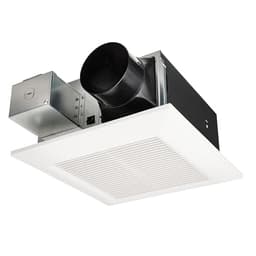
WhisperFit DC Ventilation Fan
Panasonic · FV-0511VF1 · best for only where ceiling depth genuinely rules out anything else
Buy it only if the joist depth forces you to — Panasonic publishes neither a sone value nor a wattage for it.
The WhisperFit DC exists for the constraint that stops most fan upgrades: there is nothing above the ceiling. If that is your situation it is the right answer, and it is the only reason to choose it over the WhisperCeiling.
Panasonic publishes a “Low-profile 5-5/8″ housing depth” that “fits in 2″ x 6″ joist size or larger”. In a flat, a single-story extension or anywhere with shallow joists, that is the difference between a possible upgrade and an impossible one.
It keeps the “Pick-A-Flow® Airflow Selector, 50-80-110 CFM” and ENERGY STAR certification, and publishes a “Plastic standard 4″ adapter with backdraft damper/shutter” with a 3 inch reducer included. The backdraft damper matters — it is what stops cold air and smells coming back down the duct when the fan is off.
Panasonic also publishes installation “from below the ceiling”, which is what makes it a retrofit rather than a rebuild.
So why is it the skip? Because on this page Panasonic publishes neither a sone value nor a wattage for it — only that sones are “certified at 0.25 w.g.”. Those are precisely the two numbers that make the WhisperCeiling worth recommending, and a fan bought without a noise figure is a fan you may end up not switching on.
If you have the depth for the WhisperCeiling, take the published specifications. If you do not, this is a good product bought on trust rather than on data, and that is the honest way to describe it.
Renter-Safe Install Rating
- Drilling
- Required
- Tools
- Not published
- Time to fit
- Not published
- Power
- Hardwired
- Reversible on move-out
- No
Why: Shallower than most, and still a hardwired ceiling fan on a duct run. The low profile makes it a retrofit option for an owner, not a renter-safe one.
Read from published documentation, not from fitting one. Panasonic — WhisperFit DC 50-80-110 CFM, published airflow, housing depth and duct adapter. How the verdict is derived: renter-safe ratings explained.
What’s wrong with it
Panasonic publishes no sone value and no wattage on this product page — only that sones are certified at 0.25 w.g.
What we can’t tell you
Noise and power draw are both unpublished here, which are the two things you would most want to compare.
Published specifications
| Airflow | “Pick-A-Flow® Airflow Selector, 50-80-110 CFM” |
|---|---|
| Housing depth | “Low-profile 5-5/8″ housing depth fits in 2″ x 6″ joist size or larger” |
| Duct | “Plastic standard 4″ adapter with backdraft damper/shutter”, 3 in. reducer included |
| Certification | ENERGY STAR certified |
| Retrofit | Panasonic publishes installation “from below the ceiling for added convenience” |
| Noise | Panasonic states sones are “certified at 0.25 w.g.” but publishes no value on this page |
| Power draw | Not published on this page |
| Warranty | Not published on the product page |
Source: Panasonic — WhisperFit DC 50-80-110 CFM, published airflow, housing depth and duct adapter
There is no buy button on this one. It is easy enough to find if you want it anyway — we would rather point you at something that is still on the wall in a year.
Where to buy
Everything recommended on this page, in one place. Each link is an Amazon Associates link — we earn a commission at no extra cost to you, and it never decides a pick.
- Check price on Amazon
WhisperCeiling DC Ventilation Fan
Panasonic · FV-0511VQ1 · Renter verdict: Owner-only
#ad Prices are not shown because we only publish figures we have verified on the day. How we’re funded.
Questions people actually ask
what size bathroom exhaust fan do i need
Roughly 1 CFM per square foot of floor for a standard eight-foot ceiling, with 50 CFM as a practical minimum. A 40 square foot bathroom wants 50 CFM; an 80 square foot one wants 80. Higher ceilings and enclosed toilets need more.
what is a good sone rating for a bathroom fan
Below 0.5 sones is close to inaudible; 1.0 is a quiet refrigerator; 2.0 and above is the fan people stop switching on. Panasonic publishes below 0.3 sones at 50 and 80 CFM, which is why it dominates this category.
can i install a bathroom exhaust fan myself
We would not treat it as a DIY job. It is wired into a branch circuit, mounted into ceiling structure and connected to a duct that must terminate outside the building. Electrical work in a wet room is licensed work in many places.
how long should you run a bathroom fan after a shower
About twenty minutes after the shower ends does far more than running it during. At the WhisperCeiling's published 16.4 watts maximum, that costs a fraction of a cent per shower.
will an exhaust fan stop my mirror fogging
Only slowly. A fan removes humid air over minutes while the mirror fogs in seconds. For instant clarity you want a heated or fogless mirror; the fan is solving the longer-term damp problem instead.
Sources
Read next
Back to Fixtures & Fittings.