Humidity-sensing vs timer bathroom fans
Both approaches solve the same failure: a fan that gets switched off while the mirror is still fogged. They differ in what you pay and what fits in your ceiling.
By Sawyer V. · · How we research
The short answer
We earn a commission if you buy through the links on this page, at no extra cost to you. It does not change which products we pick or what we say about them — here is exactly how that works.
Quick picks
Tap any row for the full write-up. Prices are checked against Amazon rather than remembered — where we have no verified figure the button says so.
| # | Product | Best for | Renter | Price |
|---|---|---|---|---|
| 1 |  WhisperSense DC Spot Ventilation Fan Humidity and motion sensing with an adjustable delay timer, below 0.3 sones at 0.1 in. static pressure, 4.0 to 16.4 W. | A bathroom where nobody remembers the fan | Owner-only | |
| 2 |  WhisperFit DC Ventilation Fan The same Pick-A-Flow airflow in a 5-5/8 in. housing that Panasonic publishes as installable from below the ceiling. | A retrofit into 2 x 6 joists, or a fan paired with a timer switch | Owner-only |
The failure both are trying to fix
Moisture leaves a bathroom long after the shower stops. A fan switched off with the light has cleared a fraction of it, which is why the mirror fogs again, the paint peels above the tile and the sealant blackens.
A timer switch fixes the leaving-too-early half: the fan keeps running for a set period after you walk out. A humidity sensor fixes both halves: it starts when the air gets damp and stops when it does not, whether or not anyone touched a switch. Fan against dehumidifier is compared here.
Where the money goes
The sensing fan costs meaningfully more than the plain one — live prices are beside each pick above. Against that, a timer switch is an extra part and an extra bit of wiring, and it still cannot start the fan when a guest showers and leaves the switch alone.
On running cost the sensing model is the only one that publishes a figure: 4.0 to 16.4 W depending on speed and static pressure. At the top of that range and an hour a day, that is under a dollar a year of electricity at 18.34 cents per kWh. Ventilation is not where a bathroom’s energy goes.
The measurement that may decide it for you
Housing depth. Panasonic publishes 5-5/8 in. for the WhisperFit and describes it as fitting 2 x 6 joists or larger, with installation possible from below the ceiling. If you are retrofitting into a shallow joist bay, or if there is no attic above the bathroom, that is not a preference — it is the only one of the two that goes in.
What neither fixes
A fan is only as good as its duct. A long flexible run, a crushed elbow or a duct that ends in the loft instead of outside will defeat either model. The full fan ranking is here. Both are hardwired ceiling installs and both rate Owner-only; neither is a rental job. Renter-friendly ventilation is covered here.
Which to buy
Humidity sensing if the bathroom has no window, if it is used by people who will never touch the fan switch, or if you have already had a damp problem. The sensing fans are ranked here.
Plain fan plus a timer switch if the ceiling is shallow, if you want the cheapest competent answer, or if the fan is in a bathroom used by one or two people who are happy to press a switch.
Every pick in full
2 we would buy. Each carries its Renter-Safe Install Rating, the published specs behind it, and the honest gap in what we know.
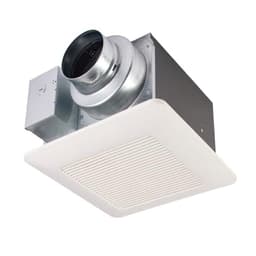
1. The fan that decides for itself
WhisperSense DC Spot Ventilation Fan
Panasonic · FV-0511VQC1 · best for a bathroom where nobody remembers the fan
Humidity and motion sensing with an adjustable delay timer, below 0.3 sones at 0.1 in. static pressure, 4.0 to 16.4 W.
Panasonic’s WhisperSense DC publishes “Variable humidity control from 30-80% relative humidity” plus a motion sensor with “Motion on/Motion off” and “Motion on/Humidity off” modes, and an “Adjustable delay timer from 30 seconds to 60 minutes”.
It is quiet enough that you will not switch it off out of irritation: below 0.3 sones at all three speeds at 0.1 in. static pressure, rising to 0.4, 0.6 and 0.9 sones at 0.25 in. Power draw is published as 4.0 to 16.4 W, and it is “ENERGY STAR® certified”, awarded “2018 Most Efficient”.
Airflow is selectable on the same unit — the “Pick-A-Flow®” selector sets 50, 80 or 110 CFM, so one model covers most bathroom sizes. Sizing a fan to the room is here.
Renter-Safe Install Rating
- Drilling
- Required
- Tools
- Not published
- Time to fit
- Not published
- Power
- Hardwired
- Reversible on move-out
- No
Why: A hardwired ceiling fan on a duct run. The sensors change when it runs, not how it is installed.
Read from published documentation, not from fitting one. Panasonic — WhisperSense DC 50-80-110 CFM, published humidity range, sensors, sones and watts. How the verdict is derived: renter-safe ratings explained.
What’s wrong with it
Substantially more expensive than the plain fan, and it needs a 10-1/2 in. square opening with a 13 in. grille.
What we can’t tell you
Panasonic publishes no warranty term on the product page, and no housing depth for this model.
Published specifications
| Airflow | “Pick-A-Flow®” selector — 50, 80 or 110 CFM |
|---|---|
| Noise | Below 0.3 sones at all three speeds at 0.1 in. static pressure; 0.4, 0.6 and 0.9 sones at 0.25 in. |
| Power draw | 4.0 to 16.4 watts depending on speed and static pressure |
| Humidity sensor | “Variable humidity control from 30-80% relative humidity” |
| Motion sensor | Included, with “Motion on/Motion off” and “Motion on/Humidity off” modes |
| Delay timer | “Adjustable delay timer from 30 seconds to 60 minutes” |
| Certification | “ENERGY STAR® certified”, awarded “2018 Most Efficient” |
| Duct | 4 in. or 6 in. |
| Grille and opening | 13 in. square grille; 10-1/2 in. square mounting opening |
| Warranty | Not published on the product page |
Source: Panasonic — WhisperSense DC 50-80-110 CFM, published humidity range, sensors, sones and watts
#ad Price $223.99 as of October 19, 2026. Prices change; Amazon’s listing is the one that counts. How we’re funded.
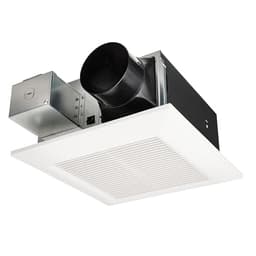
2. The one that fits where others do not
WhisperFit DC Ventilation Fan
Panasonic · FV-0511VF1 · best for a retrofit into 2 x 6 joists, or a fan paired with a timer switch
The same Pick-A-Flow airflow in a 5-5/8 in. housing that Panasonic publishes as installable from below the ceiling.
The WhisperFit DC drops the sensors and keeps the fan. Panasonic publishes a “Low-profile 5-5/8″ housing depth fits in 2″ x 6″ joist size or larger” and installation “from below the ceiling for added convenience” — the two things that decide whether a retrofit is a morning or a weekend.
Airflow is the same “Pick-A-Flow® Airflow Selector, 50-80-110 CFM”, it is ENERGY STAR certified, and the duct connection is a “Plastic standard 4″ adapter with backdraft damper/shutter” with a 3 in. reducer included.
Pair it with a timer switch at the wall and you get most of the behavior of a sensing fan: it keeps running after you leave. What it cannot do is start itself, or keep going because the room is still damp.
Renter-Safe Install Rating
- Drilling
- Required
- Tools
- Not published
- Time to fit
- Not published
- Power
- Hardwired
- Reversible on move-out
- No
Why: Shallower than most, and still a hardwired ceiling fan on a duct run. The low profile makes it a retrofit option for an owner, not a renter-safe one.
Read from published documentation, not from fitting one. Panasonic — WhisperFit DC 50-80-110 CFM, published airflow, housing depth and duct adapter. How the verdict is derived: renter-safe ratings explained.
What’s wrong with it
No sensors at all, so the fan only runs when something — you or a timer switch — says so.
What we can’t tell you
Panasonic states sones are “certified at 0.25 w.g.” but publishes no sone value and no wattage for this model.
Published specifications
| Airflow | “Pick-A-Flow® Airflow Selector, 50-80-110 CFM” |
|---|---|
| Housing depth | “Low-profile 5-5/8″ housing depth fits in 2″ x 6″ joist size or larger” |
| Duct | “Plastic standard 4″ adapter with backdraft damper/shutter”, 3 in. reducer included |
| Certification | ENERGY STAR certified |
| Retrofit | Panasonic publishes installation “from below the ceiling for added convenience” |
| Noise | Panasonic states sones are “certified at 0.25 w.g.” but publishes no value on this page |
| Power draw | Not published on this page |
| Warranty | Not published on the product page |
Source: Panasonic — WhisperFit DC 50-80-110 CFM, published airflow, housing depth and duct adapter
#ad Price $135.99 as of October 19, 2026. Prices change; Amazon’s listing is the one that counts. How we’re funded.
Where to buy
Everything recommended on this page, in one place. Each link is an Amazon Associates link — we earn a commission at no extra cost to you, and it never decides a pick.
- $223.99View on Amazon
WhisperSense DC Spot Ventilation Fan
Panasonic · FV-0511VQC1 · Renter verdict: Owner-only
- $135.99View on Amazon
WhisperFit DC Ventilation Fan
Panasonic · FV-0511VF1 · Renter verdict: Owner-only
#ad Prices are not shown because we only publish figures we have verified on the day. How we’re funded.
Questions people actually ask
are humidity sensing bathroom fans worth it
They are if the fan currently gets switched off early or never switched on. Panasonic's sensing model runs on a 30 to 80% humidity setting with a delay timer from 30 seconds to 60 minutes, which removes the human from the decision.
is a timer switch as good as a humidity sensor
It fixes half the problem. A timer keeps the fan running after you leave, but it cannot start the fan when someone else showers, and it stops on time rather than when the air is actually dry.
how long should a bathroom fan run after a shower
Long enough to clear the moisture, which is why the sensing model offers a delay timer up to 60 minutes and a humidity threshold instead of a fixed interval.
what fan fits in shallow ceiling joists
Panasonic publishes a 5-5/8 in. housing depth on the WhisperFit DC, stated to fit 2 x 6 joists or larger, with installation possible from below the ceiling.
Sources
- Panasonic — WhisperSense DC 50-80-110 CFM (humidity range, motion modes, delay timer, sones, watts, ENERGY STAR)
- Panasonic — WhisperFit DC 50-80-110 CFM (airflow selector, 5-5/8 in. housing depth, duct adapter, retrofit)
- U.S. Energy Information Administration, Electric Power Monthly Table 5.6.A — US residential average 18.34 cents/kWh, June 2026
Read next
Back to Fixtures & Fittings.