Bathroom exhaust fan vs window
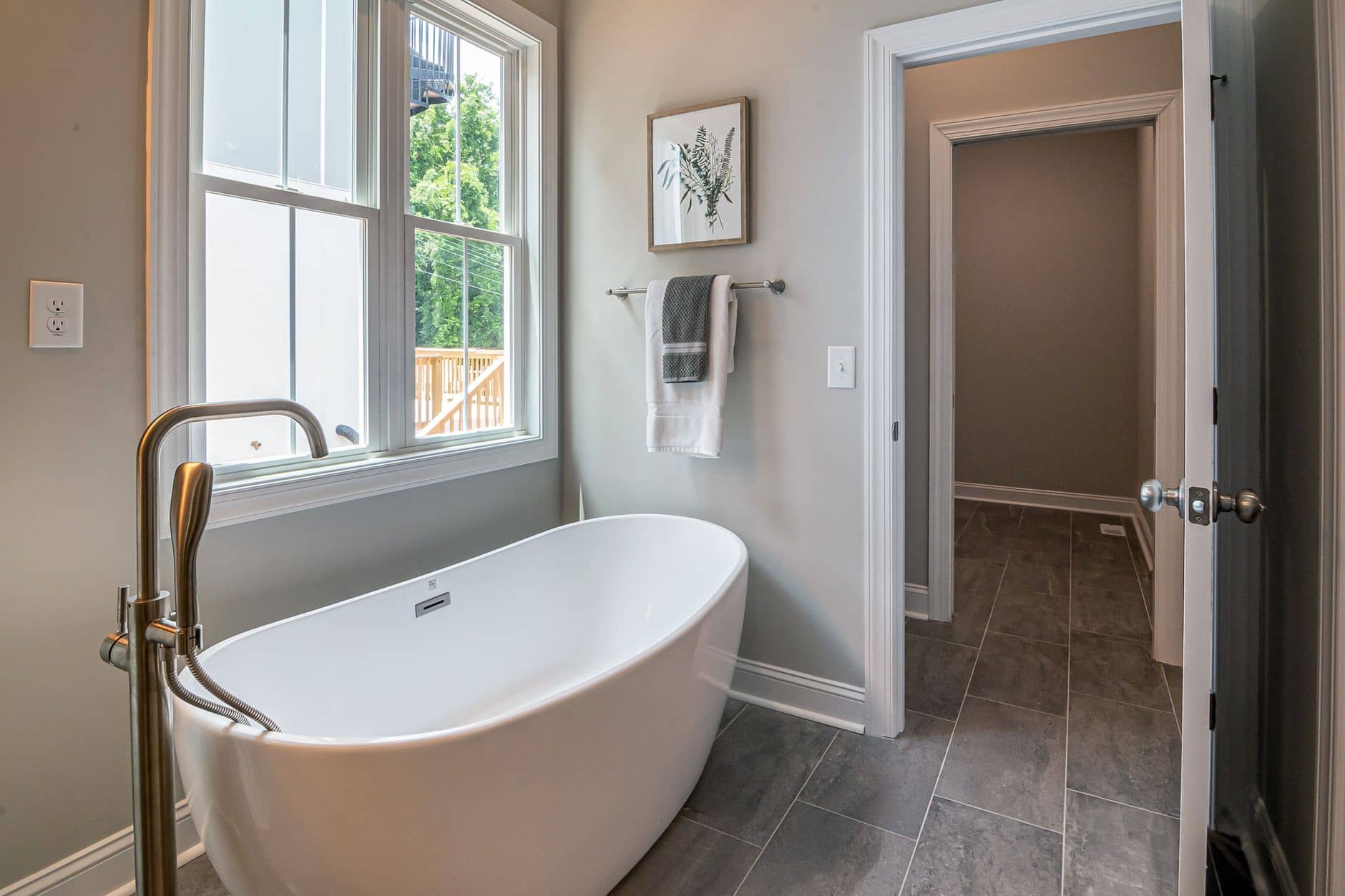
An open window is free ventilation with conditions attached. A fan is a published number of cubic feet a minute, whatever the weather is doing.
By Sawyer V. · · How we research
The short answer
We earn a commission if you buy through the links on this page, at no extra cost to you. It does not change which products we pick or what we say about them — here is exactly how that works.
Quick picks
Tap any row for the full write-up. Prices are checked against Amazon rather than remembered — where we have no verified figure the button says so.
| # | Product | Best for | Renter | Price |
|---|---|---|---|---|
| 1 | No photo yet WhisperCeiling DC Ventilation Fan 50, 80 or 110 CFM at below 0.3 sones on the lower speeds, 4.0 to 16.4 watts, ENERGY STAR certified. | Any bathroom where the steam has to go | Owner-only | |
| 2 |  WhisperSense DC Spot Ventilation Fan A humidity sensor adjustable from 30 to 80% RH, plus a delay timer from 30 seconds to 60 minutes. | Households that never run the fan long enough | Owner-only |
What each one actually does
A fan pulls air out of the room at a rated volume and pushes it outdoors through a duct. The rate is published: 50, 80 or 110 cubic feet a minute on the fans here.
A window exchanges air by pressure and temperature difference. When it is cold outside and the door is shut, that exchange can be brisk; on a still, warm, humid day it can be almost nothing. Nobody publishes a CFM figure for an open window, and we are not going to invent one.
The target, from the EPA
Whichever you use, the goal is the same: “Keep indoor humidity below 60 percent (ideally between 30 and 50 percent) relative humidity.” A $10 hygrometer tells you whether your bathroom clears or lingers, which is more useful than any argument about fans.
Where a window wins
- It is free, and it is available in a rental where a fan is not.
- It moves a lot of air when the weather helps, especially with the door open.
- It has nothing to fail — no motor, no duct, no damper.
Where a fan wins
- It works in February. Nobody opens a window at 6 a.m. in winter, which is exactly when the room needs it.
- It is a known quantity. HVI’s sizing rule of “1 CFM per square foot” only means something because the fan publishes its rate. Our sizing guide is here.
- It can run itself. A humidity sensor and a delay timer do not depend on anyone remembering.
- It works with the door shut, and with the blind down.
Running cost is not the deciding factor
Panasonic publishes 4.0 to 16.4 watts for the WhisperCeiling DC. Twenty minutes a day at the top figure is about 5.5 watt-hours, which at 18.34 cents per kWh works out to roughly 37 cents a year — our arithmetic from Panasonic’s published figure. A window is free, and the difference between the two is not worth thinking about.
If you have both
Use them in sequence: start the fan before you get in, and open the window afterwards if the weather suits. If mildew keeps coming back, the EPA is blunt about the remedy — “increasing ventilation (running a fan or opening a window) and cleaning more frequently will usually prevent mold from recurring”.
What a fan cannot fix
A fan only helps if the air it moves actually leaves the building. If yours is loud, weak, or the mirror still fogs with it running, the problem is usually the ducting or the fan’s age rather than the idea. A dehumidifier is not the substitute people hope for either.
If you rent
Every fan here rates Owner-only on our install rating. The window is the tenant’s tool, and the rest of the renter’s options are here.
Every pick in full
2 we would buy. Each carries its Renter-Safe Install Rating, the published specs behind it, and the honest gap in what we know.
1. The fan
WhisperCeiling DC Ventilation Fan
Panasonic · FV-0511VQ1 · best for any bathroom where the steam has to go
50, 80 or 110 CFM at below 0.3 sones on the lower speeds, 4.0 to 16.4 watts, ENERGY STAR certified.
Panasonic’s WhisperCeiling DC is the fan we would fit. The installer picks 50, 80 or 110 CFM with the Pick-A-Flow selector, and Panasonic publishes below 0.3 sones at 50 and 80 CFM — well inside HVI’s bar that “For quiet bathroom ventilation the fan should be rated at 1.0 sones or less”.
It draws 4.0 to 16.4 watts and is ENERGY STAR certified, which by ENERGY STAR’s own figures means fans that “use about 48% less energy than standard models”.
Renter-Safe Install Rating
- Drilling
- Required
- Tools
- Not published
- Time to fit
- Not published
- Power
- Hardwired
- Reversible on move-out
- No
Why: A ceiling-mounted fan wired into a branch circuit and connected to a duct run. It is an electrical and structural alteration, not a fitting, and it is not available to a tenant.
Read from published documentation, not from fitting one. Panasonic — WhisperCeiling DC 50-80-110 CFM, published airflow, sones, watts and dimensions. How the verdict is derived: renter-safe ratings explained.
What’s wrong with it
Hardwired and ducted, so fitting one is an electrician's job on a home you own.
What we can’t tell you
Panasonic publishes no warranty on the product page.
Published specifications
| Airflow | “Pick-A-Flow” speed selector — “50, 80, 110 CFM” |
|---|---|
| Noise | Below 0.3 sones at 50 and 80 CFM, and 0.9 sones at 110 CFM (0.1 in. static pressure) |
| Power draw | “4.0 to 16.4 Watts” depending on speed and static pressure |
| Certification | “ENERGY STAR® Certified”, recognized as “2021 Most Efficient” |
| Duct | Dual duct adapter for 4 in. or 6 in. |
| Grille | 13 in. square |
| Mounting opening | 10-1/2 in. square |
| Weight | 11.0 lbs gross |
| Motor | DC motor with ECM and SmartFlow |
| Bracket | “Single-hinged Flex-Z-Fast® bracket” |
| Warranty | Not published on the product page |
Source: Panasonic — WhisperCeiling DC 50-80-110 CFM, published airflow, sones, watts and dimensions
#ad We have no verified live price for this one right now, so we are not showing a number. How we’re funded.
2. The fan that solves the human problem
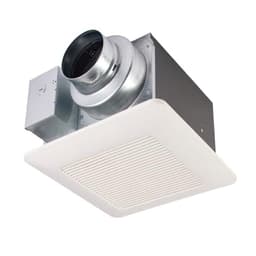
WhisperSense DC Spot Ventilation Fan
Panasonic · FV-0511VQC1 · best for households that never run the fan long enough
A humidity sensor adjustable from 30 to 80% RH, plus a delay timer from 30 seconds to 60 minutes.
A window has one failure mode and a fan has another: nobody leaves either open long enough. Panasonic’s WhisperSense DC removes the decision with “Variable humidity control from 30-80% relative humidity” and an “Adjustable delay timer from 30 seconds to 60 minutes”.
Set the delay to 20 minutes and it matches HVI’s recommendation without anyone remembering to.
Renter-Safe Install Rating
- Drilling
- Required
- Tools
- Not published
- Time to fit
- Not published
- Power
- Hardwired
- Reversible on move-out
- No
Why: A hardwired ceiling fan on a duct run. The sensors change when it runs, not how it is installed.
Read from published documentation, not from fitting one. Panasonic — WhisperSense DC 50-80-110 CFM, published humidity range, sensors, sones and watts. How the verdict is derived: renter-safe ratings explained.
What’s wrong with it
More settings to get right at installation, and the same hardwired, ducted install.
What we can’t tell you
No warranty published on the product page.
Published specifications
| Airflow | “Pick-A-Flow®” selector — 50, 80 or 110 CFM |
|---|---|
| Noise | Below 0.3 sones at all three speeds at 0.1 in. static pressure; 0.4, 0.6 and 0.9 sones at 0.25 in. |
| Power draw | 4.0 to 16.4 watts depending on speed and static pressure |
| Humidity sensor | “Variable humidity control from 30-80% relative humidity” |
| Motion sensor | Included, with “Motion on/Motion off” and “Motion on/Humidity off” modes |
| Delay timer | “Adjustable delay timer from 30 seconds to 60 minutes” |
| Certification | “ENERGY STAR® certified”, awarded “2018 Most Efficient” |
| Duct | 4 in. or 6 in. |
| Grille and opening | 13 in. square grille; 10-1/2 in. square mounting opening |
| Warranty | Not published on the product page |
Source: Panasonic — WhisperSense DC 50-80-110 CFM, published humidity range, sensors, sones and watts
#ad Price $223.99 as of October 18, 2026. Prices change; Amazon’s listing is the one that counts. How we’re funded.
Where to buy
Everything recommended on this page, in one place. Each link is an Amazon Associates link — we earn a commission at no extra cost to you, and it never decides a pick.
- Check price on Amazon
WhisperCeiling DC Ventilation Fan
Panasonic · FV-0511VQ1 · Renter verdict: Owner-only
- $223.99View on Amazon
WhisperSense DC Spot Ventilation Fan
Panasonic · FV-0511VQC1 · Renter verdict: Owner-only
#ad Prices are not shown because we only publish figures we have verified on the day. How we’re funded.
Questions people actually ask
is a bathroom exhaust fan better than a window
A fan moves a published volume of air every time regardless of weather, and can run on a timer or humidity sensor. A window is free and can move more air when conditions suit. The EPA recommends either: run the bathroom fan or open the window when showering.
do you need an exhaust fan if you have a window
Requirements vary by local code, so check yours. Practically, a window only ventilates when someone opens it and the weather cooperates, which is why fans with humidity sensors and delay timers exist.
how long should you leave a bathroom fan on
HVI recommends that the fan be left on for 20 minutes after use of the bathroom. Panasonic's WhisperSense publishes a delay timer adjustable from 30 seconds to 60 minutes, which automates exactly that.
what humidity should a bathroom be after a shower
The EPA advises keeping indoor humidity below 60 percent, ideally between 30 and 50 percent relative humidity.
Sources
- US EPA — A Brief Guide to Mold, Moisture and Your Home
- Home Ventilating Institute — Bathroom ventilation guidance (sizing and 20-minute run time)
- Home Ventilating Institute — Bathroom exhaust fans (1.0 sones or less for quiet)
- ENERGY STAR — Ventilation fans (48% less energy than standard models)
- Panasonic — WhisperCeiling DC FV-0511VQ1 published airflow, sones and watts
Read next
Back to Fixtures & Fittings.