Are bathroom space heaters safe?
A heater in a wet room is the one appliance in this catalog where the specification is genuinely a safety matter rather than a preference.
By Sawyer V. · · How we research

The short answer
We earn a commission if you buy through the links on this page, at no extra cost to you. It does not change which products we pick or what we say about them — here is exactly how that works.
Quick picks
Tap any row for the full write-up. Prices are checked against Amazon rather than remembered — where we have no verified figure the button says so.
| # | Product | Best for | Renter | Price |
|---|---|---|---|---|
| 1 | No photo yet Lasko 8″ Bathroom Ceramic Heater with ALCI Plug Integrated ALCI safety plug, ETL listed, 900–1500 W with a 1-hour auto-shutoff and a published bathroom design intent. | Heating a bathroom, with the protection built into the plug | Safe | |
| 2 |  WarmlyYours Ibiza Freestanding Towel Warmer 90 W, cULus listed, with published overheat protection capped at 149°F — a fraction of the power and a stated ceiling. | Continuous gentle warmth with no 1500 W load | Safe | |
| — |  Vornado VH202 Personal Space Heater Good safety features and no published ALCI plug or bathroom rating — Vornado does not market it for this room. | Skip this one | Safe | No buy link |
What an ALCI plug is
ALCI stands for Appliance Leakage Current Interrupter. It is a ground-fault detector built into the appliance’s own plug — the chunky molded block with a test and reset button that you also find on hairdryers.
It watches the current going out against the current coming back. If they differ by a few milliamps, that difference is leaking somewhere it should not be, and the device cuts power in a fraction of a second.
In a bathroom that matters more than anywhere else, because water on skin dramatically lowers the body’s resistance. A fault that would be a shock elsewhere is a considerably more serious event in a wet room.
The important property is that the protection is part of the appliance. A GFCI outlet does the same job, but you cannot know whether the outlet in a rented bathroom is one, or whether it still works. An ALCI plug travels with the heater.
How to tell the difference on a product page
Three things to look for, in order.
1. A published ALCI or GFCI plug. Lasko publishes an integrated ALCI safety plug on the CD08200. If a maker has fitted one, they say so, because it is expensive and it is a selling point.
2. An explicit bathroom statement. Lasko states the design is “specifically for bathroom use”. Manufacturers do not make that claim casually.
3. A safety listing. ETL or UL means tested to a standard for its class. Lasko publishes ETL listed. It is necessary and not sufficient — a listed heater may be listed as a general-purpose heater.
If all three are absent, treat the heater as a bedroom appliance. That is not us being cautious; it is reading what the maker chose to publish.
The two things people get wrong
Assuming a bathroom outlet is GFCI protected. Modern US electrical code requires it, but older housing predates the requirement, and a GFCI device can fail without any visible sign. If you rely on the outlet, you are relying on something you cannot verify. An ALCI plug you can see and test.
Using an extension lead. This is the one to avoid absolutely. A 1500 W heater on a domestic extension lead is a load most leads are not rated for continuously; running it across a wet floor adds a trip hazard in the room where falls are most common; and it can defeat the outlet’s protection.
If the heater does not reach the outlet, the heater is in the wrong place, or the room needs an outlet. Neither is solved with a lead.
Placement, which is free and matters
Well away from the bath, the shower and the basin. Far enough that it cannot be splashed and cannot be knocked in.
On a flat, stable floor. A tip-over switch, which Vornado publishes and most makers fit, is a backstop rather than a plan.
Nothing draped over it, ever. A heater is not a towel rail. If you want to warm towels, a rail with a published temperature cap is the correct appliance, and it is designed for fabric to touch it.
Not left running unattended. Lasko publishes a 1-hour auto-shutoff on the CD08200, which is the maker building the habit in for you.
The load question in an older flat
A 1500 W heater is one of the largest single loads in a home. On an older circuit shared with a hairdryer — also around 1500 W — that is a tripped breaker at best.
Lasko publishes two settings, 900 W and 1500 W, and in a small bathroom the lower one is usually enough. Published coverage is up to 100 sq ft, which is most bathrooms twice over.
This is another argument for a rail if the goal is a room that is never cold rather than a room that warms up quickly: 90 W is not a load any circuit notices.
Renter status, which is not the issue here
Every product on this page rates Safe on our install rating. They stand on the floor and plug in. Nothing is fitted and nothing is undone.
The renter question is settled; the bathroom question is not, and it is settled by what the maker publishes rather than by how the appliance is installed. That is the distinction this page exists to make. The full heater comparison is here.
Every pick in full
2 we would buy, and one we would not. Each carries its Renter-Safe Install Rating, the published specs behind it, and the honest gap in what we know.
1. The one designed for the room
Lasko 8″ Bathroom Ceramic Heater with ALCI Plug
Lasko · CD08200 · best for heating a bathroom, with the protection built into the plug
Integrated ALCI safety plug, ETL listed, 900–1500 W with a 1-hour auto-shutoff and a published bathroom design intent.
The Lasko CD08200 is the only heater on this site whose maker publishes the two things that matter here.
First, the protective device: an integrated ALCI safety plug. That is a ground-fault interrupter built into the heater’s own plug, so the protection travels with the appliance rather than depending on the outlet.
Second, the intent: Lasko states the design is “specifically for bathroom use”. Manufacturers are careful about statements like that, and its presence is meaningful in a way that its absence also is.
It publishes “900 W to 1500 W”, two heat settings, ETL listing, a 1-hour auto-shutoff, coverage up to 100 sq ft, and “3.35 lb” at “8.00 in” tall.
About seven cents to run for the fifteen minutes it takes to shower and dry off.
Renter-Safe Install Rating
- Drilling
- None
- Tools
- None
- Time to fit
- None — “fully assembled” and “requires no tools”
- Power
- Standard outlet, via the heater’s own ALCI plug
- Reversible on move-out
- Fully
Why: It plugs in and sits on the floor. The ALCI plug is the heater’s own protective device, so it does not need an outlet upgrade to be used as designed.
Read from published documentation, not from fitting one. Lasko, 8″ Bathroom Ceramic Heater CD08200. How the verdict is derived: renter-safe ratings explained.
What it costs to run — Electricity
- Rated power
- 1500 W on high (Lasko’s published maximum)
- Run time
- 15 minutes while you shower and dry off
- Electricity rate
- 18.34 cents per kWh (US residential average, June 2026)
1500 W x 0.25 h / 1000 x $0.1834 = $0.069
About 7 cents a shower — and about 28 cents an hour if you forget the timer
Arithmetic on published specifications, not a measurement. Rate source: U.S. Energy Information Administration, Electric Power Monthly Table 5.6.A — US residential average 18.34 cents/kWh, June 2026.
What’s wrong with it
1500 W is a large load. On an older circuit already carrying a hairdryer, expect to find out where the breaker is.
What we can’t tell you
Lasko publishes no noise figure, which matters in a small hard-surfaced room.
Published specifications
| Wattage | “900 W to 1500 W” |
|---|---|
| Supply | “120 V”, “7.5 A to 12.5 A” |
| Heat settings | Two, high and low |
| Bathroom safety | “an integrated ALCI safety plug, overheat protection, a self-regulating ceramic element, and a cool-touch exterior are designed specifically for bathroom use” |
| Timer | 1-hour auto-shutoff via the Simple Heat button |
| Dimensions | “8.00 in” high, “6.25 in” wide and deep |
| Weight | “3.35 lb” |
| Coverage | Up to 100 sq ft |
| Certification | ETL Listed |
| Warranty | “3 year warranty” |
#ad We have no verified live price for this one right now, so we are not showing a number. How we’re funded.
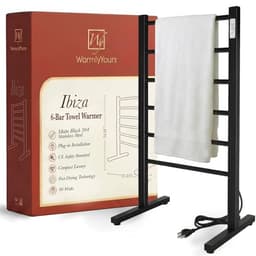
2. The safer way to heat a bathroom
WarmlyYours Ibiza Freestanding Towel Warmer
WarmlyYours · TWS5-IBZ06PP · best for continuous gentle warmth with no 1500 w load
90 W, cULus listed, with published overheat protection capped at 149°F — a fraction of the power and a stated ceiling.
Worth putting on the table: the safest bathroom heater may not be a heater.
The Ibiza towel rail publishes “90 W” and “307 Btu” per hour, cULus listed, with “built-in TempSmart overheat protection” capped at “149°F (65°C)”.
Ninety watts against 1500 is a different order of appliance. There is no fan, no glowing element, no 1500 W draw on a bathroom circuit, and the surface temperature has a published ceiling enforced by a device.
It will not warm a cold room in five minutes. It will keep the room above the dew point and your towels dry, which for many people is the actual complaint.
Renter-Safe Install Rating
- Drilling
- None
- Tools
- None
- Time to fit
- Not published
- Power
- Standard outlet
- Reversible on move-out
- Fully
Why: WarmlyYours publishes this one as freestanding with a NEMA 5-15 plug: it stands on the floor, plugs into a normal outlet, and leaves with you.
Read from published documentation, not from fitting one. WarmlyYours, Ibiza Freestanding Towel Warmer (TWS5-IBZ06PP). How the verdict is derived: renter-safe ratings explained.
What it costs to run — Electricity
- Rated power
- 90 W (WarmlyYours’s published figure)
- Run time
- 2 hours a day on a plug-in timer
- Electricity rate
- 18.34 cents per kWh (US residential average, June 2026)
90 W x 2 h / 1000 x $0.1834 = $0.033 a day
About 3 cents a day, or roughly $12 a year on a two-hour daily timer
Arithmetic on published specifications, not a measurement. Rate source: U.S. Energy Information Administration, Electric Power Monthly Table 5.6.A — US residential average 18.34 cents/kWh, June 2026.
What’s wrong with it
It is not a room heater. If you want the bathroom warm quickly before a shower, 90 W will not do it.
What we can’t tell you
No published warm-up time.
Published specifications
| Wattage | “90 W” |
|---|---|
| Supply | “120 V”, “0.75 A” |
| Heat output | “307 Btu” per hour |
| Bars | “6” heated bars |
| Dimensions | “34.84″ (885 mm) H x 21.85″ (555 mm) W x 13.97″ (355 mm) D” |
| Material | “304-stainless steel”, published in “Polished Stainless Steel” and “Matte Black” finishes |
| Cord and plug | “71″” cord, “NEMA 5-15 (Type B)” |
| Mounting | “Freestanding” — no wall mounting or drilling |
| Safety | “built-in TempSmart overheat protection” preventing surface temperatures above “149°F (65°C)” |
| Certification | “cULus Listed” |
| Warranty | “5-year limited warranty” |
Source: WarmlyYours, Ibiza Freestanding Towel Warmer (TWS5-IBZ06PP)
#ad Price $351.00 as of October 18, 2026. Prices change; Amazon’s listing is the one that counts. How we’re funded.
The one to skip
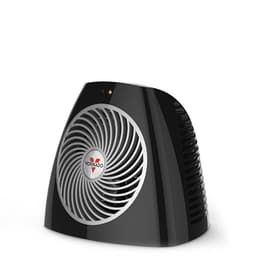
Vornado VH202 Personal Space Heater
Vornado · VH202 · best for a bedroom or a study, where it is a good heater
Good safety features and no published ALCI plug or bathroom rating — Vornado does not market it for this room.
This is the skip, and it is not because the VH202 is a bad heater. It is because of what Vornado does not say about it.
Vornado publishes real safety engineering: “a tipover switch that immediately cuts the heat and fan if the heater tips”, “a cool touch case that doesn’t get hot even after extended operation”, two heat settings and a fan-only mode, in a unit that “occupies less than 8″ in any direction”.
What is absent is the bathroom-specific part. There is no published ALCI plug, no published bathroom rating, and Vornado does not market it as a bathroom heater. Nor does it publish a wattage on the product page.
In a category where one specification is the difference between a protected appliance and an unprotected one in a wet room, absence is the answer. It is a good heater for a bedroom.
Renter-Safe Install Rating
- Drilling
- None
- Tools
- None
- Time to fit
- None
- Power
- Standard outlet
- Reversible on move-out
- Fully
Why: Nothing is fitted — it stands on the floor and plugs in. The renter question is settled; the bathroom question is not, and we say so in the write-up.
Read from published documentation, not from fitting one. Vornado, VH202 Personal Space Heater. How the verdict is derived: renter-safe ratings explained.
What’s wrong with it
No published ALCI plug, no published bathroom rating, and no published wattage. All three matter here.
What we can’t tell you
Wattage and any bathroom suitability rating are both unpublished.
Published specifications
| Heat settings | “2 heat settings (Low/High) giving you control of your heat. A ‘fan only’ mode” |
|---|---|
| Tip-over protection | “a tipover switch that immediately cuts the heat and fan if the heater tips” |
| Case | “a cool touch case that doesn’t get hot even after extended operation” |
| Size | “occupies less than 8″ in any direction” |
| Warranty | “3-Year Satisfaction Guarantee”; “If any product defects are discovered within 5 years of the purchase date, Vornado will replace the product” |
| Wattage | Not published on the product page |
| ALCI / bathroom rating | Not published — Vornado does not market this as a bathroom heater |
There is no buy button on this one. It is easy enough to find if you want it anyway — we would rather point you at something that is still on the wall in a year.
Where to buy
Everything recommended on this page, in one place. Each link is an Amazon Associates link — we earn a commission at no extra cost to you, and it never decides a pick.
- Check price on Amazon
Lasko 8″ Bathroom Ceramic Heater with ALCI Plug
Lasko · CD08200 · Renter verdict: Safe
- $351.00View on Amazon
WarmlyYours Ibiza Freestanding Towel Warmer
WarmlyYours · TWS5-IBZ06PP · Renter verdict: Safe
#ad Prices are not shown because we only publish figures we have verified on the day. How we’re funded.
Questions people actually ask
are space heaters safe in bathrooms
Only ones designed for it. Look for a published ALCI or GFCI plug — a ground-fault interrupter built into the heater's own plug — plus an explicit bathroom statement from the maker. Lasko publishes both for the CD08200; most general-purpose heaters publish neither.
what is an alci plug
An Appliance Leakage Current Interrupter: a ground-fault detector built into the plug itself. It compares current going out with current coming back and cuts power in a fraction of a second if they differ. Because it is part of the appliance, it works regardless of what the outlet is.
can you use an extension cord with a bathroom heater
No. A 1500 W load exceeds what many domestic leads carry continuously, a lead across a wet floor is a trip hazard in the room where falls are most common, and it can defeat the outlet's own protection. If it does not reach, move the heater.
is a heated towel rail safer than a space heater
It is a much smaller appliance in every sense: 90 W against 1500, no fan, no exposed element, and WarmlyYours publishes overheat protection capped at 149°F. It will not warm a cold room quickly, but it keeps the room above the dew point.
Sources
- Lasko — CD08200, published ALCI safety plug, ETL listing, wattage and bathroom design statement
- Vornado — VH202 Personal Space Heater, published tipover switch and cool-touch case
- WarmlyYours — Ibiza, published wattage, cULus listing and 149F overheat cap
- U.S. Energy Information Administration, Electric Power Monthly Table 5.6.A — US residential average 18.34 cents/kWh, June 2026
Read next
Back to Warmers & Comfort.