Are heated towel rails safe?
Four things to check, all of them published by the good manufacturers and absent from the rest. Here is what each one means.
By Sawyer V. · · How we research
The short answer
We earn a commission if you buy through the links on this page, at no extra cost to you. It does not change which products we pick or what we say about them — here is exactly how that works.
Quick picks
Tap any row for the full write-up. Prices are checked against Amazon rather than remembered — where we have no verified figure the button says so.
| # | Product | Best for | Renter | Price |
|---|---|---|---|---|
| 1 |  WarmlyYours Ibiza Freestanding Towel Warmer cULus listed with published TempSmart overheat protection capping surface temperature at 149°F. | Knowing what has been checked | Safe | |
| 2 | No photo yet WarmlyYours Palma Wall-Mounted Plug-In Towel Warmer cULus listed, wall-mounted so nothing can tip it, and plug-in rather than hardwired. | Getting it off the floor | Owner-only | |
| 3 | No photo yet Lasko 8″ Bathroom Ceramic Heater with ALCI Plug Published as designed specifically for bathroom use, with an integrated ALCI plug — the standard other products should be judged against. | Understanding what a bathroom rating looks like | Safe |
1. A real certification
A UL, cULus or ETL listing means an independent laboratory has tested the product against a published safety standard. It is the single most useful signal available to a buyer, because it does not depend on trusting the manufacturer’s own description.
WarmlyYours publishes cULus listings on both rails. VEVOR publishes “ETL & FCC-certified” on its bucket. Lasko publishes ETL. Zadro and Brookstone publish no certification we could find.
Absence is not proof of danger — certification costs money and smaller brands skip it — but it does mean nobody outside the company has verified the product against a standard. For a mains appliance in the wettest room in the house, we would weigh that heavily.
2. A published surface temperature
A heated rail gets warm by design. The question is how warm, and the good manufacturers answer it in a number.
WarmlyYours publishes overheat protection capping the Ibiza at “149°F (65°C)”. VEVOR publishes an overheat indicator that turns red above “60°C/140°F”. Those are checkable statements.
Why it matters: 149°F is hot enough to be uncomfortable but is a deliberately limited figure, and knowing it is limited is the point. A rail with no published limit is a rail whose behavior under fault conditions you have to take on trust.
3. How it connects to power
Plug-in is the safer arrangement for a non-professional, and both WarmlyYours rails are published this way with a NEMA 5-15 plug. You can unplug it. There is no permanent connection to get wrong, and no work behind a wall.
Hardwired is a permanent electrical connection and needs an electrician, and in most jurisdictions a permit. It is not less safe when done properly — it is more permanent, and it is not a DIY job.
An ALCI plug, which Lasko publishes on its bathroom heater, is a ground-fault interrupter built into the plug so the appliance protects itself rather than relying on the outlet. No towel warmer we researched publishes one, which is worth knowing — towel rails draw far less current than a heater, but the room is just as wet.
4. Where you put it
This is the part that is entirely up to you, and where most of the real risk lives.
Not where it can be pulled into a bath. A freestanding rail on a cord next to a bathtub is the arrangement to avoid. WarmlyYours publishes a 71-inch cord on both rails, which gives you room to place it sensibly rather than at the nearest outlet.
Not on a cord that crosses a wet floor. Trip hazard, and a cord lying in water is a cord degrading.
Never on an extension lead. Same rule as everywhere else in a bathroom. If the cord does not reach, move the rail.
With clearance around it. A rail needs air to move around the bars. Jammed into a corner with a laundry basket against it, it cannot shed heat the way it was designed to.
Towels on a rail: the question people ask
Is it safe to leave towels draped on a heated rail? Yes — that is the entire purpose of the product, and a rail limited to 149°F is nowhere near the ignition temperature of cotton.
The sensible caveats are about performance rather than danger. Do not bury the rail under a thick pile of laundry, because it cannot dry what it cannot reach, and the bars underneath stay damp. Drape rather than fold, so air gets to both faces of the towel.
Children and pets
The published temperature caps exist precisely for this. 149°F is uncomfortable to touch for more than a moment and is not going to injure a child in the way a radiator or a hot tap can, which is why the limit is set where it is.
For buckets the concern is different and better addressed: a container of very hot air with a lid is a thing small children investigate. VEVOR publishes a “Child Lock” for exactly that reason, and it is the feature to look for if there are children in the house.
What we cannot tell you
We have not tested any of these, we have no laboratory, and we have not measured a surface temperature. Everything above is what the manufacturers publish and what the certifications mean.
That is also the argument for buying certified products: a cULus or ETL listing is somebody with a laboratory doing the thing we cannot do. Our contribution is telling you which products have one and which do not.
Every pick in full
3 we would buy. Each carries its Renter-Safe Install Rating, the published specs behind it, and the honest gap in what we know.
1. Best published safety spec
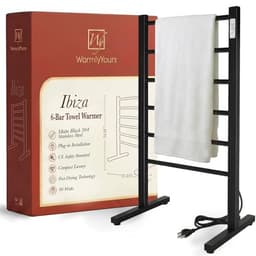
WarmlyYours Ibiza Freestanding Towel Warmer
WarmlyYours · TWS5-IBZ06PP · best for knowing what has been checked
cULus listed with published TempSmart overheat protection capping surface temperature at 149°F.
This is what a well-documented product looks like. WarmlyYours publishes “cULus Listed” — independently tested to a North American safety standard — and “built-in TempSmart overheat protection” preventing surface temperatures exceeding “149°F (65°C)”.
That temperature figure is the one to look for if there are children in the house. A number you can read is worth considerably more than an assurance that a product is “safe”.
It is also freestanding on a standard plug, so there is no wiring and no wall fixing to get wrong.
Renter-Safe Install Rating
- Drilling
- None
- Tools
- None
- Time to fit
- Not published
- Power
- Standard outlet
- Reversible on move-out
- Fully
Why: WarmlyYours publishes this one as freestanding with a NEMA 5-15 plug: it stands on the floor, plugs into a normal outlet, and leaves with you.
Read from published documentation, not from fitting one. WarmlyYours, Ibiza Freestanding Towel Warmer (TWS5-IBZ06PP). How the verdict is derived: renter-safe ratings explained.
What it costs to run — Electricity
- Rated power
- 90 W (WarmlyYours’s published figure)
- Run time
- 2 hours a day on a plug-in timer
- Electricity rate
- 18.34 cents per kWh (US residential average, June 2026)
90 W x 2 h / 1000 x $0.1834 = $0.033 a day
About 3 cents a day, or roughly $12 a year on a two-hour daily timer
Arithmetic on published specifications, not a measurement. Rate source: U.S. Energy Information Administration, Electric Power Monthly Table 5.6.A — US residential average 18.34 cents/kWh, June 2026.
What’s wrong with it
Freestanding means it can be knocked over, which a wall-mounted rail cannot.
What we can’t tell you
No published warm-up time or bar temperature during normal operation.
Published specifications
| Wattage | “90 W” |
|---|---|
| Supply | “120 V”, “0.75 A” |
| Heat output | “307 Btu” per hour |
| Bars | “6” heated bars |
| Dimensions | “34.84″ (885 mm) H x 21.85″ (555 mm) W x 13.97″ (355 mm) D” |
| Material | “304-stainless steel”, published in “Polished Stainless Steel” and “Matte Black” finishes |
| Cord and plug | “71″” cord, “NEMA 5-15 (Type B)” |
| Mounting | “Freestanding” — no wall mounting or drilling |
| Safety | “built-in TempSmart overheat protection” preventing surface temperatures above “149°F (65°C)” |
| Certification | “cULus Listed” |
| Warranty | “5-year limited warranty” |
Source: WarmlyYours, Ibiza Freestanding Towel Warmer (TWS5-IBZ06PP)
#ad Price $351.00 as of October 18, 2026. Prices change; Amazon’s listing is the one that counts. How we’re funded.
2. Safest mounting
WarmlyYours Palma Wall-Mounted Plug-In Towel Warmer
WarmlyYours · TWS2-PLM04PP · best for getting it off the floor
cULus listed, wall-mounted so nothing can tip it, and plug-in rather than hardwired.
A wall-mounted rail removes the two hazards a freestanding one has: it cannot be knocked over and there is no cord running across a wet floor. WarmlyYours publishes cULus listing, 60 W, 120 V and a NEMA 5-15 plug, with an included hardware kit.
Plug-in rather than hardwired means no electrician and no permanent connection — you can simply unplug it, which is a genuine safety feature in itself.
Renter-Safe Install Rating
- Drilling
- Required
- Tools
- Drill
- Time to fit
- Not published
- Power
- Standard outlet
- Reversible on move-out
- With patching
Why: WarmlyYours ships it with a wall-mount hardware kit, which means anchors in tile or drywall. The plug end is renter-friendly; the bracket end leaves four holes you would have to make good.
Read from published documentation, not from fitting one. WarmlyYours, Palma Towel Warmer (TWS2-PLM04PP). How the verdict is derived: renter-safe ratings explained.
What it costs to run — Electricity
- Rated power
- 60 W (WarmlyYours’s published figure)
- Run time
- 24 hours a day, the way most people actually leave them
- Electricity rate
- 18.34 cents per kWh (US residential average, June 2026)
60 W x 24 h / 1000 x $0.1834 = $0.264 a day
About 26 cents a day left on permanently — roughly $96 a year
Arithmetic on published specifications, not a measurement. Rate source: U.S. Energy Information Administration, Electric Power Monthly Table 5.6.A — US residential average 18.34 cents/kWh, June 2026.
What’s wrong with it
It drills, which makes it an owner's product rather than a renter's.
What we can’t tell you
WarmlyYours does not publish a surface-temperature limit for the Palma specifically.
Published specifications
| Wattage | “60 W” |
|---|---|
| Supply | “120 V”, “0.5 A” |
| Heat output | “205 Btu” per hour |
| Bars | “4” heated bars, “Square” profile |
| Dimensions | “19.68″” H x “17.71″” W x “4.33″” D |
| Material | “304-stainless steel”, “Polished Stainless Steel” finish |
| Cord and plug | “71″” cord, “NEMA 5-15 (Type B)” |
| Mounting | “Wall Mounted”, “Plug-in”, shipped with an “installation manual and hardware kit” |
| Certification | “cULus listed” |
| Warranty | “5-year limited warranty” |
#ad We have no verified live price for this one right now, so we are not showing a number. How we’re funded.
3. The bathroom-rated comparison
Lasko 8″ Bathroom Ceramic Heater with ALCI Plug
Lasko · CD08200 · best for understanding what a bathroom rating looks like
Published as designed specifically for bathroom use, with an integrated ALCI plug — the standard other products should be judged against.
Worth including here as a reference point. Lasko publishes that the CD08200’s “integrated ALCI safety plug, overheat protection, a self-regulating ceramic element, and a cool-touch exterior are designed specifically for bathroom use”, and it is ETL listed.
That is the most explicit bathroom-safety statement of any product on this site. When you are comparing two similar-looking appliances, the presence or absence of that kind of language is the most informative difference between them.
Renter-Safe Install Rating
- Drilling
- None
- Tools
- None
- Time to fit
- None — “fully assembled” and “requires no tools”
- Power
- Standard outlet, via the heater’s own ALCI plug
- Reversible on move-out
- Fully
Why: It plugs in and sits on the floor. The ALCI plug is the heater’s own protective device, so it does not need an outlet upgrade to be used as designed.
Read from published documentation, not from fitting one. Lasko, 8″ Bathroom Ceramic Heater CD08200. How the verdict is derived: renter-safe ratings explained.
What it costs to run — Electricity
- Rated power
- 1500 W on high (Lasko’s published maximum)
- Run time
- 15 minutes while you shower and dry off
- Electricity rate
- 18.34 cents per kWh (US residential average, June 2026)
1500 W x 0.25 h / 1000 x $0.1834 = $0.069
About 7 cents a shower — and about 28 cents an hour if you forget the timer
Arithmetic on published specifications, not a measurement. Rate source: U.S. Energy Information Administration, Electric Power Monthly Table 5.6.A — US residential average 18.34 cents/kWh, June 2026.
What’s wrong with it
It is a heater rather than a towel warmer, and at 1500 W it is a much bigger load.
What we can’t tell you
No published heat-up time or temperature rise.
Published specifications
| Wattage | “900 W to 1500 W” |
|---|---|
| Supply | “120 V”, “7.5 A to 12.5 A” |
| Heat settings | Two, high and low |
| Bathroom safety | “an integrated ALCI safety plug, overheat protection, a self-regulating ceramic element, and a cool-touch exterior are designed specifically for bathroom use” |
| Timer | 1-hour auto-shutoff via the Simple Heat button |
| Dimensions | “8.00 in” high, “6.25 in” wide and deep |
| Weight | “3.35 lb” |
| Coverage | Up to 100 sq ft |
| Certification | ETL Listed |
| Warranty | “3 year warranty” |
#ad We have no verified live price for this one right now, so we are not showing a number. How we’re funded.
Where to buy
Everything recommended on this page, in one place. Each link is an Amazon Associates link — we earn a commission at no extra cost to you, and it never decides a pick.
- $351.00View on Amazon
WarmlyYours Ibiza Freestanding Towel Warmer
WarmlyYours · TWS5-IBZ06PP · Renter verdict: Safe
- Check price on Amazon
WarmlyYours Palma Wall-Mounted Plug-In Towel Warmer
WarmlyYours · TWS2-PLM04PP · Renter verdict: Owner-only
- Check price on Amazon
Lasko 8″ Bathroom Ceramic Heater with ALCI Plug
Lasko · CD08200 · Renter verdict: Safe
#ad Prices are not shown because we only publish figures we have verified on the day. How we’re funded.
Questions people actually ask
are heated towel rails safe
Ones with a published certification and a stated surface-temperature limit are designed to be. WarmlyYours publishes cULus listing and a TempSmart cap of 149°F on the Ibiza. Look for the listing, the temperature figure, a plug-in rather than hardwired connection, and sensible placement.
heated towel rail how to bleed
Only hydronic rails — ones plumbed into a hot-water heating system — need bleeding. Every product covered on this site is electric, sealed and has nothing to bleed. If yours has a bleed valve, it is a plumbed radiator rather than an electric towel warmer.
towel warmer how to turn on
Electric rails have a switch on the unit or simply run whenever they are plugged in, which is why a plug-in timer is worth having. Buckets have a control panel with timer settings and shut off automatically at the end of a cycle.
Sources
Read next
Back to Warmers & Comfort.