Plug-in vs hardwired towel warmers
One of these you can fit this afternoon. The other needs an electrician, a permit in most places, and a bathroom you own.
By Sawyer V. · · How we research
The short answer
We earn a commission if you buy through the links on this page, at no extra cost to you. It does not change which products we pick or what we say about them — here is exactly how that works.
Quick picks
Tap any row for the full write-up. Prices are checked against Amazon rather than remembered — where we have no verified figure the button says so.
| # | Product | Best for | Renter | Price |
|---|---|---|---|---|
| 1 |  WarmlyYours Ibiza Freestanding Towel Warmer Freestanding, NEMA 5-15 plug, 71-inch cord — the most fittable towel warmer on this site. | No electrician, no drilling, no lease problem | Safe | |
| 2 | No photo yet WarmlyYours Palma Wall-Mounted Plug-In Towel Warmer Wall-mounted but still plug-in — the middle path, if you own the bathroom and can drill. | A tidy wall without an electrician | Owner-only |
What the two actually mean
Plug-in ends in an ordinary plug and goes into an ordinary outlet. WarmlyYours publishes NEMA 5-15 — the standard three-pin American domestic plug — on both of its rails. No electrical work of any kind.
Hardwired connects permanently to your electrical system, usually into a junction box behind the rail so no cord is visible. That is electrician work, and in most jurisdictions it means a permit and an inspection.
Note that plug-in and wall-mounted are not opposites. A rail can be screwed to the wall and still plug in, which is exactly what the Palma does — and it is the option most people overlook.
The case for plug-in
No electrician. The install cost is zero, or the price of a drill bit.
You can unplug it. Genuinely useful and genuinely a safety feature: a plug is an isolation point you can operate without a screwdriver.
A timer becomes possible. This one is bigger than it looks. Neither WarmlyYours rail has a built-in timer, and a $10 plug-in timer takes the Ibiza from about 40 cents a day to about three. You cannot do that with a hardwired rail without a wired timer module and, again, an electrician. The arithmetic is here.
It moves. To another wall, another room, another home.
It does not need permission. Plugging in an appliance is not an alteration to anyone’s property.
The case for hardwired
No visible cord. This is the real reason people choose it, and it is a fair one — a cord snaking down a tiled wall does undercut the look.
No outlet needed nearby. If there is no socket within cord reach, hardwiring is a legitimate solution rather than a stylistic one.
It can be wired to a wall switch. Convenient, and it puts control at the door rather than behind the rail.
Higher-output rails are often hardwired only. The larger rails in this category frequently do not come in a plug-in version at all.
Cost, honestly
The rails themselves cost about the same either way; some manufacturers sell a “dual-connect” model that can be either.
The difference is labour, and we are not going to quote you a figure. Electrical rates vary by a factor of three across the country and by more between a simple job and one that needs a new circuit run. Any number we published would be someone’s wrong number, and we would rather tell you that than invent an average.
What we will say plainly: for a plug-in rail the installation cost is zero, and for a hardwired one it is the largest single cost of the project. That ratio does not change wherever you live.
The renter answer is not a judgment call
Hardwiring is a permanent alteration to a property’s electrical system. It is categorically not a renter’s decision, it is not reversible, and no lease we have ever read would treat it as anything other than a landlord matter.
Freestanding plug-in is the renter answer, and it is a good one. WarmlyYours publishes the Ibiza with a 71-inch cord, which is generous enough to reach a sensible outlet from a sensible position — and the whole thing scores Safe on our install rating.
The rule that applies to both
Do not solve a reach problem with an extension lead. A permanently-installed appliance on a general-purpose extension in a bathroom is exactly what neither manufacturers nor electrical codes intend.
If the cord will not reach, the options are: move the rail, choose a freestanding model you can position freely, or have an outlet added properly. Not a lead across the floor.
Every pick in full
2 we would buy. Each carries its Renter-Safe Install Rating, the published specs behind it, and the honest gap in what we know.
1. Best plug-in
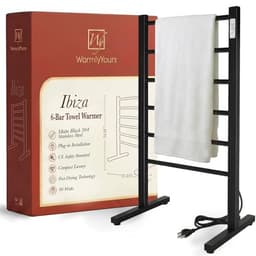
WarmlyYours Ibiza Freestanding Towel Warmer
WarmlyYours · TWS5-IBZ06PP · best for no electrician, no drilling, no lease problem
Freestanding, NEMA 5-15 plug, 71-inch cord — the most fittable towel warmer on this site.
This is the maximum-flexibility answer. WarmlyYours publishes the Ibiza as “Freestanding” with a “NEMA 5-15 (Type B)” plug and a 71-inch cord. No wall fixing and no electrical work: it stands up and plugs in.
Being able to unplug it matters more than it sounds. You can take it out of the room, put it in a cupboard for the summer, and move it to the next flat.
Renter-Safe Install Rating
- Drilling
- None
- Tools
- None
- Time to fit
- Not published
- Power
- Standard outlet
- Reversible on move-out
- Fully
Why: WarmlyYours publishes this one as freestanding with a NEMA 5-15 plug: it stands on the floor, plugs into a normal outlet, and leaves with you.
Read from published documentation, not from fitting one. WarmlyYours, Ibiza Freestanding Towel Warmer (TWS5-IBZ06PP). How the verdict is derived: renter-safe ratings explained.
What it costs to run — Electricity
- Rated power
- 90 W (WarmlyYours’s published figure)
- Run time
- 2 hours a day on a plug-in timer
- Electricity rate
- 18.34 cents per kWh (US residential average, June 2026)
90 W x 2 h / 1000 x $0.1834 = $0.033 a day
About 3 cents a day, or roughly $12 a year on a two-hour daily timer
Arithmetic on published specifications, not a measurement. Rate source: U.S. Energy Information Administration, Electric Power Monthly Table 5.6.A — US residential average 18.34 cents/kWh, June 2026.
What’s wrong with it
The cord is visible and it stands on the floor. Neither is elegant.
What we can’t tell you
No published warm-up time.
Published specifications
| Wattage | “90 W” |
|---|---|
| Supply | “120 V”, “0.75 A” |
| Heat output | “307 Btu” per hour |
| Bars | “6” heated bars |
| Dimensions | “34.84″ (885 mm) H x 21.85″ (555 mm) W x 13.97″ (355 mm) D” |
| Material | “304-stainless steel”, published in “Polished Stainless Steel” and “Matte Black” finishes |
| Cord and plug | “71″” cord, “NEMA 5-15 (Type B)” |
| Mounting | “Freestanding” — no wall mounting or drilling |
| Safety | “built-in TempSmart overheat protection” preventing surface temperatures above “149°F (65°C)” |
| Certification | “cULus Listed” |
| Warranty | “5-year limited warranty” |
Source: WarmlyYours, Ibiza Freestanding Towel Warmer (TWS5-IBZ06PP)
#ad Price $351.00 as of October 19, 2026. Prices change; Amazon’s listing is the one that counts. How we’re funded.
2. Best wall-mounted plug-in
WarmlyYours Palma Wall-Mounted Plug-In Towel Warmer
WarmlyYours · TWS2-PLM04PP · best for a tidy wall without an electrician
Wall-mounted but still plug-in — the middle path, if you own the bathroom and can drill.
The Palma is the compromise a lot of people are actually looking for: WarmlyYours publishes it as “Wall Mounted” and “Plug-in”, shipping with an “installation manual and hardware kit”.
You get the built-in look and the floor space back, without an electrician, a permit or a junction box. The cost is four anchors in your tile, which makes it Owner-only on our install rating.
Renter-Safe Install Rating
- Drilling
- Required
- Tools
- Drill
- Time to fit
- Not published
- Power
- Standard outlet
- Reversible on move-out
- With patching
Why: WarmlyYours ships it with a wall-mount hardware kit, which means anchors in tile or drywall. The plug end is renter-friendly; the bracket end leaves four holes you would have to make good.
Read from published documentation, not from fitting one. WarmlyYours, Palma Towel Warmer (TWS2-PLM04PP). How the verdict is derived: renter-safe ratings explained.
What it costs to run — Electricity
- Rated power
- 60 W (WarmlyYours’s published figure)
- Run time
- 24 hours a day, the way most people actually leave them
- Electricity rate
- 18.34 cents per kWh (US residential average, June 2026)
60 W x 24 h / 1000 x $0.1834 = $0.264 a day
About 26 cents a day left on permanently — roughly $96 a year
Arithmetic on published specifications, not a measurement. Rate source: U.S. Energy Information Administration, Electric Power Monthly Table 5.6.A — US residential average 18.34 cents/kWh, June 2026.
What’s wrong with it
It drills, and the cord still has to run from the rail to an outlet.
What we can’t tell you
No published surface-temperature limit for this model.
Published specifications
| Wattage | “60 W” |
|---|---|
| Supply | “120 V”, “0.5 A” |
| Heat output | “205 Btu” per hour |
| Bars | “4” heated bars, “Square” profile |
| Dimensions | “19.68″” H x “17.71″” W x “4.33″” D |
| Material | “304-stainless steel”, “Polished Stainless Steel” finish |
| Cord and plug | “71″” cord, “NEMA 5-15 (Type B)” |
| Mounting | “Wall Mounted”, “Plug-in”, shipped with an “installation manual and hardware kit” |
| Certification | “cULus listed” |
| Warranty | “5-year limited warranty” |
#ad We have no verified live price for this one right now, so we are not showing a number. How we’re funded.
Where to buy
Everything recommended on this page, in one place. Each link is an Amazon Associates link — we earn a commission at no extra cost to you, and it never decides a pick.
- $351.00View on Amazon
WarmlyYours Ibiza Freestanding Towel Warmer
WarmlyYours · TWS5-IBZ06PP · Renter verdict: Safe
- Check price on Amazon
WarmlyYours Palma Wall-Mounted Plug-In Towel Warmer
WarmlyYours · TWS2-PLM04PP · Renter verdict: Owner-only
#ad Prices are not shown because we only publish figures we have verified on the day. How we’re funded.
Questions people actually ask
plug in towel warmer
One that ends in an ordinary domestic plug — WarmlyYours publishes NEMA 5-15 on both of its rails. No electrician, no permit, and you can add an inexpensive plug-in timer, which is what actually determines the running cost.
hardwired towel warmer
One wired permanently into your electrical system, usually via a junction box so no cord shows. It looks cleaner and needs an electrician and, in most places, a permit. It is not a renter's option.
heated towel rack installation cost
Zero for freestanding, and just your time for a wall-mounted plug-in model. Hardwiring is the only version with a real installation cost, and it varies too much by region for us to quote a figure honestly.
Sources
Read next
Back to Warmers & Comfort.