Hydronic vs electric towel warmers
One is plumbing, the other is a plug. The difference decides who can install it, what it costs to run, and whether you can buy it at all.
By Sawyer V. · · How we research
The short answer
We earn a commission if you buy through the links on this page, at no extra cost to you. It does not change which products we pick or what we say about them — here is exactly how that works.
Quick picks
Tap any row for the full write-up. Prices are checked against Amazon rather than remembered — where we have no verified figure the button says so.
| # | Product | Best for | Renter | Price |
|---|---|---|---|---|
| 1 |  WarmlyYours Ibiza Freestanding Towel Warmer 90 W on a NEMA 5-15 plug, freestanding, with the running cost calculable to the cent. | Any bathroom with an outlet | Safe | |
| 2 |  Grande 10 Towel Warmer, Brushed, Hardwired, 10 Bars 10 bars at 155 W, hardwired by an electrician, with no cord showing and no plumbing touched. | A remodel where the wires can be buried | Owner-only |
What each one actually is
A hydronic towel warmer is a radiator. WarmlyYours describes them as “hydronic (water-filled) towel warmers that connect to a home’s hot water system”: hot water circulates through the bars, so the rail is part of the plumbing.
An electric towel warmer heats itself. WarmlyYours puts the practical difference plainly: electric “models plug into a standard outlet or wire directly into the wall — making them far easier to install in any bathroom”, across a published “Wattage range: 60–240W”.
Installation: a plumber against a plug
This is the whole comparison. A plug-in electric rail is a plug; a hardwired one is an electrician. A hydronic rail has to be tied into a circulating hot water loop, and Amba, one of the few makers offering the option, publishes what that takes: “The hydronic version requires a valve kit so it can connect to a circulating water system.”
Two consequences follow. A hydronic rail is only sensible while a bathroom is already open for plumbing work, and it is never a tenant’s change — it rates Owner-only on our install rating before you even look at the model.
Availability: the part nobody mentions
Hydronic is a minority format in US bathrooms, and the catalogs show it. Amba states that “Jeeves can be ordered as a hydronic special-order option” and that “This is a Jeeves-specific special-order option, not a general option across the full Amba lineup.” WarmlyYours’ towel warmers are electric.
That is why this site ranks no hydronic rail: we only cover products that are currently purchasable with published specifications, and a special order with no public spec sheet is neither.
Running cost: one you can calculate, one you cannot
Electric rails publish watts, and watts turn into money. At 18.34 cents per kWh, the 90 W Ibiza is about three cents a day on a two-hour timer, and a 60 W rail left on permanently is about 26 cents a day — roughly $96 a year.
A hydronic rail has no wattage. Its cost depends on the fuel your water heater or boiler burns, its efficiency, and whether the loop runs in summer for the towel rail alone. We will not publish an estimate dressed up as a figure; nobody can give you that number from a spec sheet. Whether a towel warmer is worth it at all is answered here.
Which to choose
- You rent, or you want it this week: plug-in electric. Nothing is fixed, and the rail leaves with you.
- You are remodeling and want no cord: hardwired electric, fitted by an electrician at least 24 in. from a wet location.
- Your bathroom is being replumbed and already has a circulating loop: a hydronic rail is worth pricing with your plumber, as a special order.
What we cannot tell you
Neither maker publishes a heat-up time comparison between the two formats, and no hydronic rail we found publishes a surface temperature the way WarmlyYours does for its electric rails (149°F on the Infinity). Anyone claiming a hydronic rail is warmer, cheaper or faster is not reading it off a spec sheet.
Every pick in full
2 we would buy. Each carries its Renter-Safe Install Rating, the published specs behind it, and the honest gap in what we know.
1. The electric answer
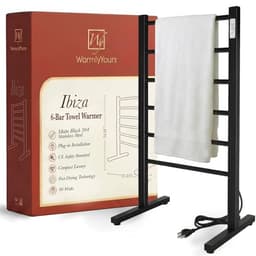
WarmlyYours Ibiza Freestanding Towel Warmer
WarmlyYours · TWS5-IBZ06PP · best for any bathroom with an outlet
90 W on a NEMA 5-15 plug, freestanding, with the running cost calculable to the cent.
Everything that makes electric the default is on this spec sheet: the Ibiza publishes “90 W”, “120 V”, a “71″” cord on a “NEMA 5-15 (Type B)” plug, and “Freestanding” mounting.
Because the wattage is published, so is the bill: about three cents a day on a two-hour timer at 18.34 cents per kWh. No hydronic rail can tell you that, because its heat comes from whatever your boiler is burning.
Renter-Safe Install Rating
- Drilling
- None
- Tools
- None
- Time to fit
- Not published
- Power
- Standard outlet
- Reversible on move-out
- Fully
Why: WarmlyYours publishes this one as freestanding with a NEMA 5-15 plug: it stands on the floor, plugs into a normal outlet, and leaves with you.
Read from published documentation, not from fitting one. WarmlyYours, Ibiza Freestanding Towel Warmer (TWS5-IBZ06PP). How the verdict is derived: renter-safe ratings explained.
What it costs to run — Electricity
- Rated power
- 90 W (WarmlyYours’s published figure)
- Run time
- 2 hours a day on a plug-in timer
- Electricity rate
- 18.34 cents per kWh (US residential average, June 2026)
90 W x 2 h / 1000 x $0.1834 = $0.033 a day
About 3 cents a day, or roughly $12 a year on a two-hour daily timer
Arithmetic on published specifications, not a measurement. Rate source: U.S. Energy Information Administration, Electric Power Monthly Table 5.6.A — US residential average 18.34 cents/kWh, June 2026.
What’s wrong with it
It needs an outlet near where the rail stands, and the cord is 71 in.
What we can’t tell you
WarmlyYours publishes no surface temperature for the Ibiza's freestanding models on this page.
Published specifications
| Wattage | “90 W” |
|---|---|
| Supply | “120 V”, “0.75 A” |
| Heat output | “307 Btu” per hour |
| Bars | “6” heated bars |
| Dimensions | “34.84″ (885 mm) H x 21.85″ (555 mm) W x 13.97″ (355 mm) D” |
| Material | “304-stainless steel”, published in “Polished Stainless Steel” and “Matte Black” finishes |
| Cord and plug | “71″” cord, “NEMA 5-15 (Type B)” |
| Mounting | “Freestanding” — no wall mounting or drilling |
| Safety | “built-in TempSmart overheat protection” preventing surface temperatures above “149°F (65°C)” |
| Certification | “cULus Listed” |
| Warranty | “5-year limited warranty” |
Source: WarmlyYours, Ibiza Freestanding Towel Warmer (TWS5-IBZ06PP)
#ad Price $351.00 as of October 18, 2026. Prices change; Amazon’s listing is the one that counts. How we’re funded.
2. The electric rail that looks plumbed in
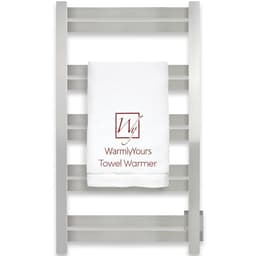
Grande 10 Towel Warmer, Brushed, Hardwired, 10 Bars
WarmlyYours · TWS6-GRD10BH · best for a remodel where the wires can be buried
10 bars at 155 W, hardwired by an electrician, with no cord showing and no plumbing touched.
Most people who want the clean look of a hydronic rail actually want a hardwired electric one. The Grande 10 publishes 155 W at 120 V, 10 flat bars, and a mounting footprint of 19 x 27-1/8 in.
WarmlyYours specifies installation by a “professional who is certified to do electrical wiring” and “at least 24" away from a wet location”. That is an electrician for an afternoon, not a plumber and a boiler loop. Plug-in against hardwired is compared here.
Renter-Safe Install Rating
- Drilling
- Required
- Tools
- Not published
- Time to fit
- Not published
- Power
- Hardwired
- Reversible on move-out
- No
Why: A GFCI-protected hardwired circuit and a certified electrician, by WarmlyYours' own terms. Not a tenant's change.
Read from published documentation, not from fitting one. WarmlyYours — Grande 10 hardwired towel warmer TWS6-GRD10BH support page. How the verdict is derived: renter-safe ratings explained.
What it costs to run — Electricity
- Power
- 155 W (published)
- Use
- 24 hours a day (left on)
- Rate
- 18.34 cents per kWh (US residential average, June 2026)
155 W x 24 h / 1000 x $0.1834 = $0.68 a day
About 68 cents a day left on, about $249 a year
Arithmetic on published specifications, not a measurement. Rate source: U.S. Energy Information Administration, Electric Power Monthly Table 5.6.A — US residential average 18.34 cents/kWh, June 2026.
What’s wrong with it
It is owner's work: an electrician, a circuit, and holes in the wall.
What we can’t tell you
WarmlyYours does not publish a heat-up time for the Grande 10 on its support page.
Published specifications
| Bars | “10 heated, flat bars with top-bar spacing for hand towels” |
|---|---|
| Power | 155 W, 120 V, 1.29 A |
| Surface temperature | “Average Surface Temperature 122°F / 50°C”; safety limit 149-167°F |
| Dimensions | 34.25 in. tall, 20.5 in. wide, 4.3 in. deep; mounting footprint 19 x 27-1/8 in. |
| Material | 304 stainless steel, brushed finish |
| Circuit | “A towel warmer with a hardwired connection must be on a GFCI-protected circuit” |
| Installation | By a “professional who is certified to do electrical wiring”; “at least 24" away from a wet location” |
| Warranty | 5 years |
| Heat-up time | Not published on the support page |
Source: WarmlyYours — Grande 10 hardwired towel warmer TWS6-GRD10BH support page
#ad Price $372.98 as of October 18, 2026. Prices change; Amazon’s listing is the one that counts. How we’re funded.
Where to buy
Everything recommended on this page, in one place. Each link is an Amazon Associates link — we earn a commission at no extra cost to you, and it never decides a pick.
- $351.00View on Amazon
WarmlyYours Ibiza Freestanding Towel Warmer
WarmlyYours · TWS5-IBZ06PP · Renter verdict: Safe
- $372.98View on Amazon
Grande 10 Towel Warmer, Brushed, Hardwired, 10 Bars
WarmlyYours · TWS6-GRD10BH · Renter verdict: Owner-only
#ad Prices are not shown because we only publish figures we have verified on the day. How we’re funded.
Questions people actually ask
what is a hydronic towel warmer
A towel rail plumbed into the home's hot water. WarmlyYours describes hydronic towel warmers as water-filled units that connect to a home's hot water system, and Amba's hydronic option requires a valve kit to connect to a circulating water system.
are hydronic towel warmers cheaper to run than electric
Nobody can tell you from a spec sheet. Electric rails publish their wattage, so the cost is arithmetic; a hydronic rail's cost depends on the fuel and efficiency of the water heater or boiler feeding it, which is not published on the rail.
can you install a hydronic towel warmer yourself
No. It ties into a circulating hot water loop and needs a valve kit, which is plumbing work. An electric plug-in rail, by contrast, needs only an outlet.
why are hydronic towel warmers hard to buy in the us
They are a special order at the makers who offer them at all. Amba publishes its hydronic Jeeves as a special-order option and says it is not a general option across the lineup; WarmlyYours' towel warmers are electric.
Sources
- WarmlyYours — guide to electric towel warmers (hydronic definition, plug-in and hardwired install, 60-240 W range)
- Amba Products — FAQ (hydronic Jeeves special order, valve kit, circulating water system)
- WarmlyYours — Ibiza TWS5-IBZ06PP product page (90 W, 120 V, cord and plug, freestanding)
- WarmlyYours — Grande 10 TWS6-GRD10BH support page (155 W, certified electrician, 24 in. wet-location clearance)
- EIA — US residential average electricity price, June 2026 (18.34 cents per kWh)
Read next
Back to Warmers & Comfort.