How to hang adhesive hooks so they actually stay up
There are six steps and five of them take seconds. The sixth takes an hour, nobody does it, and it is the reason hooks end up on the floor.
By Sawyer V. · · How we research
The short answer
We earn a commission if you buy through the links on this page, at no extra cost to you. It does not change which products we pick or what we say about them — here is exactly how that works.
Quick picks
Tap any row for the full write-up. Prices are checked against Amazon rather than remembered — where we have no verified figure the button says so.
| # | Product | Best for | Renter | Price |
|---|---|---|---|---|
| 1 | No photo yet Command Bath Hooks with Water-Resistant Strips 3M publishes the whole sequence — surfaces, press times, cure time and removal — which is why this is the reference product. | Following instructions that exist | Safe | |
| 2 |  Tooletries The Arnold Shower Hook Silicone grip rather than adhesive: it works immediately, moves as often as you like, and leaves nothing behind. | Getting it wrong the first time | Safe |
Why rubbing alcohol specifically
3M’s published cleaning instruction names rubbing alcohol, and the specificity is deliberate.
Isopropyl alcohol dissolves oils and evaporates completely, leaving nothing behind. That is exactly what an adhesive needs: a chemically clean surface with no residue.
Household bathroom cleaners are formulated to leave a residue — a surfactant film, a shine agent, sometimes a water-repellent coating. Every one of those is a barrier between the adhesive and the wall. Cleaning with a bathroom spray genuinely makes adhesion worse than cleaning with nothing.
Plain water is not enough either, because it does not remove oils. A bathroom wall carries a film of soap residue and skin oil that is invisible and completely disqualifying.
What is happening during the hour
Pressure-sensitive adhesive does not set like glue. It flows.
When you press it against a wall, the adhesive begins deforming into the microscopic irregularities of the surface, increasing the true contact area over time. The initial press gets you a fraction of the eventual bond; the rest develops over the following hour as the adhesive continues to wet out the surface.
Load it early and the peel force works against an adhesive that has not yet spread into the surface. It may hold for a day and fail later, which is why people so often blame the product rather than the timing.
The practical version: fit hooks in the evening, use them in the morning.
Temperature matters more than people expect
Adhesive flows better when warm. Applying a hook to a cold tile wall in an unheated bathroom in winter gives you noticeably less initial contact than the same hook on a warm wall.
If your bathroom is cold, run the shower hot for a few minutes to warm the room, then dry the wall completely, clean with alcohol, and fit the hook. The surface must be dry — warm and damp is worse than cold and dry.
Where hooks go wrong on tile
Grout lines. 3M’s published instruction is to avoid them, and the reason is geometric: a grout line is a recess, so any strip crossing it has a gap under part of its area. On small-format tile there may be no continuous flat area large enough for a strip at all.
Textured surfaces. Tooletries publishes that its grip needs “flat, smooth, shiny, non-porous surfaces” and names “mosaic, subway, and kit-kat tiles” as unsuitable. Texture reduces true contact area in exactly the same way as a grout line, only continuously.
Porous stone. Unsealed natural stone absorbs the adhesive and both bonds badly and stains. Sealed and polished stone is fine.
Removal without damage
This is where damage-free hardware stops being damage-free, and it takes five seconds to get right.
3M publishes the sequence: slide the hook up and off its base, hold the base gently against the wall, and “always pull straight down”. The stretch-release adhesive elongates along the wall and releases from both surfaces cleanly.
Pull outward and it behaves like ordinary tape, concentrating force at the edge of the bond — which is what takes paint. Lever it with a knife and you will take paint, glaze or both.
A silicone hook needs no technique: peel a corner and lift it off.
Two habits that make the difference
Split heavy loads across two hooks. Two 4 lb hooks sharing a robe is far more reliable than one 5 lb hook at its limit, because neither is near its rating and the failure of one does not drop the load.
Do not hang things wet if you can avoid it. Wet cotton is several times its dry weight, and published ratings assume static loads. A dripping towel on a hook rated for a dry one is the most common overload in a bathroom.
Every pick in full
2 we would buy. Each carries its Renter-Safe Install Rating, the published specs behind it, and the honest gap in what we know.
1. Best documented method
Command Bath Hooks with Water-Resistant Strips
3M Command · Command Bath range · best for following instructions that exist
3M publishes the whole sequence — surfaces, press times, cure time and removal — which is why this is the reference product.
The reason to buy Command rather than an unbranded equivalent is not the adhesive, it is the documentation. 3M publishes press times, a cure time, a surface rule and a removal method. Most competing hooks publish a photograph.
Strips are rated 3 lb (medium) and 5 lb (large), and the hook is reusable with refill strips, so each move costs a strip rather than a hook.
Renter-Safe Install Rating
- Drilling
- None
- Tools
- Hands only
- Time to fit
- About 1 minute to fit, then a full hour before it carries anything
- Power
- None
- Reversible on move-out
- Fully
Why: 3M publishes a stretch-release removal that comes away without taking paint or tile glaze with it — provided you pull the tab straight down rather than levering the hook off the wall.
Read from published documentation, not from fitting one. 3M, Command Water-Resistant Strips product information sheet (weight ratings, application sequence and removal). How the verdict is derived: renter-safe ratings explained.
What’s wrong with it
It cannot be repositioned once it touches the wall.
What we can’t tell you
3M's strips sheet does not publish the hooks' own materials or dimensions.
Published specifications
| Published weight ratings | 3M rates the Command water-resistant strips at 3 lb (medium) and 5 lb (large) in its product information sheet |
|---|---|
| Application | 3M's published sequence: clean the surface with rubbing alcohol, remove the liner, press to the wall for 10 seconds, press the base firmly for 30 seconds, then “wait 1 hour before use” |
| Placement | 3M's own instruction is to choose a location where the strips are not over grout lines |
| Removal | Slide the hook up and off, hold the base, and “always pull straight down” |
| Drilling | None |
| Reusable | The hook is reusable with Command Bath refill strips |
| Material | Not published in the strips information sheet |
#ad We have no verified live price for this one right now, so we are not showing a number. How we’re funded.
2. No cure time at all
Tooletries The Arnold Shower Hook
Tooletries · The Arnold · best for getting it wrong the first time
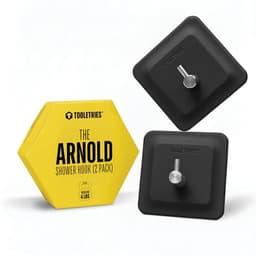
Silicone grip rather than adhesive: it works immediately, moves as often as you like, and leaves nothing behind.
If the waiting hour is the problem, silicone is the answer. Tooletries publishes The Arnold as “completely removable and reusable”, in “heavy-duty stainless steel” with “100% waterproof silicone”, rated “up to 4lbs”.
Nothing cures, so there is nothing to wait for and no penalty for putting it in the wrong place. The surface rules still apply, and Tooletries publishes them clearly.
Renter-Safe Install Rating
- Drilling
- None
- Tools
- Hands only
- Time to fit
- Not published
- Power
- None
- Reversible on move-out
- Fully
Why: Tooletries publishes it as “completely removable and reusable” with a silicone grip rather than an adhesive. Nothing cures, so nothing has to be peeled off a wall later.
Read from published documentation, not from fitting one. Tooletries, The Arnold Shower Hook, plus the published surface compatibility guide. How the verdict is derived: renter-safe ratings explained.
What’s wrong with it
It holds less than a fully cured adhesive strip and is fussier about surface texture.
What we can’t tell you
No published dimensions.
Published specifications
| Material | “heavy-duty stainless steel” with “100% waterproof silicone” |
|---|---|
| Weight capacity | “carry up to 4lbs” |
| Reusable | “completely removable and reusable” |
| Suitable surfaces | “flat, smooth, shiny, non-porous surfaces” — Tooletries names gloss-finished tile, glass, mirrors, fiberglass, polished marble and gloss-finished metal |
| Surfaces to avoid | “textured, rough, porous, or uneven surfaces” and over grout lines; “mosaic, subway, and kit-kat tiles” are named as unsuitable |
| Guarantee | “30 Day Money Back Guarantee” (restrictions apply) |
| Dimensions | Not published |
Source: Tooletries, The Arnold Shower Hook, plus the published surface compatibility guide
#ad Price $19.99 as of October 19, 2026. Prices change; Amazon’s listing is the one that counts. How we’re funded.
Where to buy
Everything recommended on this page, in one place. Each link is an Amazon Associates link — we earn a commission at no extra cost to you, and it never decides a pick.
- Check price on Amazon
Command Bath Hooks with Water-Resistant Strips
3M Command · Command Bath range · Renter verdict: Safe
- $19.99View on Amazon
Tooletries The Arnold Shower Hook
Tooletries · The Arnold · Renter verdict: Safe
#ad Prices are not shown because we only publish figures we have verified on the day. How we’re funded.
Questions people actually ask
how to hang adhesive hooks
Choose a flat spot away from grout lines, clean it with rubbing alcohol and let it dry, press the strip to the wall for 10 seconds, press the hook base on for 30 seconds, and wait a full hour before hanging anything on it.
how to use adhesive wall hooks
The same sequence, and the same discipline about the hour. Remove them by sliding the hook off the base and pulling the tab straight down along the wall — never outward, and never with a knife.
adhesive towel hooks for tile
Large-format glazed tile is ideal. Small-format tile often is not, because 3M's instruction is to keep strips off grout lines and there may be no continuous flat area big enough. On mosaic or subway tile, use a tension caddy instead.
Sources
Read next
Back to Hardware & Storage.