Toilet paper holders that don't need drilling
The original holder pulled out of the drywall, or there was never one within reach of the toilet. Neither problem needs a drill.
By Sawyer V. · · How we research
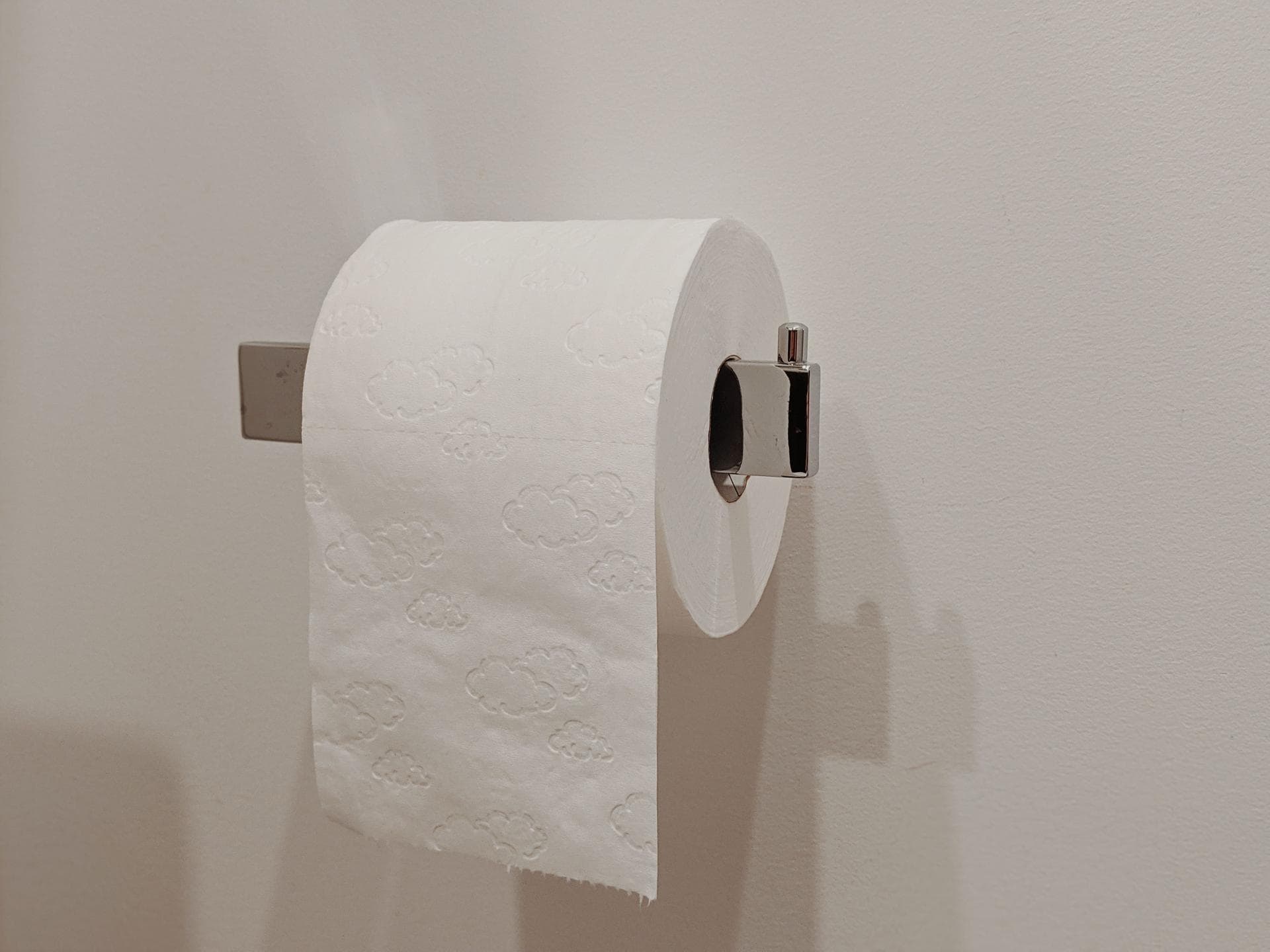
The short answer
We earn a commission if you buy through the links on this page, at no extra cost to you. It does not change which products we pick or what we say about them — here is exactly how that works.
Quick picks
Tap any row for the full write-up. Prices are checked against Amazon rather than remembered — where we have no verified figure the button says so.
| # | Product | Best for | Renter | Price |
|---|---|---|---|---|
| 1 | No photo yet Command Bath Toilet Paper Holder The only no-drill holder in this category whose maker publishes its adhesive rating, its surfaces, and a tested removal method. | Putting the roll exactly where the old one was | Safe | |
| — |  Tower Toilet Paper Stand Genuinely well specified and genuinely renter-safe, and still the wrong answer for most bathrooms — including on availability. | Skip this one | Safe | No buy link |
Why this is a search at all
Almost everyone arrives here for one of two reasons, and they want different things.
The old holder pulled out of the wall. Toilet paper holders are very often fixed into hollow drywall with the cheapest possible anchors, and the sideways yank of pulling paper off a roll is exactly the load those anchors are worst at. It works loose, then it comes out, and it leaves two ragged holes.
There was never one within reach. Common in rentals and in bathrooms that have been reconfigured, where the holder is behind you, or across the room, or the roll simply lives on the cistern.
The first group has a repair problem as well as a mounting problem, and it changes the answer — an adhesive holder mounted over damaged drywall will fail, because it is only ever as strong as the surface underneath it.
The four formats that need no drill
Adhesive. A plate stuck to the wall with pressure-sensitive strips, with the holder clipping onto it. The only format that puts the roll where a drilled holder would be. Depends entirely on having a smooth, sound, clean surface.
Over-tank. A steel hook that hangs over the back of the cistern, under the lid, holding one roll and often storing spares. Requires no adhesive and no surface at all, which makes it the most reliable format on this list. It also puts the roll behind you, on a toilet that has a separate tank — which rules out most one-piece and wall-hung toilets.
Freestanding. A weighted stand on the floor. Works in any bathroom, attaches to nothing, and costs you floor space next to the toilet.
Vanity or cabinet-mounted. A bracket that clamps over the side of a vanity cabinet or hooks inside a cabinet door. No wall involved, but only useful if there happens to be a cabinet within arm’s reach of the toilet, which in a small bathroom there sometimes genuinely is.
Why we are only ranking one product
This is a category where the honest answer is uncomfortable, so we will state it plainly.
We researched the over-tank format properly. Those holders are real, they are stocked at every major US retailer, and mechanically they are the most dependable thing on this page — there is no adhesive to fail and no surface to prepare. But no manufacturer in that format publishes a specification we can cite: no material grade, no rated capacity, no maximum tank lid thickness, no corrosion treatment. What is published is retailer listing copy that varies between retailers for the same item.
We are not going to rank products on that. The whole basis of this site is that every figure in a spec table traces to something the manufacturer actually published, and where nothing is published the row reads “Not published” rather than quietly becoming an estimate. An over-tank holder is very likely fine. We cannot tell you which one, and neither can anyone else who has not handled them.
The same applies to vanity-mounted brackets, where the load-bearing figure — the range of panel thickness the clamp actually fits — is published by nobody.
So: one recommendation, on published specs, and an honest account of the rest. If you want the over-tank format, buy one from a retailer with a good returns policy and treat it as a low-cost experiment rather than a researched purchase.
The height nobody measures
Since you are mounting from scratch, it is worth getting right, and there is an actual convention rather than a guess.
The widely used figure in US residential construction is roughly 26 inches from the finished floor to the center of the holder, set about 8 to 12 inches forward of the front edge of the bowl. Accessible design guidance places it differently — further forward and within a defined reach range — because the requirement there is reaching it from a seated transfer rather than from the seat.
Two practical notes that matter more than the number. Mount it too high and the roll unspools against the wall and binds. Mount it too far back and you have to twist to reach it, which is the specific failure of most builder-placed holders.
On left versus right: there is no standard, and it is not an accessibility question in a domestic bathroom. Put it on the side with a free wall and no door swing. If both sides are free, put it on your dominant-hand side.
This is one clear advantage of the adhesive format that nobody advertises: you get to choose the position rather than inherit it, and if you get it wrong you can move it. A drilled holder in the wrong place is in the wrong place forever.
Making adhesive actually work
Adhesive mounting has a bad reputation earned entirely by people skipping two steps. Both are published, and both are boring.
Clean with rubbing alcohol, not a bathroom cleaner. This is the step that gets skipped most and causes the most failures. Bathroom sprays and most household cleaners leave a surfactant or silicone film specifically designed to make surfaces slick, and adhesive will not key to it. Isopropyl alcohol removes that film and evaporates clean. Do not substitute soapy water.
Press for 30 seconds, then wait a full hour. 3M publishes both numbers. The press is what wets the adhesive out against the surface; the hour is what lets it build strength. A holder loaded ten minutes after mounting is a holder that will be on the floor by the weekend.
Avoid grout lines. 3M’s own instruction for its bath range is to pick a spot where the strips are not bridging grout. A recessed grout line means part of the strip is touching nothing.
Textured and matte-emulsion walls are the real limit. This is where adhesive genuinely struggles, and no maker publishes guidance for it. Heavy texture reduces contact area to the high points; chalky matte paint can release from the wall itself, taking a patch of paint with it. If your wall is tile, gloss or semi-gloss paint, glass or a laminate panel, you are in good shape. If it is flat matte paint over patched drywall, consider the over-tank or freestanding route instead.
Our full method for adhesive mounting is here, and it is the same procedure for a holder as for a hook.
If the old holder left holes
Do not mount anything over damaged drywall and expect it to hold. An adhesive plate needs a sound, flat surface, and the crumbled edge of a failed anchor hole is neither.
Fill the holes with a lightweight filler, let it cure fully, sand flush, and if the wall is painted, touch it in. Then mount the new holder somewhere slightly different if you can — filler is not as sound a substrate as the original board.
There is a second reason to do this properly if you rent: those two holes are the kind of thing that gets noticed at the end of a tenancy, and repairing them is cheap. Our move-out checklist covers the sequence, and removing adhesive fittings without taking paint with them is its own small skill.
What we would not buy
Suction cups. Suction is not an adhesive; it is a pressure differential that leaks. In a room that cycles between hot and humid and cold and dry several times a day, it leaks faster. We have set out the full case against suction in a bathroom elsewhere and it applies here without modification.
Anything that also stores your phone. A surprising number of no-drill holders add a phone shelf. It puts a phone at splash height beside a toilet, on a bracket rated for nothing in particular, and it is the one accessory whose failure mode costs more than the bathroom fitting.
Heavy multi-roll adhesive units. Adhesive is comfortable here precisely because a single roll weighs a few ounces. A unit holding four spare rolls plus a shelf changes both the static load and the leverage on the plate, and 3M publishes no rating for that.
Where this sits on the install rating
Both products on this page rate Safe on our install rating: no drilling, no tools, no power, and fully reversible.
The adhesive holder is reversible in the specific sense that matters to a tenant — 3M publishes a stretch-release removal that leaves “no holes, no sticky residue”. Pull the tab straight down and slowly. Pull it out at an angle and it snaps, which is when people start prying and take paint off.
The freestanding stand is reversible in the trivial sense that you pick it up and leave.
Neither needs permission, and neither is the kind of change a landlord could reasonably object to. If you want to replace something that is currently broken and fixed to the wall, that is a different conversation and framing it as a repair rather than a request is the whole trick — a holder hanging out of the drywall is a fault, not a preference.
Every pick in full
1 we would buy, and one we would not. Each carries its Renter-Safe Install Rating, the published specs behind it, and the honest gap in what we know.
1. Best overall
Command Bath Toilet Paper Holder
3M Command · B5005604033 (satin nickel) / B5005604034 (matte black) · best for putting the roll exactly where the old one was
The only no-drill holder in this category whose maker publishes its adhesive rating, its surfaces, and a tested removal method.
The Command Bath Toilet Paper Holder wins this page largely by being the one product in it with a specification you can check.
3M publishes what is in the pack — one holder and two water-resistant strips — and publishes the surfaces it is meant for: “glass, mirror, tile, wood and painted surfaces”, with metal and laminates added elsewhere in its own copy. That list is doing real work, because the surface is what decides whether an adhesive mount holds.
The load rating comes from the strips rather than the holder. 3M’s water-resistant strips product information sheet rates the medium strip at 3 lb and the large at 5 lb, and states they hold in hot, wet and humid conditions. A roll of toilet paper weighs a few ounces, so unlike a towel bar this is not a product operating near its limit — which is the main reason adhesive is a better bet here than it is for anything you hang wet laundry on.
It goes where the old holder went. That is the whole point of the format, and none of the other three manage it.
Renter-Safe Install Rating
- Drilling
- None
- Tools
- Hands only
- Time to fit
- About 2 minutes to fit, then the published hour before the first roll goes on
- Power
- None
- Reversible on move-out
- Fully
Why: 3M publishes a stretch-release removal that comes away without taking paint or tile glaze with it. The two rules people skip are the ones that decide whether it stays up: press for 30 seconds, and leave it a full hour before loading it.
Read from published documentation, not from fitting one. 3M Command — Bath Satin Nickel Toilet Paper Holder product page (contents, surfaces, damage-free removal). How the verdict is derived: renter-safe ratings explained.
What’s wrong with it
You must give up the wall for an hour. 3M publishes a 30-second press and then "wait 1 hour before use", and the failures in this category are almost entirely people who loaded it immediately.
What we can’t tell you
3M publishes no rated load for the holder itself and no dimensions — only the strip ratings. It also publishes no guidance for textured or matte-painted walls, which is exactly where adhesive is least predictable.
Published specifications
| Mounting | Command water-resistant strips — 3M rates the medium strip at 3 lb and the large at 5 lb in its product information sheet |
|---|---|
| In the pack | 3M publishes one holder and two water-resistant strips |
| Surfaces | 3M publishes “glass, mirror, tile, wood and painted surfaces”, and elsewhere adds metal and laminates |
| Application | 3M publishes the sequence: clean with rubbing alcohol, press firmly for 30 seconds, then “wait 1 hour before use” |
| Removal | Stretch-release tab pulled straight down. 3M publishes “no holes, no sticky residue” |
| Roll capacity | One standard roll |
| Finish | Satin nickel or matte black, rust-resistant |
| Drilling | None |
| Rated load for the holder | Not published — 3M rates the strips but publishes no separate weight limit for the holder itself |
| Dimensions | Not published |
#ad We have no verified live price for this one right now, so we are not showing a number. How we’re funded.
The one to skip
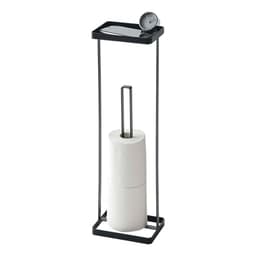
Tower Toilet Paper Stand
Yamazaki Home · Tower Toilet Paper Stand - Steel · best for a bathroom where nothing can touch the walls at all
Genuinely well specified and genuinely renter-safe, and still the wrong answer for most bathrooms — including on availability.
The freestanding stand is the format people reach for when adhesive has already let them down, and Yamazaki Home publishes more about theirs than anyone else in this category publishes about anything.
You get steel construction, a stated capacity of three rolls, dimensions of 6.38 in wide by 4.75 in deep by 20.5 in tall with a rod height of 14.88 in, an inner opening diameter of 1.4 in so you can check your rolls fit, and a removable tray insert. That is a better spec sheet than the adhesive category manages.
It is still the pick to skip, for three reasons.
It is on the floor. A bathroom floor next to a toilet is the one surface in the home you least want to store paper on, and it is the surface that gets mopped.
It occupies floor space you probably do not have. The people searching for a no-drill holder are overwhelmingly in small rentals, and a footprint of roughly 6 by 5 inches beside the toilet is real estate a small bathroom cannot spare.
It was sold out. At the time of writing Yamazaki Home’s own store listed it as out of stock with a back-in-stock notification, though it continues to appear at third-party retailers. We do not recommend on the strength of a listing we cannot see the stock behind.
If your walls are genuinely off limits — unpainted brick, heavy texture, or a landlord who has said no to adhesive in writing — the format is legitimate and this is the best-documented example of it. For everyone else, put the roll on the wall.
Renter-Safe Install Rating
- Drilling
- None
- Tools
- None
- Time to fit
- Not published
- Power
- None
- Reversible on move-out
- Fully
Why: It stands on the floor and attaches to nothing, so there is no install to reverse and nothing a landlord could object to. The objection is practical rather than contractual.
Read from published documentation, not from fitting one. Yamazaki Home — Toilet Paper Stand (Steel), published dimensions, capacity, roll fit and finishes. How the verdict is derived: renter-safe ratings explained.
What’s wrong with it
Floor storage beside a toilet, a footprint a small bathroom cannot spare, and nothing stopping it being knocked over.
What we can’t tell you
Yamazaki publishes no weight, no warranty and no care instructions, and no maker in this format publishes a tip-over or stability rating.
Published specifications
| Material | Steel |
|---|---|
| Capacity | Holds up to three toilet paper rolls |
| Dimensions | 6.38 in wide x 4.75 in deep x 20.5 in tall, with a rod height of 14.88 in |
| Roll fit | Inner opening diameter of 1.4 in (3.56 cm) |
| Tray | Removable protective insert included |
| Finishes | White or black |
| Mounting | None — freestanding on the floor |
| Drilling | None |
| Weight | Not published |
| Warranty | Not published |
| Availability | Sold out on Yamazaki Home's own store at the time of writing, with a back-in-stock notification offered |
Source: Yamazaki Home — Toilet Paper Stand (Steel), published dimensions, capacity, roll fit and finishes
There is no buy button on this one. It is easy enough to find if you want it anyway — we would rather point you at something that is still on the wall in a year.
Where to buy
Everything recommended on this page, in one place. Each link is an Amazon Associates link — we earn a commission at no extra cost to you, and it never decides a pick.
- Check price on Amazon
Command Bath Toilet Paper Holder
3M Command · B5005604033 (satin nickel) / B5005604034 (matte black) · Renter verdict: Safe
#ad Prices are not shown because we only publish figures we have verified on the day. How we’re funded.
Questions people actually ask
how to install a toilet paper holder without screws
Use an adhesive holder and follow two published steps: clean the wall with rubbing alcohol rather than a bathroom cleaner, press the plate for 30 seconds, then wait a full hour before loading a roll. Skipping the hour is the single most common cause of failure.
do adhesive toilet paper holders actually hold
Yes, and with more margin than most adhesive fittings. 3M rates its water-resistant strips at 3 lb for the medium and 5 lb for the large, while a roll of toilet paper weighs a few ounces — so unlike a towel bar this is not a product working near its limit.
what is the standard toilet paper holder height
Roughly 26 inches from the finished floor to the center of the holder, set about 8 to 12 inches forward of the front of the bowl. Accessible design guidance places it differently because the requirement is reaching it from a seated transfer.
should a toilet paper holder be on the left or right
There is no standard for a domestic bathroom. Choose the side with free wall and no door swing; if both are free, use your dominant hand side. An adhesive holder lets you choose the position rather than inherit it, and lets you move it if you get it wrong.
what can i use instead of a wall mounted toilet paper holder
Three formats need no wall: over-tank hooks that hang under the cistern lid, freestanding floor stands, and brackets that clamp to a vanity cabinet. Over-tank is mechanically the most reliable, but no manufacturer in that format publishes specs we can rank on.
will an adhesive holder work on a textured wall
This is where adhesive genuinely struggles and no maker publishes guidance. Heavy texture cuts contact down to the high points, and chalky matte paint can release from the wall itself. Tile, gloss paint, glass and laminate are reliable; flat matte over patched drywall is not.
Sources
- 3M Command — Bath Satin Nickel Toilet Paper Holder, published contents, surfaces and damage-free removal
- 3M — Command Water-Resistant Strips product information sheet, published 3 lb and 5 lb ratings, 30-second press and 1-hour wait
- Yamazaki Home — Toilet Paper Stand (Steel), published dimensions, roll fit, capacity and finishes
Read next
Back to Hardware & Storage.