How to remove Command hooks without taking the paint with them
The whole point of adhesive hardware is that it comes off cleanly. Five seconds of impatience at the end throws that away.
By Sawyer V. · · How we research
The short answer
We earn a commission if you buy through the links on this page, at no extra cost to you. It does not change which products we pick or what we say about them — here is exactly how that works.
Quick picks
Tap any row for the full write-up. Prices are checked against Amazon rather than remembered — where we have no verified figure the button says so.
| # | Product | Best for | Renter | Price |
|---|---|---|---|---|
| 1 | No photo yet Command Bath Hooks with Water-Resistant Strips 3M publishes the application sequence, the cure time and the removal method — which is why this is the adhesive worth buying. | Hooks you intend to remove one day | Safe | |
| 2 | No photo yet Command Bath Hand Towel Bar A bar uses the same stretch-release strips, so the same technique applies — one mounting point at a time. | Bars, which have two bonds to release | Safe | |
| 3 |  Tooletries The Arnold Shower Hook Silicone grip rather than adhesive — published as completely removable and reusable, and it just peels off. | Avoiding this problem entirely | Safe |
Why the direction matters so much
Command strips are not ordinary adhesive tape. They are a stretch-release adhesive, and the engineering is genuinely clever — but it only works if you use it as designed.
The adhesive is formulated so that when it is stretched parallel to the surface, it thins, loses its grip along its whole length simultaneously, and releases from both faces cleanly. Pulled that way, it comes off a painted wall without taking anything with it.
Pull it outward instead and none of that happens. The force concentrates at one edge of the bond and peels it like ordinary tape — and ordinary tape on emulsion paint takes paint. The adhesive is often stronger than the bond between the paint and the wall beneath it, which is why the failure is a patch of bare plaster rather than a clean release.
So: straight down, slowly, along the wall. That single instruction is most of what damage-free means in practice.
When the tab breaks
It happens, usually on an old strip or one that has been pulled at an angle first. Do not switch to a knife.
Warm it. A hairdryer on low for thirty to sixty seconds, held a few inches away. Warm adhesive is softer and considerably more willing to let go. This alone often frees a stubborn base.
Then use floss. Take a length of dental floss or fishing line and work it behind the mounting base in a sawing motion, keeping it flat against the wall. You are cutting through the adhesive layer parallel to the surface, which is the same geometry the stretch- release was designed around.
Be patient. This takes a couple of minutes rather than a couple of seconds. A blade, a scraper or a chisel will be faster and will take paint or glaze with it — which costs far more time than the two minutes saved.
Clearing residue
Some adhesive residue is normal, especially from older strips. Rubbing alcohol on a soft cloth removes almost all of it, and it is the same product 3M specifies for cleaning the surface before application.
Do this even when the wall looks clean. A thin invisible film picks up dust and darkens over the following weeks, leaving a visible rectangle exactly where the hook was — which is the kind of thing that gets noticed at a move-out inspection.
What not to use: acetone or nail polish remover, which will strip paint far more effectively than it strips residue; and any abrasive pad, which will dull a gloss tile permanently.
Surfaces that need extra care
Freshly painted walls. Paint needs weeks to fully cure, and adhesive applied to paint that is only touch-dry will take it off on removal regardless of technique. If the wall was painted within the last month, wait.
Wallpaper. Removal will very often take the paper. Command publishes hooks for many surfaces, but wallpaper is the one where damage-free is genuinely unreliable.
Textured or flaking paint. If the wall is already failing, the adhesive will simply take the loose layer with it. That is the wall’s condition rather than the hook’s fault, but it is your deposit either way.
Tile and glass. The easiest surfaces of all. Glazed tile and glass are non-porous, so nothing to lift and residue wipes off completely.
Removing everything before you move
Do the adhesive first, while you are unhurried. It is the only step in a bathroom reversal where rushing causes damage, and doing it on the day the van is waiting is how tabs get levered off with a car key.
Then work through the rest of the room in order — the move-out checklist covers the full sequence, including the two original parts people always throw away.
And if you are refitting hooks at the next address, the application discipline matters as much as the removal did: clean with alcohol, press 30 seconds, wait an hour.
Every pick in full
3 we would buy. Each carries its Renter-Safe Install Rating, the published specs behind it, and the honest gap in what we know.
1. The system this method is for
Command Bath Hooks with Water-Resistant Strips
3M Command · Command Bath range · best for hooks you intend to remove one day
3M publishes the application sequence, the cure time and the removal method — which is why this is the adhesive worth buying.
The reason to buy Command rather than an unbranded adhesive hook is not the glue, it is the documentation. 3M publishes strip ratings of 3 lb and 5 lb, an application sequence with real timings, and an explicit removal instruction: “always pull straight down”.
The hooks are also reusable with refill strips, so each move costs a strip rather than a hook.
Renter-Safe Install Rating
- Drilling
- None
- Tools
- Hands only
- Time to fit
- About 1 minute to fit, then a full hour before it carries anything
- Power
- None
- Reversible on move-out
- Fully
Why: 3M publishes a stretch-release removal that comes away without taking paint or tile glaze with it — provided you pull the tab straight down rather than levering the hook off the wall.
Read from published documentation, not from fitting one. 3M, Command Water-Resistant Strips product information sheet (weight ratings, application sequence and removal). How the verdict is derived: renter-safe ratings explained.
What’s wrong with it
It cannot be repositioned once bonded, so placement mistakes cost a strip.
What we can’t tell you
3M's strips sheet publishes adhesive properties but not the hooks' own materials.
Published specifications
| Published weight ratings | 3M rates the Command water-resistant strips at 3 lb (medium) and 5 lb (large) in its product information sheet |
|---|---|
| Application | 3M's published sequence: clean the surface with rubbing alcohol, remove the liner, press to the wall for 10 seconds, press the base firmly for 30 seconds, then “wait 1 hour before use” |
| Placement | 3M's own instruction is to choose a location where the strips are not over grout lines |
| Removal | Slide the hook up and off, hold the base, and “always pull straight down” |
| Drilling | None |
| Reusable | The hook is reusable with Command Bath refill strips |
| Material | Not published in the strips information sheet |
#ad We have no verified live price for this one right now, so we are not showing a number. How we’re funded.
2. Same method, more contact area
Command Bath Hand Towel Bar
3M Command · BATH41-SN-ES · best for bars, which have two bonds to release
A bar uses the same stretch-release strips, so the same technique applies — one mounting point at a time.
The Command Bath towel bar works the same way with one difference: it has two mounting points rather than one.
Slide the bar off both bases first, then release each base separately, straight down. Trying to lever the whole assembly off in one movement pulls both bonds outward at once, which is the failure mode this guide exists to prevent.
Renter-Safe Install Rating
- Drilling
- None
- Tools
- Hands only
- Time to fit
- About 2 minutes to fit, then an hour before you hang anything on it
- Power
- None
- Reversible on move-out
- Fully
Why: 3M publishes a stretch-release removal that comes away without taking paint or tile glaze with it. The only rule that matters is the one people ignore: press for 30 seconds and leave it a full hour before the first towel.
Read from published documentation, not from fitting one. 3M, Command Water-Resistant Strips product information sheet (weight ratings, application and removal). How the verdict is derived: renter-safe ratings explained.
What’s wrong with it
Two mounting points means twice as much wall has to be clean, flat and grout-free.
What we can’t tell you
3M does not publish the bar's own material or dimensions in the strips information sheet.
Published specifications
| Adhesive | Command water-resistant strips — 3M rates the medium strip at 3 lb and the large at 5 lb in its product information sheet |
|---|---|
| Application | 3M publishes the sequence: clean the surface with rubbing alcohol, press the base firmly for 30 seconds, then “wait 1 hour before use” |
| Placement | 3M's own instruction is to choose a spot where the strips are not over grout lines |
| Removal | Slide the bar up and off the base, then pull the tab straight down |
| Finish | Satin nickel, rust-resistant |
| Bar length | 9 inches (hand towel size) |
| Drilling | None |
#ad We have no verified live price for this one right now, so we are not showing a number. How we’re funded.
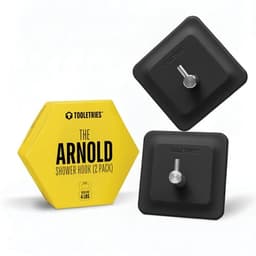
3. Nothing to remove
Tooletries The Arnold Shower Hook
Tooletries · The Arnold · best for avoiding this problem entirely
Silicone grip rather than adhesive — published as completely removable and reusable, and it just peels off.
If the removal anxiety is the thing putting you off adhesive, there is a mechanism that sidesteps it. The Arnold uses a silicone grip rather than a curing adhesive, and Tooletries publishes it as “completely removable and reusable”.
There is no tab, no technique and no residue. You peel a corner and lift it off, and it grips again somewhere else immediately.
Renter-Safe Install Rating
- Drilling
- None
- Tools
- Hands only
- Time to fit
- Not published
- Power
- None
- Reversible on move-out
- Fully
Why: Tooletries publishes it as “completely removable and reusable” with a silicone grip rather than an adhesive. Nothing cures, so nothing has to be peeled off a wall later.
Read from published documentation, not from fitting one. Tooletries, The Arnold Shower Hook, plus the published surface compatibility guide. How the verdict is derived: renter-safe ratings explained.
What’s wrong with it
It holds less than a fully cured adhesive strip and needs a genuinely flat, smooth surface.
What we can’t tell you
No published dimensions.
Published specifications
| Material | “heavy-duty stainless steel” with “100% waterproof silicone” |
|---|---|
| Weight capacity | “carry up to 4lbs” |
| Reusable | “completely removable and reusable” |
| Suitable surfaces | “flat, smooth, shiny, non-porous surfaces” — Tooletries names gloss-finished tile, glass, mirrors, fiberglass, polished marble and gloss-finished metal |
| Surfaces to avoid | “textured, rough, porous, or uneven surfaces” and over grout lines; “mosaic, subway, and kit-kat tiles” are named as unsuitable |
| Guarantee | “30 Day Money Back Guarantee” (restrictions apply) |
| Dimensions | Not published |
Source: Tooletries, The Arnold Shower Hook, plus the published surface compatibility guide
#ad Price $19.99 as of October 19, 2026. Prices change; Amazon’s listing is the one that counts. How we’re funded.
Where to buy
Everything recommended on this page, in one place. Each link is an Amazon Associates link — we earn a commission at no extra cost to you, and it never decides a pick.
- Check price on Amazon
Command Bath Hooks with Water-Resistant Strips
3M Command · Command Bath range · Renter verdict: Safe
- Check price on Amazon
Command Bath Hand Towel Bar
3M Command · BATH41-SN-ES · Renter verdict: Safe
- $19.99View on Amazon
Tooletries The Arnold Shower Hook
Tooletries · The Arnold · Renter verdict: Safe
#ad Prices are not shown because we only publish figures we have verified on the day. How we’re funded.
Questions people actually ask
how to remove command hooks without damaging wall
Slide the hook off its base, hold the base gently against the wall, and pull the release tab slowly straight down along the wall. 3M publishes this as always pull straight down — the adhesive is engineered to release when stretched parallel to the surface.
what if the command strip tab breaks
Warm the base with a hairdryer on low for up to a minute, then work dental floss or fishing line behind it in a sawing motion, kept flat against the wall. Do not switch to a knife or scraper — that is what takes paint.
do command hooks damage paint
Not when removed correctly on cured paint. They do take paint when pulled outward instead of down, when levered off, or when applied to paint less than about a month old, because the adhesive can be stronger than the bond between fresh paint and the wall.
how do you get command strip residue off
Rubbing alcohol on a soft cloth — the same product 3M specifies for cleaning the surface before application. Avoid acetone, which strips paint, and abrasive pads, which permanently dull gloss tile.
Sources
Read next
Back to Hardware & Storage.