Adhesive vs drilled bathroom hardware
Adhesive is not a compromise version of drilling. They fail differently, they suit different loads, and only one of them is reversible.
By Sawyer V. · · How we research

The short answer
We earn a commission if you buy through the links on this page, at no extra cost to you. It does not change which products we pick or what we say about them — here is exactly how that works.
Quick picks
Tap any row for the full write-up. Prices are checked against Amazon rather than remembered — where we have no verified figure the button says so.
| # | Product | Best for | Renter | Price |
|---|---|---|---|---|
| 1 | No photo yet Command Bath Hand Towel Bar Published strip ratings of 3 lb and 5 lb, and a stretch-release removal that leaves the wall as it was. | Light loads, reversibly | Safe | |
| 2 |  simplehuman Tension Shower Caddy, 9 ft A tension pole carries far more than adhesive and still makes no holes — the answer most of this argument overlooks. | Heavy loads without holes | Safe | |
| 3 | No photo yet WarmlyYours Palma Wall-Mounted Plug-In Towel Warmer A 60 W heated rail that ships with a wall-mount hardware kit — an example of a product no adhesive could ever hold. | When drilling is genuinely the only option | Owner-only |
The honest comparison
| Adhesive / silicone | Tension | Drilled | |
|---|---|---|---|
| Published load | 3–5 lb | Not published, but far more | Whatever the anchor is rated for |
| Reversible | Yes, completely | Yes, completely | No |
| Surface-dependent | Highly | Not at all | Depends on substrate |
| Time to fit | 5 minutes, plus 1 hour cure | Minutes | An afternoon, with the right bit |
| Risk if it goes wrong | It falls off | It slips slowly | A cracked tile |
| Renter verdict | Safe | Safe | Owner-only |
Where adhesive genuinely wins
Anything you might move. Bathroom layouts get rearranged, and a hook in the wrong place is a mistake you can correct for the price of a strip.
Anything in a rental. The whole point.
Glass and mirrors. You cannot drill a mirror or a glass shower screen without specialist tools and a real risk of destroying it. Adhesive is not the compromise here — it is the correct method.
Tile you would rather not risk. Which is most tile, honestly.
Where drilling is the only real answer
Grab bars. Non-negotiable. A grab bar is a safety device that takes the full weight of an adult falling, and it must be anchored into structure. No adhesive product should ever be used for this, whatever the packaging says.
Heated towel rails. Weight plus permanence plus a cord that should not be disturbed.
Anything holding real weight over time. A shelf of heavy bottles, a full-length mirror, a cabinet.
What drilling tile actually involves
People underestimate this, so it is worth stating plainly. It is not hard, and it is unforgiving.
You need a diamond or carbide tile bit — a masonry bit will wander and crack the glaze. You start slow with no hammer action, you keep the bit cool, and you use the right anchor for what is behind the tile, which you cannot see. And you have to avoid pipes and wiring in a room that is full of both.
A cracked tile is not a small problem. Matching a fifteen-year-old tile is often impossible, and the repair is visible forever.
None of that means do not do it. It means: if the load can be handled by tension or adhesive, that is not the lesser option, it is the lower-risk one.
The decision, in order
Is it a grab bar or a safety fixture? Drill, into structure, or have it done. Nothing else.
Do you rent? Adhesive or tension. Drilling is not your call, and undoing it costs more than the hardware.
Is the load under 4 lb on a smooth surface? Adhesive or silicone. It will hold, and you can move it.
Is the load heavier but you would rather not drill? Tension, if you have a ceiling in range.
Is the surface mosaic, textured or porous? Not adhesive. Tension, or accept that drilling is the honest answer.
And if you rent and the answer keeps coming out “drill”, that is a conversation with a landlord rather than a purchase — the boundaries are set out here.
Every pick in full
3 we would buy. Each carries its Renter-Safe Install Rating, the published specs behind it, and the honest gap in what we know.
1. The adhesive case
Command Bath Hand Towel Bar
3M Command · BATH41-SN-ES · best for light loads, reversibly
Published strip ratings of 3 lb and 5 lb, and a stretch-release removal that leaves the wall as it was.
Adhesive is genuinely excellent within its limits. 3M publishes ratings of 3 lb and 5 lb for its water-resistant strips, an application sequence with real timings, and a removal method that comes away cleanly.
The whole proposition is reversibility: no holes, no anchors, nothing to make good. For a hand towel, a robe, or a bathroom organizer, that is the correct trade.
Renter-Safe Install Rating
- Drilling
- None
- Tools
- Hands only
- Time to fit
- About 2 minutes to fit, then an hour before you hang anything on it
- Power
- None
- Reversible on move-out
- Fully
Why: 3M publishes a stretch-release removal that comes away without taking paint or tile glaze with it. The only rule that matters is the one people ignore: press for 30 seconds and leave it a full hour before the first towel.
Read from published documentation, not from fitting one. 3M, Command Water-Resistant Strips product information sheet (weight ratings, application and removal). How the verdict is derived: renter-safe ratings explained.
What’s wrong with it
3 to 5 lb is a genuine ceiling, and it is well below a wet bath towel.
What we can’t tell you
3M's strips sheet does not publish the hardware's own materials or dimensions.
Published specifications
| Adhesive | Command water-resistant strips — 3M rates the medium strip at 3 lb and the large at 5 lb in its product information sheet |
|---|---|
| Application | 3M publishes the sequence: clean the surface with rubbing alcohol, press the base firmly for 30 seconds, then “wait 1 hour before use” |
| Placement | 3M's own instruction is to choose a spot where the strips are not over grout lines |
| Removal | Slide the bar up and off the base, then pull the tab straight down |
| Finish | Satin nickel, rust-resistant |
| Bar length | 9 inches (hand towel size) |
| Drilling | None |
#ad We have no verified live price for this one right now, so we are not showing a number. How we’re funded.
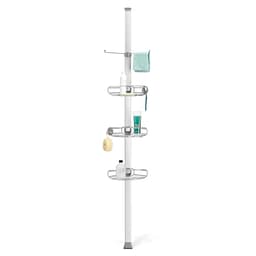
2. The third option people forget
simplehuman Tension Shower Caddy, 9 ft
simplehuman · Tension Shower Caddy 9 ft · best for heavy loads without holes
A tension pole carries far more than adhesive and still makes no holes — the answer most of this argument overlooks.
The adhesive-versus-drilling framing hides a third mechanism that beats adhesive on load and beats drilling on reversibility.
simplehuman publishes a “reinforced aluminum tension pole with high-compression spring and grippy rubber feet” extending six to nine feet, in rust-proof stainless and anodized aluminum, with a five-year warranty.
If your reason for considering drilling is that adhesive will not hold what you need, check tension first.
Renter-Safe Install Rating
- Drilling
- None
- Tools
- None
- Time to fit
- Not published
- Power
- None
- Reversible on move-out
- Fully
Why: The pole holds itself up with spring tension between the floor and the ceiling. There is no fixing, and the rubber feet are the only thing that touches the room.
Read from published documentation, not from fitting one. simplehuman, Tension Shower Caddy 9 ft. How the verdict is derived: renter-safe ratings explained.
What’s wrong with it
It needs a ceiling within range and it is a visually substantial object.
What we can’t tell you
simplehuman publishes no weight capacity.
Published specifications
| Height range | Extends from 6 to 9 feet, floor to ceiling |
|---|---|
| Material | “Constructed from rust-proof stainless steel and anodized aluminum” |
| Pole | “Reinforced aluminum tension pole with high-compression spring and grippy rubber feet” |
| Shelves | Adjustable wire-frame shelves that “slide up or down” the pole |
| Mounting | Tension between floor and ceiling — no drilling |
| Warranty | 5-Year Warranty |
| Weight capacity | Not published |
#ad Price $149.99 as of October 19, 2026. Prices change; Amazon’s listing is the one that counts. How we’re funded.
3. The drilled case
WarmlyYours Palma Wall-Mounted Plug-In Towel Warmer
WarmlyYours · TWS2-PLM04PP · best for when drilling is genuinely the only option
A 60 W heated rail that ships with a wall-mount hardware kit — an example of a product no adhesive could ever hold.
Some things have to be screwed to a wall, and this is a clean example. WarmlyYours ships the Palma with an “installation manual and hardware kit” because a heated metal rail at that weight is far beyond any adhesive rating, and because it needs to stay exactly where it is.
It is still plug-in rather than hardwired — a NEMA 5-15 plug and a 71-inch cord — so the electrical side needs no professional. Only the mounting does.
Renter-Safe Install Rating
- Drilling
- Required
- Tools
- Drill
- Time to fit
- Not published
- Power
- Standard outlet
- Reversible on move-out
- With patching
Why: WarmlyYours ships it with a wall-mount hardware kit, which means anchors in tile or drywall. The plug end is renter-friendly; the bracket end leaves four holes you would have to make good.
Read from published documentation, not from fitting one. WarmlyYours, Palma Towel Warmer (TWS2-PLM04PP). How the verdict is derived: renter-safe ratings explained.
What it costs to run — Electricity
- Rated power
- 60 W (WarmlyYours’s published figure)
- Run time
- 24 hours a day, the way most people actually leave them
- Electricity rate
- 18.34 cents per kWh (US residential average, June 2026)
60 W x 24 h / 1000 x $0.1834 = $0.264 a day
About 26 cents a day left on permanently — roughly $96 a year
Arithmetic on published specifications, not a measurement. Rate source: U.S. Energy Information Administration, Electric Power Monthly Table 5.6.A — US residential average 18.34 cents/kWh, June 2026.
What’s wrong with it
Four anchor holes in bathroom tile, which is permanent and is Owner-only.
What we can’t tell you
No published surface-temperature limit for this model.
Published specifications
| Wattage | “60 W” |
|---|---|
| Supply | “120 V”, “0.5 A” |
| Heat output | “205 Btu” per hour |
| Bars | “4” heated bars, “Square” profile |
| Dimensions | “19.68″” H x “17.71″” W x “4.33″” D |
| Material | “304-stainless steel”, “Polished Stainless Steel” finish |
| Cord and plug | “71″” cord, “NEMA 5-15 (Type B)” |
| Mounting | “Wall Mounted”, “Plug-in”, shipped with an “installation manual and hardware kit” |
| Certification | “cULus listed” |
| Warranty | “5-year limited warranty” |
#ad We have no verified live price for this one right now, so we are not showing a number. How we’re funded.
Where to buy
Everything recommended on this page, in one place. Each link is an Amazon Associates link — we earn a commission at no extra cost to you, and it never decides a pick.
- Check price on Amazon
Command Bath Hand Towel Bar
3M Command · BATH41-SN-ES · Renter verdict: Safe
- $149.99View on Amazon
simplehuman Tension Shower Caddy, 9 ft
simplehuman · Tension Shower Caddy 9 ft · Renter verdict: Safe
- Check price on Amazon
WarmlyYours Palma Wall-Mounted Plug-In Towel Warmer
WarmlyYours · TWS2-PLM04PP · Renter verdict: Owner-only
#ad Prices are not shown because we only publish figures we have verified on the day. How we’re funded.
Questions people actually ask
adhesive vs drilled bathroom hardware
Adhesive holds 3 to 5 lb on a smooth surface and comes off cleanly; drilling holds whatever the anchor is rated for and is permanent. Tension is the overlooked third option — far more load than adhesive, and still no holes.
no drill grab bar for shower
We would not recommend one. A grab bar takes the full weight of an adult falling, which is far beyond any published adhesive or suction rating. This is the one item in the bathroom that should be anchored into structure, by someone who knows what is behind the tile.
renter friendly bathroom hooks
Adhesive hooks with a published weight rating, fitted to a smooth non-porous surface, cleaned with rubbing alcohol and left a full hour before use. Silicone-grip hooks are the alternative where the tile is too textured for adhesive.
Sources
Read next
Back to Hardware & Storage.