How long does a towel warmer take?
We looked for a published figure on every towel warmer on this site. There is not one. Here is what the numbers that are published actually tell you.
By Sawyer V. · · How we research

The short answer
We earn a commission if you buy through the links on this page, at no extra cost to you. It does not change which products we pick or what we say about them — here is exactly how that works.
Quick picks
Tap any row for the full write-up. Prices are checked against Amazon rather than remembered — where we have no verified figure the button says so.
| # | Product | Best for | Renter | Price |
|---|---|---|---|---|
| 1 |  Zadro 20-Liter Towel Warmer Bucket 480 W into a 20-liter insulated tub with 15/30/45/60-minute timer settings — high power, short cycle, enclosed space. | One properly hot towel, on demand | Safe | |
| 2 |  WarmlyYours Ibiza Freestanding Towel Warmer 90 W across six bars, 307 Btu/h, freestanding — designed for continuous low heat rather than a fast cycle. | Warm and dry towels on a schedule, not on demand | Safe | |
| 3 |  WarmlyYours Barcelona Freestanding Towel Warmer 150 W over eight bars, 512 Btu/h, published as “warming up to 2 large towels”. | Two large towels rather than several small ones | Safe |
The honest answer: nobody publishes it
We went looking for a warm-up time on every towel warmer on this site. WarmlyYours publishes wattage, Btu output, bar count, dimensions, material, cord length, certification and warranty — and no warm-up time. Zadro publishes capacity, wattage, timer settings, dimensions, weight and materials, and explicitly no heat-up time. VEVOR and Brookstone publish less again.
That is a category-wide gap, and it is the sort of absence this site exists to report rather than paper over. We could produce a plausible-sounding figure. It would be invented, and you would have no way to tell.
So instead: here is what the published numbers do tell you.
Wattage per bar is the closest usable proxy
Heating is a rate. The power going in, divided by the mass being heated, sets how fast the temperature rises.
Zadro bucket: 480 W into a 20-liter insulated tub holding one towel.
WarmlyYours Barcelona: 150 W over 8 bars, published for 2 large towels.
WarmlyYours Ibiza: 90 W over 6 bars.
WarmlyYours Palma: 60 W over 4 bars.
The bucket has roughly five times the power of the Ibiza applied to a fifth of the towel, inside an insulated enclosure. That is a very large difference in heating rate, and it explains why the two formats are sold to different people.
Btu output, which two makers do publish
WarmlyYours publishes a heat output in Btu per hour alongside the wattage: 307 Btu/h for the Ibiza, 512 for the Barcelona, 205 for the Palma.
This is the same quantity expressed differently — watts and Btu/h are both rates of energy delivery, and one converts directly into the other. It is a useful cross-check that the figures are consistent, and it tells you nothing extra about time.
What it does tell you is how much heat is going into the room, which matters if the reason you want a rail is a cold bathroom rather than warm towels.
The question you are actually asking
“How long does it take” usually means one of two quite different things.
“How long until my towel is hot?” This is a bucket question. You want a specific towel at a specific temperature at a specific moment, and a 480 W enclosed appliance with a 15-minute setting is the format designed for it.
“How long until my towel is dry?” This is a rail question, and the answer depends far more on your bathroom than on the rail. Air movement, humidity, how much of the towel is in contact with a bar, and how heavy the towel is all matter more than the wattage. A lighter towel changes this more than a hotter rail.
Most people who buy a rail discover the second question was the real one. The warm towel is pleasant; the dry towel is what stops the bathroom smelling.
Use a timer, and the question stops mattering
This is the practical answer to a page about speed: make the appliance ready before you are.
A plug-in mechanical timer set to switch on an hour before your alarm means the rail is warm when you get in the shower, and it runs for two hours instead of twenty-four.
The cost difference is not marginal. At the US average residential rate, 90 W for two hours a day is about three cents; the same rail left on continuously is about 40 cents a day. Over a year that is roughly $12 against roughly $145. The full arithmetic is here.
None of the WarmlyYours rails has a built-in timer, which is the one thing we would change about them.
What we will not tell you
We are not going to publish “about 20 minutes” or “roughly an hour”. Not because we do not have a view, but because a number in a table looks like a manufacturer figure whether or not it is one, and the whole point of this site is that you can check every figure against its source.
If warm-up time is the deciding factor in your purchase, ask the manufacturer directly before buying. It is a reasonable question, it should be published, and enough people asking is how it gets published.
In the meantime the format tells you most of what you need: a bucket for a fast hot towel, a rail for towels that are dry when you want them. The full comparison is here.
Every pick in full
3 we would buy. Each carries its Renter-Safe Install Rating, the published specs behind it, and the honest gap in what we know.
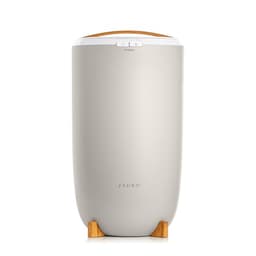
1. Fastest by design
Zadro 20-Liter Towel Warmer Bucket
Zadro · TWB01 · best for one properly hot towel, on demand
480 W into a 20-liter insulated tub with 15/30/45/60-minute timer settings — high power, short cycle, enclosed space.
The Zadro bucket is the format built for speed, and the published numbers show why even though the time itself is absent.
Zadro publishes a maximum of 480 W into a “20-Liter large towel heater tub”, with a timer you “set to 15, 30, 45 or 60 minutes before automatically shutting off”.
Three things are working together: high wattage, a small insulated volume, and direct contact with the towel. That is the recipe for heating one towel quickly rather than keeping several warm.
The timer settings are the closest thing to guidance available. A maker offering 15 minutes as its shortest option is implying that 15 minutes is a usable cycle — but that is our inference from the control range, not a claim Zadro makes.
Renter-Safe Install Rating
- Drilling
- None
- Tools
- None
- Time to fit
- None — it arrives assembled and plugs in
- Power
- Standard outlet
- Reversible on move-out
- Fully
Why: It is an appliance that sits on the floor and plugs into an outlet. There is nothing to fit, so there is nothing to undo.
Read from published documentation, not from fitting one. Zadro, Large Towel Warmer Bucket 20L (TWB). How the verdict is derived: renter-safe ratings explained.
What it costs to run — Electricity
- Rated power
- 480 W (Zadro’s published maximum)
- Cycle length
- 30 minutes — the middle of Zadro’s own timer settings
- Electricity rate
- 18.34 cents per kWh (US residential average, June 2026)
480 W x 0.5 h / 1000 x $0.1834 = $0.044
About 4 cents for a 30-minute cycle, or roughly $16 a year if you run one every day
Arithmetic on published specifications, not a measurement. Rate source: U.S. Energy Information Administration, Electric Power Monthly Table 5.6.A — US residential average 18.34 cents/kWh, June 2026.
What’s wrong with it
It holds one towel. Zadro publishes neither a heat-up time nor a maximum temperature, so both the speed and the ceiling are unknown.
What we can’t tell you
Heat-up time and maximum temperature are both explicitly not published.
Published specifications
| Capacity | “20-Liter large towel heater tub” (5.3 gallons) |
|---|---|
| Maximum wattage | 480 W |
| Supply | 120 V AC, 60 Hz |
| Timer | “set timer to 15, 30, 45 or 60 minutes before automatically shutting off” |
| Dimensions | 21.25″ high, 12″ diameter |
| Weight | 8.5 lbs |
| Materials | “50% Plastic, 45% Metal, 5% Electronics” |
| Plug | “polarized B power plug for increased safety”, 83″ cord |
| Heat-up time | Not published |
| Maximum temperature | Not published |
#ad Price $169.99 as of October 18, 2026. Prices change; Amazon’s listing is the one that counts. How we’re funded.
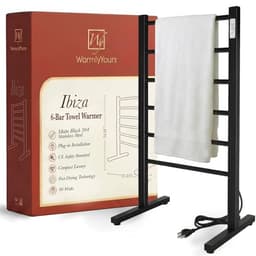
2. Best on a timer
WarmlyYours Ibiza Freestanding Towel Warmer
WarmlyYours · TWS5-IBZ06PP · best for warm and dry towels on a schedule, not on demand
90 W across six bars, 307 Btu/h, freestanding — designed for continuous low heat rather than a fast cycle.
The Ibiza answers a different question. WarmlyYours publishes “90 W”, “307 Btu” per hour and “6” heated bars, in “304-stainless steel”, cULus listed with overheat protection capped at “149°F (65°C)”.
Ninety watts spread over six bars is gentle. It is not trying to heat a towel in fifteen minutes; it is trying to keep six towel-widths of steel warm all day so that whatever hangs on them dries.
Which reframes the question. On a rail the useful measure is not warm-up time — it is whether the towel is dry by evening, and the answer to that depends on your bathroom more than the appliance.
The practical approach is a plug-in timer set to come on an hour before you get up. At 90 W for two hours a day it costs about three cents.
Renter-Safe Install Rating
- Drilling
- None
- Tools
- None
- Time to fit
- Not published
- Power
- Standard outlet
- Reversible on move-out
- Fully
Why: WarmlyYours publishes this one as freestanding with a NEMA 5-15 plug: it stands on the floor, plugs into a normal outlet, and leaves with you.
Read from published documentation, not from fitting one. WarmlyYours, Ibiza Freestanding Towel Warmer (TWS5-IBZ06PP). How the verdict is derived: renter-safe ratings explained.
What it costs to run — Electricity
- Rated power
- 90 W (WarmlyYours’s published figure)
- Run time
- 2 hours a day on a plug-in timer
- Electricity rate
- 18.34 cents per kWh (US residential average, June 2026)
90 W x 2 h / 1000 x $0.1834 = $0.033 a day
About 3 cents a day, or roughly $12 a year on a two-hour daily timer
Arithmetic on published specifications, not a measurement. Rate source: U.S. Energy Information Administration, Electric Power Monthly Table 5.6.A — US residential average 18.34 cents/kWh, June 2026.
What’s wrong with it
It is nearly three feet tall and takes real floor space.
What we can’t tell you
WarmlyYours publishes no warm-up time and no time-to-dry figure.
Published specifications
| Wattage | “90 W” |
|---|---|
| Supply | “120 V”, “0.75 A” |
| Heat output | “307 Btu” per hour |
| Bars | “6” heated bars |
| Dimensions | “34.84″ (885 mm) H x 21.85″ (555 mm) W x 13.97″ (355 mm) D” |
| Material | “304-stainless steel”, published in “Polished Stainless Steel” and “Matte Black” finishes |
| Cord and plug | “71″” cord, “NEMA 5-15 (Type B)” |
| Mounting | “Freestanding” — no wall mounting or drilling |
| Safety | “built-in TempSmart overheat protection” preventing surface temperatures above “149°F (65°C)” |
| Certification | “cULus Listed” |
| Warranty | “5-year limited warranty” |
Source: WarmlyYours, Ibiza Freestanding Towel Warmer (TWS5-IBZ06PP)
#ad Price $351.00 as of October 18, 2026. Prices change; Amazon’s listing is the one that counts. How we’re funded.
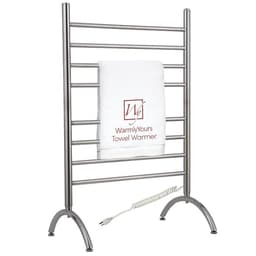
3. Most power in a rail
WarmlyYours Barcelona Freestanding Towel Warmer
WarmlyYours · TW-BC-08BS-FS2 · best for two large towels rather than several small ones
150 W over eight bars, 512 Btu/h, published as “warming up to 2 large towels”.
The Barcelona is the highest-powered rail on this site, and the specification that matters is not the watts but the sentence attached to them.
WarmlyYours publishes “150 W”, “512 Btu” per hour and “8” heated round bars, “warming up to 2 large towels”.
That is a capacity statement rather than a speed one, and it is the most useful thing any maker here says. Two large towels is a specific, checkable claim about what the appliance is for.
More power over more bars means more heated surface in contact with the fabric, which does shorten the time to warm — but nobody publishes by how much, so we will leave the arithmetic where the manufacturer left it.
Renter-Safe Install Rating
- Drilling
- None
- Tools
- None
- Time to fit
- Not published
- Power
- Standard outlet
- Reversible on move-out
- Fully
Why: WarmlyYours publishes it as freestanding on a NEMA 5-15 plug. It stands on the floor, plugs into a normal outlet, and leaves with you.
Read from published documentation, not from fitting one. WarmlyYours, Barcelona Freestanding Towel Warmer (TW-BC-08BS-FS2). How the verdict is derived: renter-safe ratings explained.
What it costs to run — Electricity
- Rated power
- 150 W (WarmlyYours's published figure)
- Run time
- 2 hours a day on a plug-in timer
- Electricity rate
- 18.34 cents per kWh (US residential average, June 2026)
150 W x 2 h / 1000 x $0.1834 = $0.055 a day
About 6 cents a day on a two-hour timer, or roughly $20 a year
Arithmetic on published specifications, not a measurement. Rate source: U.S. Energy Information Administration, Electric Power Monthly Table 5.6.A — US residential average 18.34 cents/kWh, June 2026.
What’s wrong with it
150 W continuous is more than double the Ibiza. On a timer that is fine; left on all day it is the most expensive rail here to run.
What we can’t tell you
No published warm-up time, and unlike the Ibiza no published surface-temperature cap for this model.
Published specifications
| Wattage | “150 W” |
|---|---|
| Supply | “120 V”, “1.25 A” |
| Heat output | “512 Btu” per hour |
| Bars | “8” heated round bars, “warming up to 2 large towels” |
| Dimensions | “24″ (610 mm) W x 37″ (940 mm) H x 15.5″ (394 mm) D” |
| Material | “304-stainless steel”, “Brushed Stainless Steel” finish |
| Cord and plug | “77″” cord, “NEMA 5-15 (Type B)” |
| Mounting | “Freestanding” |
| Safety | “built-in TempSmart™ overheat protection” limiting surface temperature to 167°F, plus an “Integrated power switch with indicator light” |
| Certification | “cETLus listed” |
| Warranty | “2 years” |
Source: WarmlyYours, Barcelona Freestanding Towel Warmer (TW-BC-08BS-FS2)
#ad Price $280.30 as of October 18, 2026. Prices change; Amazon’s listing is the one that counts. How we’re funded.
Where to buy
Everything recommended on this page, in one place. Each link is an Amazon Associates link — we earn a commission at no extra cost to you, and it never decides a pick.
- $169.99View on Amazon
Zadro 20-Liter Towel Warmer Bucket
Zadro · TWB01 · Renter verdict: Safe
- $351.00View on Amazon
WarmlyYours Ibiza Freestanding Towel Warmer
WarmlyYours · TWS5-IBZ06PP · Renter verdict: Safe
- $280.30View on Amazon
WarmlyYours Barcelona Freestanding Towel Warmer
WarmlyYours · TW-BC-08BS-FS2 · Renter verdict: Safe
#ad Prices are not shown because we only publish figures we have verified on the day. How we’re funded.
Questions people actually ask
how long does a towel warmer take to heat up
No manufacturer on this site publishes a figure, and we will not invent one. What is published is the format: buckets run 15 to 60-minute timed cycles at around 480 W, while rails at 60 to 150 W are designed for continuous gentle heat rather than a fast cycle.
should i leave my towel warmer on all the time
It costs about 40 cents a day for a 90 W rail left on continuously against about three cents on a two-hour timer. A cheap plug-in timer is the single best accessory for one.
do towel warmers dry towels
That is what they are genuinely good at, and it is usually the benefit owners end up valuing most. A rail with several bars lets the towel hang open with air on both sides, which does more for drying than the heat itself.
which is faster a towel warmer bucket or a rail
A bucket, by a wide margin, on published wattage: around 480 W into an insulated 20-liter tub holding one towel, against 90 W spread over six bars. They are built for different jobs rather than being fast and slow versions of the same one.
Sources
- WarmlyYours — Ibiza Freestanding Towel Warmer, published wattage, Btu output and bar count
- WarmlyYours — Barcelona Freestanding Towel Warmer, published 150 W and two-towel capacity
- Zadro — Large Towel Warmer Bucket 20L, published wattage, capacity and timer settings
- U.S. Energy Information Administration, Electric Power Monthly Table 5.6.A — US residential average 18.34 cents/kWh, June 2026
Read next
Back to Warmers & Comfort.