How to use a towel warmer properly
Most towel warmers are used badly, and the two mistakes are the same in every household: no timer, and towels folded instead of draped.
By Sawyer V. · · How we research

The short answer
We earn a commission if you buy through the links on this page, at no extra cost to you. It does not change which products we pick or what we say about them — here is exactly how that works.
Quick picks
Tap any row for the full write-up. Prices are checked against Amazon rather than remembered — where we have no verified figure the button says so.
| # | Product | Best for | Renter | Price |
|---|---|---|---|---|
| 1 |  WarmlyYours Ibiza Freestanding Towel Warmer 90 W, six bars and a standard plug — which is what makes an inexpensive plug-in timer possible. | Warm, dry towels on a timer | Safe | |
| 2 |  Zadro 20-Liter Towel Warmer Bucket 480 W with a published 15/30/45/60-minute auto-off timer — the format that manages itself. | A timed cycle rather than a habit | Safe | |
| 3 |  WarmlyYours Barcelona Freestanding Towel Warmer Eight bars and 150 W, published as warming “up to 2 large towels” — capacity is what stops a rack being crammed. | Households where the rack is always full | Safe |
The timer is the whole game
Neither WarmlyYours rail has a timer built in, which means the default behavior is to switch it on and leave it. That default is expensive and pointless.
At the US residential average of 18.34 cents per kWh, a 90 W rail left running costs about 40 cents a day — roughly $145 a year. The same rail on a two-hour daily timer costs about three cents a day, or $12 a year. Twelve times the cost for a benefit nobody can detect, because towels finish drying long before the day is out.
A basic plug-in mechanical timer costs about what three months of running the rail costs. It is the highest-return accessory in this entire category, and it also removes the need to remember to switch anything on — which is the other reason towel warmers stop getting used after a month.
The full arithmetic is at what a heated towel rack costs to run.
Drape, do not fold
This is the technique mistake, and it is almost universal.
A folded towel on a heated bar presents one narrow surface to the heat and traps the damp inside the fold. The outside gets warm, the middle stays wet, and you conclude the rack is not working.
Draped over a single bar, both faces of the towel are exposed and warm air can move through the fabric. Drying is mostly about air movement rather than temperature, which is why an unheated towel spread out often dries faster than a heated one bunched up.
The corollary: leave gaps. A rack packed solid with towels touching each other has no air path. Two well-spaced towels dry better than four crammed on.
Buckets: roll, and take it out
A bucket works differently. Zadro publishes 480 W into a 20-liter insulated tub with a 15/30/45/60-minute auto-off timer, which is a short intense cycle rather than continuous low heat.
Roll the towel loosely rather than folding it flat, so warm air can move through the middle of the roll rather than only around the outside.
Take it out when the cycle ends. This is the single most important habit with a bucket, and it is the answer to the one recurring complaint about the format — that they eventually smell. A damp towel sitting in a warm, sealed, unventilated tub is close to ideal conditions for mildew. Remove the towel, and leave the lid off between uses so the inside dries.
VEVOR publishes bottom drainage on its bucket for exactly this reason, which tells you the manufacturers know it is a real issue.
When to switch it on
Nobody in this category publishes a warm-up time, which is a genuine gap — it is the one number you would use to set a timer properly. In its absence, an hour before you shower is a sensible starting point for a rail, and you can shorten it if the towels are warm early.
For drying rather than warming, the more useful setting is after. Two hours running once wet towels are on the rack does more for the damp-towel problem than two hours before anyone has showered.
In a household with staggered showers, a timer with two daily blocks — morning and evening — costs the same as one block twice as long and covers both.
What not to do
Do not dry clothes on it. A towel warmer is rated for towels. Piling laundry on a rack blocks the airflow that makes it work, and thick fabric sitting against a bar for hours is not what the surface-temperature limits were tested against.
Do not push it into a corner. A rail needs air movement around the bars. Wedged between a wall and a laundry basket, it cannot shed heat the way it was designed to.
Do not use an extension lead. Same rule as everything electrical in a bathroom. WarmlyYours publishes 71 and 77-inch cords precisely so you can place the rack somewhere sensible; if it will not reach, move the rack rather than lengthening the cord.
Do not expect it to heat the room. 307 to 512 BTU/hr is a light bulb’s worth of heat in a tiled space with an extractor in it. That is a heater's job.
Cleaning, which takes about a minute a month
A stainless rail needs almost nothing: wipe it with a damp cloth when it is cold. In a hard-water bathroom, mineral spotting shows up on polished stainless faster than on brushed, and it comes off with the same white vinegar you would use on a showerhead — on stainless, an hour is perfectly safe.
A bucket needs the inside wiped dry occasionally and the lid left off. That is the entire maintenance schedule, and skipping it is how the smell starts.
Every pick in full
3 we would buy. Each carries its Renter-Safe Install Rating, the published specs behind it, and the honest gap in what we know.
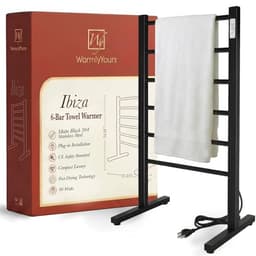
1. Best rail to use daily
WarmlyYours Ibiza Freestanding Towel Warmer
WarmlyYours · TWS5-IBZ06PP · best for warm, dry towels on a timer
90 W, six bars and a standard plug — which is what makes an inexpensive plug-in timer possible.
The single most useful property of the Ibiza for daily use is mundane: WarmlyYours publishes it with a “NEMA 5-15 (Type B)” plug on a 71-inch cord. A standard plug means a standard timer, and the timer is what makes the running cost trivial.
Six bars at 90 W with a published “built-in TempSmart overheat protection” capped at “149°F (65°C)” — warm enough to dry a towel through, never hot enough to be a problem.
Renter-Safe Install Rating
- Drilling
- None
- Tools
- None
- Time to fit
- Not published
- Power
- Standard outlet
- Reversible on move-out
- Fully
Why: WarmlyYours publishes this one as freestanding with a NEMA 5-15 plug: it stands on the floor, plugs into a normal outlet, and leaves with you.
Read from published documentation, not from fitting one. WarmlyYours, Ibiza Freestanding Towel Warmer (TWS5-IBZ06PP). How the verdict is derived: renter-safe ratings explained.
What it costs to run — Electricity
- Rated power
- 90 W (WarmlyYours’s published figure)
- Run time
- 2 hours a day on a plug-in timer
- Electricity rate
- 18.34 cents per kWh (US residential average, June 2026)
90 W x 2 h / 1000 x $0.1834 = $0.033 a day
About 3 cents a day, or roughly $12 a year on a two-hour daily timer
Arithmetic on published specifications, not a measurement. Rate source: U.S. Energy Information Administration, Electric Power Monthly Table 5.6.A — US residential average 18.34 cents/kWh, June 2026.
What’s wrong with it
No built-in timer, so the timer is a separate purchase you should treat as mandatory.
What we can’t tell you
No published warm-up time, so 'an hour before you shower' is a rule of thumb rather than a spec.
Published specifications
| Wattage | “90 W” |
|---|---|
| Supply | “120 V”, “0.75 A” |
| Heat output | “307 Btu” per hour |
| Bars | “6” heated bars |
| Dimensions | “34.84″ (885 mm) H x 21.85″ (555 mm) W x 13.97″ (355 mm) D” |
| Material | “304-stainless steel”, published in “Polished Stainless Steel” and “Matte Black” finishes |
| Cord and plug | “71″” cord, “NEMA 5-15 (Type B)” |
| Mounting | “Freestanding” — no wall mounting or drilling |
| Safety | “built-in TempSmart overheat protection” preventing surface temperatures above “149°F (65°C)” |
| Certification | “cULus Listed” |
| Warranty | “5-year limited warranty” |
Source: WarmlyYours, Ibiza Freestanding Towel Warmer (TWS5-IBZ06PP)
#ad Price $351.00 as of October 18, 2026. Prices change; Amazon’s listing is the one that counts. How we’re funded.
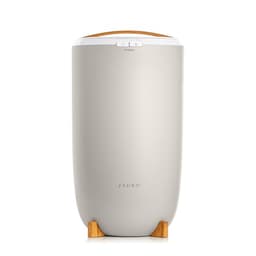
2. Best for the hot-towel moment
Zadro 20-Liter Towel Warmer Bucket
Zadro · TWB01 · best for a timed cycle rather than a habit
480 W with a published 15/30/45/60-minute auto-off timer — the format that manages itself.
A bucket has the timing problem solved in the box. Zadro publishes a timer you can “set to 15, 30, 45 or 60 minutes before automatically shutting off”, which at 480 W is not a convenience feature so much as a necessity.
The usage discipline is different from a rail: roll rather than fold, and take the towel out at the end of the cycle rather than leaving it in a warm sealed tub.
Renter-Safe Install Rating
- Drilling
- None
- Tools
- None
- Time to fit
- None — it arrives assembled and plugs in
- Power
- Standard outlet
- Reversible on move-out
- Fully
Why: It is an appliance that sits on the floor and plugs into an outlet. There is nothing to fit, so there is nothing to undo.
Read from published documentation, not from fitting one. Zadro, Large Towel Warmer Bucket 20L (TWB). How the verdict is derived: renter-safe ratings explained.
What it costs to run — Electricity
- Rated power
- 480 W (Zadro’s published maximum)
- Cycle length
- 30 minutes — the middle of Zadro’s own timer settings
- Electricity rate
- 18.34 cents per kWh (US residential average, June 2026)
480 W x 0.5 h / 1000 x $0.1834 = $0.044
About 4 cents for a 30-minute cycle, or roughly $16 a year if you run one every day
Arithmetic on published specifications, not a measurement. Rate source: U.S. Energy Information Administration, Electric Power Monthly Table 5.6.A — US residential average 18.34 cents/kWh, June 2026.
What’s wrong with it
It heats what is inside it and nothing else, so towels still need somewhere to live afterwards.
What we can’t tell you
No published heat-up time, so the right timer setting is found by trial rather than from the manual.
Published specifications
| Capacity | “20-Liter large towel heater tub” (5.3 gallons) |
|---|---|
| Maximum wattage | 480 W |
| Supply | 120 V AC, 60 Hz |
| Timer | “set timer to 15, 30, 45 or 60 minutes before automatically shutting off” |
| Dimensions | 21.25″ high, 12″ diameter |
| Weight | 8.5 lbs |
| Materials | “50% Plastic, 45% Metal, 5% Electronics” |
| Plug | “polarized B power plug for increased safety”, 83″ cord |
| Heat-up time | Not published |
| Maximum temperature | Not published |
#ad Price $169.99 as of October 18, 2026. Prices change; Amazon’s listing is the one that counts. How we’re funded.
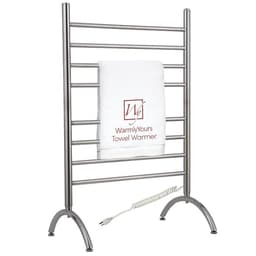
3. Best for a busy bathroom
WarmlyYours Barcelona Freestanding Towel Warmer
WarmlyYours · TW-BC-08BS-FS2 · best for households where the rack is always full
Eight bars and 150 W, published as warming “up to 2 large towels” — capacity is what stops a rack being crammed.
The most common usage mistake is overloading, and the fix is often capacity rather than technique. The Barcelona publishes eight bars and “8 brushed stainless steel bars to evenly distribute heat, warming up to 2 large towels”.
In a two-person household with daily showers, four bars are permanently occupied and nothing dries. Eight lets you leave gaps, which is where most of the drying actually happens.
Renter-Safe Install Rating
- Drilling
- None
- Tools
- None
- Time to fit
- Not published
- Power
- Standard outlet
- Reversible on move-out
- Fully
Why: WarmlyYours publishes it as freestanding on a NEMA 5-15 plug. It stands on the floor, plugs into a normal outlet, and leaves with you.
Read from published documentation, not from fitting one. WarmlyYours, Barcelona Freestanding Towel Warmer (TW-BC-08BS-FS2). How the verdict is derived: renter-safe ratings explained.
What it costs to run — Electricity
- Rated power
- 150 W (WarmlyYours's published figure)
- Run time
- 2 hours a day on a plug-in timer
- Electricity rate
- 18.34 cents per kWh (US residential average, June 2026)
150 W x 2 h / 1000 x $0.1834 = $0.055 a day
About 6 cents a day on a two-hour timer, or roughly $20 a year
Arithmetic on published specifications, not a measurement. Rate source: U.S. Energy Information Administration, Electric Power Monthly Table 5.6.A — US residential average 18.34 cents/kWh, June 2026.
What’s wrong with it
It is 24 inches wide and 37 tall — real floor space, in a room that rarely has spare.
What we can’t tell you
No published warm-up time.
Published specifications
| Wattage | “150 W” |
|---|---|
| Supply | “120 V”, “1.25 A” |
| Heat output | “512 Btu” per hour |
| Bars | “8” heated round bars, “warming up to 2 large towels” |
| Dimensions | “24″ (610 mm) W x 37″ (940 mm) H x 15.5″ (394 mm) D” |
| Material | “304-stainless steel”, “Brushed Stainless Steel” finish |
| Cord and plug | “77″” cord, “NEMA 5-15 (Type B)” |
| Mounting | “Freestanding” |
| Safety | “built-in TempSmart™ overheat protection” limiting surface temperature to 167°F, plus an “Integrated power switch with indicator light” |
| Certification | “cETLus listed” |
| Warranty | “2 years” |
Source: WarmlyYours, Barcelona Freestanding Towel Warmer (TW-BC-08BS-FS2)
#ad Price $280.30 as of October 18, 2026. Prices change; Amazon’s listing is the one that counts. How we’re funded.
Where to buy
Everything recommended on this page, in one place. Each link is an Amazon Associates link — we earn a commission at no extra cost to you, and it never decides a pick.
- $351.00View on Amazon
WarmlyYours Ibiza Freestanding Towel Warmer
WarmlyYours · TWS5-IBZ06PP · Renter verdict: Safe
- $169.99View on Amazon
Zadro 20-Liter Towel Warmer Bucket
Zadro · TWB01 · Renter verdict: Safe
- $280.30View on Amazon
WarmlyYours Barcelona Freestanding Towel Warmer
WarmlyYours · TW-BC-08BS-FS2 · Renter verdict: Safe
#ad Prices are not shown because we only publish figures we have verified on the day. How we’re funded.
Questions people actually ask
towel warmer how to use
For a rail: put it on a plug-in timer, drape towels over single bars rather than folding them, and leave gaps so air can circulate. For a bucket: roll the towel, set the timer, and take it out when the cycle ends rather than leaving it in a sealed warm tub.
heated towel rack how to use
Drape rather than fold, leave gaps between towels, and run it on a timer for a couple of hours rather than continuously. Running it around the time towels are actually wet does more than running it before anyone has showered.
towel warmer how to turn on
Freestanding rails from WarmlyYours have an integrated power switch and otherwise run whenever they are plugged in, which is why a plug-in timer is worth having. Buckets have a control panel with timed cycles that shut off automatically.
should you leave a heated towel rail on all the time
No. At 90 W that costs roughly $145 a year against about $12 on a two-hour daily timer, and towels finish drying long before the day is out. The twelve-fold difference is the single biggest variable in owning one.
Sources
Read next
Back to Warmers & Comfort.