What is a towel warmer?
Three quite different products share this name, and knowing which is which is most of the buying decision.
By Sawyer V. · · How we research
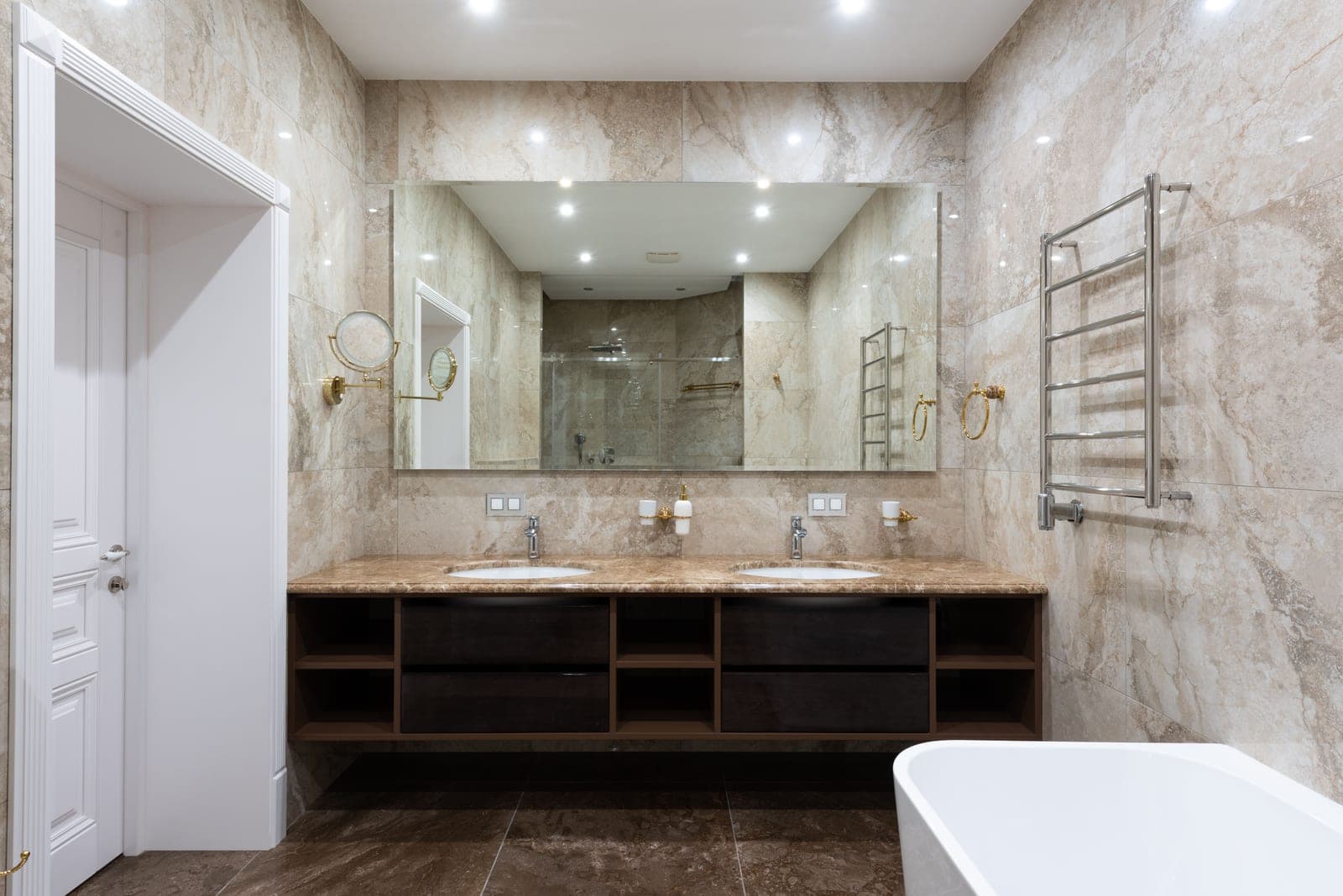
The short answer
We earn a commission if you buy through the links on this page, at no extra cost to you. It does not change which products we pick or what we say about them — here is exactly how that works.
Quick picks
Tap any row for the full write-up. Prices are checked against Amazon rather than remembered — where we have no verified figure the button says so.
| # | Product | Best for | Renter | Price |
|---|---|---|---|---|
| 1 |  WarmlyYours Ibiza Freestanding Towel Warmer Six heated bars, 90 W, freestanding — warm and dry towels rather than hot ones. | Seeing what a rail is | Safe | |
| 2 |  Zadro 20-Liter Towel Warmer Bucket An insulated 20-liter tub at 480 W with a timer — one properly hot towel per cycle. | Seeing what a bucket is | Safe |
The three formats
The rail (or rack). Heated bars, low wattage, continuous. Warms and dries several towels. Freestanding, wall-mounted or hardwired. This is what most people picture.
The bucket. An insulated tub with an element in the base, high wattage, run in timed cycles. Heats one or two rolled towels properly hot. Cheapest format, takes floor space, needs airing out between uses.
The cabinet. A heated box, usually with UV sanitizing, used in salons and spas. Expensive, large, and essentially a commercial product. Not covered on this site.
The full rail-versus-bucket comparison, with the arithmetic, is in bucket vs rack.
What the wattage actually tells you
Wattage is the most useful number on a towel warmer’s specification sheet, and it tells you two things at once.
How it behaves. Low wattage over a long period keeps things warm and dry. High wattage over a short period makes things hot. That is why a 90 W rail and a 480 W bucket feel completely different despite using similar total energy per day.
What it costs. watts × hours ÷ 1,000 × your rate per kWh. At the US average of 18.34 cents per kWh, the 90 W rail on a two-hour timer is about three cents a day. The full cost table is here.
Which is why a manufacturer that does not publish a wattage has withheld the one figure that would let you evaluate the product. VEVOR and Brookstone both do this, and we say so on their product cards.
What a towel warmer does not do
It does not heat the room. 307 BTU/hr is a rounding error against a heating system. Manufacturers are careful never quite to claim otherwise, and it is worth noticing the care. If your bathroom is cold, you want a heater.
It does not sanitize. Salon cabinets with UV lamps do; a heated rail does not, and any listing implying otherwise is stretching.
It does not dry a soaking towel quickly. A rail is gentle by design. It removes the residual damp that makes towels smell; it is not a tumble dryer.
The benefit people do not expect
Ask people who own one what they actually like about it, and the warm towel is usually the second answer. The first is that their towels stopped smelling.
A bathroom with modest ventilation leaves a towel damp for most of the day. Damp cotton develops a sour smell within a day or two, which is why towels in some bathrooms need washing twice as often as they should. A rail running a few hours a day dries them properly, and the problem disappears.
That is a small, unglamorous, entirely real benefit, and it is the one nobody puts on the box.
Mounting, and what it means for renters
Freestanding stands on the floor and plugs in. Nothing is fitted, so it is Safe on our install rating.
Wall-mounted plug-in screws to the wall and uses a normal outlet. No electrician, but anchors in tile — Owner-only.
Hardwired connects permanently to your electrical system. Electrician work, and not something this site covers.
For a renter the choice is straightforward: freestanding rail, or a bucket. Both plug in, both leave with you.
Every pick in full
2 we would buy. Each carries its Renter-Safe Install Rating, the published specs behind it, and the honest gap in what we know.
1. The rail, explained
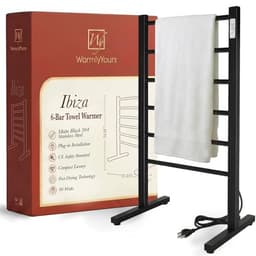
WarmlyYours Ibiza Freestanding Towel Warmer
WarmlyYours · TWS5-IBZ06PP · best for seeing what a rail is
Six heated bars, 90 W, freestanding — warm and dry towels rather than hot ones.
A rail is a ladder of hollow metal bars with a heating element inside, running continuously at low power. WarmlyYours publishes 90 W and 307 BTU/hr across six bars in 304 stainless.
The right mental model is a very gentle radiator that is also where your towels live. It never gets a towel hot; it stops one being damp.
Renter-Safe Install Rating
- Drilling
- None
- Tools
- None
- Time to fit
- Not published
- Power
- Standard outlet
- Reversible on move-out
- Fully
Why: WarmlyYours publishes this one as freestanding with a NEMA 5-15 plug: it stands on the floor, plugs into a normal outlet, and leaves with you.
Read from published documentation, not from fitting one. WarmlyYours, Ibiza Freestanding Towel Warmer (TWS5-IBZ06PP). How the verdict is derived: renter-safe ratings explained.
What it costs to run — Electricity
- Rated power
- 90 W (WarmlyYours’s published figure)
- Run time
- 2 hours a day on a plug-in timer
- Electricity rate
- 18.34 cents per kWh (US residential average, June 2026)
90 W x 2 h / 1000 x $0.1834 = $0.033 a day
About 3 cents a day, or roughly $12 a year on a two-hour daily timer
Arithmetic on published specifications, not a measurement. Rate source: U.S. Energy Information Administration, Electric Power Monthly Table 5.6.A — US residential average 18.34 cents/kWh, June 2026.
What’s wrong with it
It is furniture — 34.84 inches tall and 21.85 wide.
What we can’t tell you
No published warm-up time.
Published specifications
| Wattage | “90 W” |
|---|---|
| Supply | “120 V”, “0.75 A” |
| Heat output | “307 Btu” per hour |
| Bars | “6” heated bars |
| Dimensions | “34.84″ (885 mm) H x 21.85″ (555 mm) W x 13.97″ (355 mm) D” |
| Material | “304-stainless steel”, published in “Polished Stainless Steel” and “Matte Black” finishes |
| Cord and plug | “71″” cord, “NEMA 5-15 (Type B)” |
| Mounting | “Freestanding” — no wall mounting or drilling |
| Safety | “built-in TempSmart overheat protection” preventing surface temperatures above “149°F (65°C)” |
| Certification | “cULus Listed” |
| Warranty | “5-year limited warranty” |
Source: WarmlyYours, Ibiza Freestanding Towel Warmer (TWS5-IBZ06PP)
#ad Price $351.00 as of October 18, 2026. Prices change; Amazon’s listing is the one that counts. How we’re funded.
2. The bucket, explained
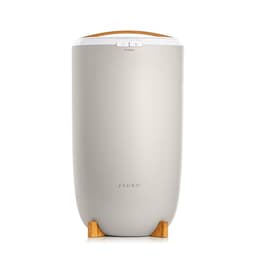
Zadro 20-Liter Towel Warmer Bucket
Zadro · TWB01 · best for seeing what a bucket is
An insulated 20-liter tub at 480 W with a timer — one properly hot towel per cycle.
A bucket is a heating element in an insulated container. Zadro publishes 20 liters, 480 W and timer settings of “15, 30, 45 or 60 minutes”.
Five times the power of a rail into a small insulated space produces a sensation the rail cannot: a towel that is actually hot when you take it out.
Renter-Safe Install Rating
- Drilling
- None
- Tools
- None
- Time to fit
- None — it arrives assembled and plugs in
- Power
- Standard outlet
- Reversible on move-out
- Fully
Why: It is an appliance that sits on the floor and plugs into an outlet. There is nothing to fit, so there is nothing to undo.
Read from published documentation, not from fitting one. Zadro, Large Towel Warmer Bucket 20L (TWB). How the verdict is derived: renter-safe ratings explained.
What it costs to run — Electricity
- Rated power
- 480 W (Zadro’s published maximum)
- Cycle length
- 30 minutes — the middle of Zadro’s own timer settings
- Electricity rate
- 18.34 cents per kWh (US residential average, June 2026)
480 W x 0.5 h / 1000 x $0.1834 = $0.044
About 4 cents for a 30-minute cycle, or roughly $16 a year if you run one every day
Arithmetic on published specifications, not a measurement. Rate source: U.S. Energy Information Administration, Electric Power Monthly Table 5.6.A — US residential average 18.34 cents/kWh, June 2026.
What’s wrong with it
One or two towels at a time, and nowhere for them to go afterwards.
What we can’t tell you
No published maximum temperature or heat-up time.
Published specifications
| Capacity | “20-Liter large towel heater tub” (5.3 gallons) |
|---|---|
| Maximum wattage | 480 W |
| Supply | 120 V AC, 60 Hz |
| Timer | “set timer to 15, 30, 45 or 60 minutes before automatically shutting off” |
| Dimensions | 21.25″ high, 12″ diameter |
| Weight | 8.5 lbs |
| Materials | “50% Plastic, 45% Metal, 5% Electronics” |
| Plug | “polarized B power plug for increased safety”, 83″ cord |
| Heat-up time | Not published |
| Maximum temperature | Not published |
#ad Price $169.99 as of October 18, 2026. Prices change; Amazon’s listing is the one that counts. How we’re funded.
Where to buy
Everything recommended on this page, in one place. Each link is an Amazon Associates link — we earn a commission at no extra cost to you, and it never decides a pick.
- $351.00View on Amazon
WarmlyYours Ibiza Freestanding Towel Warmer
WarmlyYours · TWS5-IBZ06PP · Renter verdict: Safe
- $169.99View on Amazon
Zadro 20-Liter Towel Warmer Bucket
Zadro · TWB01 · Renter verdict: Safe
#ad Prices are not shown because we only publish figures we have verified on the day. How we’re funded.
Questions people actually ask
what is a towel warmer
An electrically heated rail, bucket or cabinet that warms and dries towels. Rails run continuously at low wattage and keep several towels warm and dry; buckets run high wattage in short timed cycles and make one or two towels genuinely hot.
what is heated towel rail
A ladder of hollow metal bars with a heating element inside, mounted on a wall or standing on the floor. WarmlyYours publishes 90 W and 307 BTU/hr for a six-bar freestanding model — enough to dry towels, not to heat a room.
what is a towel warmer bucket
An insulated tub with a heating element in the base and a lid. You roll a towel into it and set a timer; twenty to thirty minutes later the towel is hot. Zadro publishes 20 liters and a 480 W maximum.
Sources
Read next
Back to Warmers & Comfort.