How to stop hard water spots on shower glass
Two pages on this site tell you that a filter will not fix scale on the glass. This is the page that says what will.
By Sawyer V. · · How we research
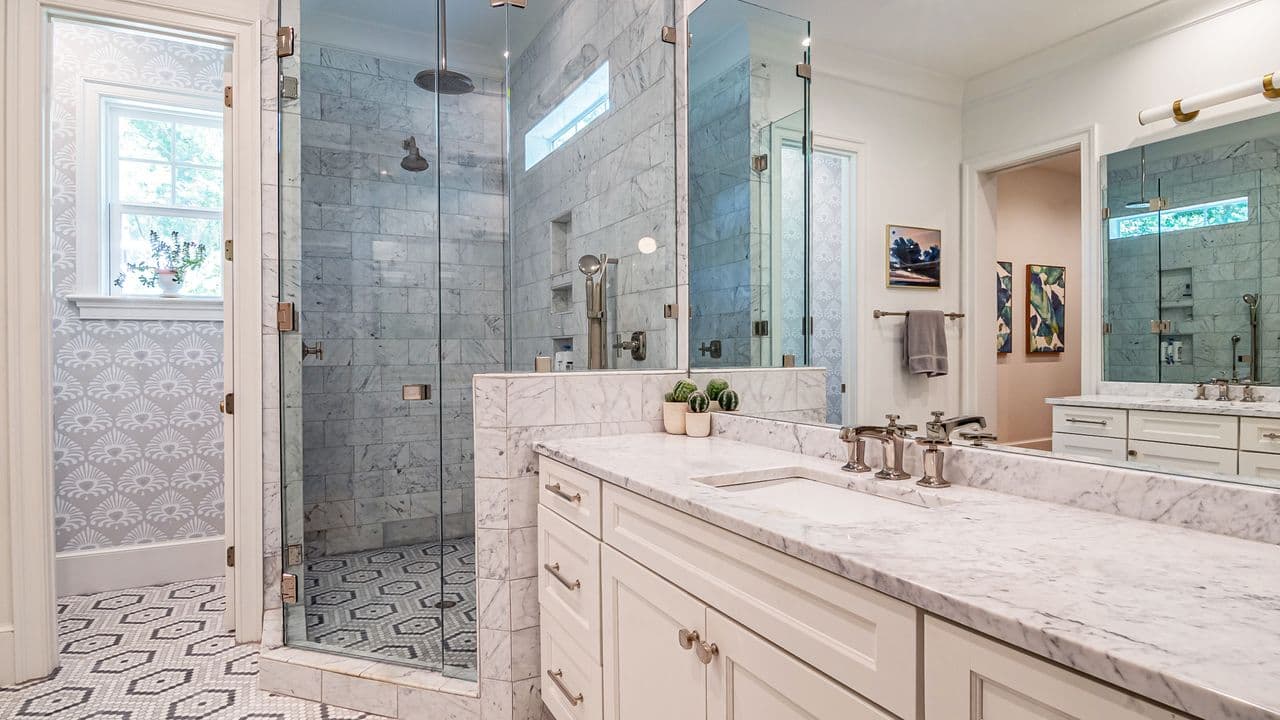
The short answer
We earn a commission if you buy through the links on this page, at no extra cost to you. It does not change which products we pick or what we say about them — here is exactly how that works.
Quick picks
Tap any row for the full write-up. Prices are checked against Amazon rather than remembered — where we have no verified figure the button says so.
| # | Product | Best for | Renter | Price |
|---|---|---|---|---|
| 1 |  Window Vac WV 1 Plus (White) A cordless vacuum that lifts the water into a 3.38 oz tank instead of pushing it onto the floor, with 25 minutes of run time per charge. | A large glass enclosure, or anyone who will not use a squeegee twice | Safe |
What a spot actually is
Tap water carries dissolved minerals, mostly calcium and magnesium. When a drop sits on vertical glass and the water evaporates, the water leaves and the minerals do not. The white ring you are looking at is the dissolved solids from one drop, left behind in the shape the drop dried in.
Two consequences follow, and they organize this entire page. First, the problem is evaporation, not dirt — which is why scrubbing harder does not prevent it. Second, it is cumulative. Each shower adds a layer, and layers bond. Fresh deposits wipe off; three months of deposits need an acid and a lot of patience.
Do you actually have hard water?
Worth settling before you buy anything, because the answer is published and free. The USGS gives the classification in milligrams per liter as calcium carbonate: “0 to 60 mg/L (milligrams per liter) as calcium carbonate is classified as soft; 61 to 120 mg/L as moderately hard; 121 to 180 mg/L as hard; and more than 180 mg/L as very hard”. It also names the cause plainly: “compounds of calcium and magnesium, and by a variety of other metals”.
Your own figure comes from your water supplier’s annual water quality report, which states hardness alongside everything else it tests for. You do not need a test kit to find out, and the number tells you how quickly the glass will spot rather than whether it will — even soft water leaves something behind when it dries.
If you land in the hard or very hard bands, treat the daily routine below as the maintenance schedule for the enclosure, in the same way a hard-water bathroom needs a shower head that is easy to descale. The hard-water shower head picks are here.
Why no shower filter fixes it
This is the most common wasted purchase in the category, and it is worth being precise about why. A shower filter reduces what is reactive in the water — chlorine, mostly, tested to NSF/ANSI 177. Hardness is a different property, removed by ion exchange, and no cartridge that screws onto a shower arm does it.
The site says this already in two places. The premium filtered heads page tells you to buy neither if your complaint is limescale on the glass, and the hard-water picks page treats scale as a water problem rather than a fitting problem. Neither page had anywhere to send you next, which is why this one exists. What shower filters do and do not do is here.
So remove the water
If the minerals arrive dissolved in water and are deposited by evaporation, then interrupting the evaporation is the whole fix. Get the water off the glass and there is nothing left to dry.
This is unglamorous and it is free. A squeegee pass takes about thirty seconds on a standard enclosure, and the step-by-step above is the whole method. The only thing that makes it fail is doing it sometimes.
Once a day is enough. The habit that sticks for most households is the last person out of the shower does the glass, the same way the last person out of the kitchen wipes the counter.
Squeegee or window vac
A squeegee is a few dollars, needs no power, and pushes the water downward: onto the frame, into the bottom track and onto the tray. Those are the places that scale worst, so the routine has to include wiping them.
A window vac lifts the water into a tank instead. It is heavier, it needs charging, and it costs roughly five times as much — but it takes the water out of the enclosure entirely, and the one above is the only product in this corner of the bathroom whose maker publishes a nozzle width, a tank size, a run time and a coverage figure.
We rank only the one, and the reason is the same one that keeps bath trays and caddies off the bathtub upgrades page: most makers in the accessory aisle publish nothing to rank them on. Squeegees are a clear case. The large brands either do not publish a blade material and width at all, or do not make one; the rest are unbranded. We are not going to invent a ranking out of listing copy.
If your glass has a coating
Some shower doors leave the factory with a hydrophobic treatment on the glass. Kohler publishes one on the Levity bypass door we rank — CleanCoat+, which it describes as a coating that “creates a hydrophobic barrier that repels water, soap scum, and residue”. If your enclosure is recent, check the maker’s spec sheet before you decide you have a cleaning problem.
Understand what a coating does and does not do. It makes water bead and run off faster, so fewer drops are left sitting to evaporate, and it buys you time. It does not change the mineral content of the water, and it is not permanent. Every coating in this category is a surface treatment that wears.
What wears it out fastest is the thing people reach for when spots appear: an abrasive pad, a scouring cream, or a strong acid left on too long. So the daily wipe matters more on coated glass, not less — it is what keeps you from ever needing the pad that destroys the coating. If you are buying an enclosure now, which doors publish a coating is covered on the sliding doors page, and what framed and frameless actually mean on a spec sheet is here.
When the glass is already covered
Prevention is a different job from removal, and this page is about prevention. If the glass is already crusted, the deposit is calcium carbonate and it comes off with an acid — the same white vinegar soak we use on a blocked shower head, given far longer to work. The vinegar method and the finishes it will damage are set out here, and the warnings there apply to the frame and the hinges even when the glass itself is fine.
Start the daily routine from the day the glass is clear, not before. Removing three months of scale and then going back to doing nothing simply restarts the clock.
What we have not done
We have not tested a squeegee against a window vac, measured a water spot, or run a hardness test on anybody’s supply. Every figure on this page is published by Kärcher or Culligan and cited at the foot of it. The mechanism — dissolved minerals, evaporation, deposition — is chemistry rather than a finding of ours, and the thirty-second routine is reasoning from that mechanism, labeled as reasoning. Where a maker publishes nothing, this page says so instead of filling the gap. Prices are read live and shown with the date they were checked.
Every pick in full
1 we would buy. Each carries its Renter-Safe Install Rating, the published specs behind it, and the honest gap in what we know.
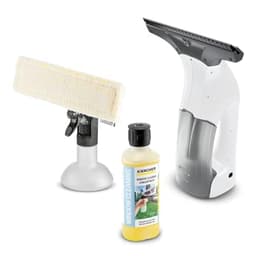
1. The tool that publishes its numbers
Window Vac WV 1 Plus (White)
Kärcher · WV 1 Plus — order number 1.633-609.0 · best for a large glass enclosure, or anyone who will not use a squeegee twice
A cordless vacuum that lifts the water into a 3.38 oz tank instead of pushing it onto the floor, with 25 minutes of run time per charge.
Kärcher’s WV 1 Plus is the only product in this category whose maker publishes anything you can check. The specification table gives a “Working width of vacuum nozzle (in) 9.84”, a “Dirty water container capacity (oz) 3.38”, “Battery run time (min) 25” against a “Battery charging time (min) 150”, and a coverage figure of “Performance per battery charge (ft²) approx. 590”.
It matters here for one mechanical reason: a squeegee moves the water, and a window vac removes it. The water a squeegee pushes down the glass ends up in the tray, on the frame and in the bottom track — which is exactly where the worst scale forms. The WV 1 Plus puts it in a tank you empty at the basin.
Kärcher names the use case rather than leaving you to infer it: “The Window Vac can be used on all smooth surfaces such as tiles, mirrors and shower areas”. At 1.1 lb with the battery it is light enough to use one-handed, and the box includes a spray bottle with a microfiber cloth and 16.91 fl oz of cleaning concentrate.
Renter-Safe Install Rating
- Drilling
- None
- Tools
- None
- Time to fit
- None — charge it and use it
- Power
- Standard outlet, to charge only
- Reversible on move-out
- Fully
Why: A cordless handheld that charges from a normal socket. Nothing is fixed to the building, so there is nothing to make good.
Read from published documentation, not from fitting one. Kärcher — Window Vac WV 1 Plus (White), order number 1.633-609.0: published nozzle width, tank capacity, run and charge times, coverage per charge, weight, dimensions, box contents, surfaces and warranty. How the verdict is derived: renter-safe ratings explained.
What’s wrong with it
It costs roughly five times a squeegee, needs charging, and 25 minutes of run time means a 150-minute recharge for a job that takes 30 seconds a day.
What we can’t tell you
Battery voltage is not published, and neither is a minimum or maximum surface temperature — so how it behaves on glass straight after a hot shower is not stated. Kärcher's own category FAQ also says “up to 30 minutes” where the specification table says 25.
Published specifications
| Blade width | “Working width of vacuum nozzle (in) 9.84” |
|---|---|
| Tank | “Dirty water container capacity (oz) 3.38” |
| Run time | “Battery run time (min) 25” on a full charge |
| Charge time | “Battery charging time (min) 150” |
| Coverage per charge | “Performance per battery charge (ft²) approx. 590” on the white version |
| Battery | “Lithium ion battery”. Kärcher publishes no battery voltage |
| Weight | “Weight incl. battery (lb) 1.1” |
| Dimensions | “Dimensions (L x W x H) (in) 5.1 x 9.8 x 10.8” |
| Surfaces | “The Window Vac can be used on all smooth surfaces such as tiles, mirrors and shower areas” — the maker names shower use directly |
| In the box | Battery charger, “Spray bottle Standard with microfiber wiping cloth” and “Cleaning agents, 16.91 fl oz” |
| Warranty | “1 Yr Warranty w/Rapid Exchange Program” |
| Surface temperature limits | Not published — Kärcher states no minimum or maximum surface temperature on the product page |
#ad Price $79.82 as of November 5, 2026. Prices change; Amazon’s listing is the one that counts. How we’re funded.
Where to buy
Everything recommended on this page, in one place. Each link is an Amazon Associates link — we earn a commission at no extra cost to you, and it never decides a pick.
- $79.82View on Amazon
Window Vac WV 1 Plus (White)
Kärcher · WV 1 Plus — order number 1.633-609.0 · Renter verdict: Safe
#ad Prices are not shown because we only publish figures we have verified on the day. How we’re funded.
Questions people actually ask
will a shower filter stop hard water spots on glass
No. A shower filter is tested for chlorine reduction under NSF/ANSI 177; hardness is a different property and is removed by ion exchange at the main, not at the shower arm. A filter will change how the water smells and feels and will not change what the glass looks like.
how often should you squeegee shower glass
Once a day, after the last shower, while the glass is still wet. The deposits are cumulative, so consistency matters far more than thoroughness — a quick pass every day beats a careful one every week.
what causes white spots on shower glass
Dissolved calcium and magnesium in the tap water. When a drop evaporates, the water leaves and the minerals stay behind in the shape the drop dried in. It is a deposit, not dirt, which is why cleaning harder does not prevent the next one.
is a window vac better than a squeegee for shower glass
It removes the water rather than pushing it down onto the frame, tray and bottom track, which are the parts that scale worst. It also costs about five times as much and needs charging. Kärcher publishes 25 minutes of run time against 150 minutes of charging for the WV 1 Plus.
how do you get rid of limescale already on shower glass
An acid, not a scrubber. White vinegar dissolves calcium carbonate given enough contact time — the same method used on a blocked shower head, left far longer. Check the finish warnings before you let it touch frames, hinges or plated hardware.
Sources
- USGS Water Science School — Hardness of water: published classification bands in mg/L as calcium carbonate, and the cause of hardness
- Kärcher — Window Vac WV 1 Plus (White), order number 1.633-609.0: published nozzle working width, dirty water capacity, battery run and charge times, coverage per charge, weight, dimensions, box contents, named surfaces including shower areas, and warranty
Read next
Back to Showers & Showerheads.