Terry vs gauze towels
Two completely different ways to build a towel out of the same fiber. One traps water in thousands of little wells; the other holds it between four flat layers and gives it back fast.
By Sawyer V. · · How we research
The short answer
We earn a commission if you buy through the links on this page, at no extra cost to you. It does not change which products we pick or what we say about them — here is exactly how that works.
Quick picks
Tap any row for the full write-up. Prices are checked against Amazon rather than remembered — where we have no verified figure the button says so.
| # | Product | Best for | Renter | Price |
|---|---|---|---|---|
| 1 |  Handwoven 4-Layer Muslin Turkish Cotton Towel Four layers of 100% Turkish cotton gauze at a published ~32 x 67 in., handwoven in Denizli, OEKO-TEX STANDARD 100 certified, with a stated 3-5% shrinkage. | A small or unventilated bathroom, and anyone who wants a big towel that is not heavy | Safe | |
| 2 |  ONSEN Sculpted Terry Bath Towel 28 x 55 in. of 100% USA-grown cotton in a short-loop sculpted terry, OEKO-TEX STANDARD 100 certified, with a 60-shower trial. | Anyone who wants pile against the skin and a published certification behind it | Safe | |
| 3 |  Air Weight Organic Towels 550 GSM of organic cotton in a twill weave with long loops, carrying GOTS, Fair Trade and Made Safe certification. | Someone who wants the substantial-towel feeling and has somewhere for it to dry | Safe |
The structural difference, in one paragraph each
Terry is a pile fabric. Thousands of cotton loops are woven so that they stand up off a backing cloth, and each loop is a little well that holds water by capillary action. That is why a terry towel feels deep, why it absorbs a lot, and why it takes so long to dry: the water is held inside a structure designed to hold it.
Gauze is a flat fabric used in multiples. Several very fine, loosely woven layers are joined so that the towel is thin in any one place but several plies thick overall — Viva Maison publishes four, and describes the weave as “an open, breathable gauze weave” that “dries you with a soft, lint-free touch”. Water sits between and within those layers rather than in standing loops, and because every layer is exposed to air on at least one side, it leaves again quickly.
Gauze or muslin? The same thing, in this market
You will see both words on the same product, and that is not a trick. Viva Maison’s own page describes the fabric as “100% Turkish cotton gauze” while the towel is sold as a muslin towel; Japanese makers use “gauze”, Turkish makers more often use “muslin”, and the construction being described — multiple fine plain-woven layers — is the same.
What does vary, and what you should check, is the number of layers. Two-ply, four-ply and six-ply towels all exist and they are not interchangeable: more plies means more absorbency and more drying time, moving the fabric slowly back toward terry’s trade-offs.
What each side publishes
| Viva Maison gauze | ONSEN sculpted terry | Coyuchi Air Weight | |
|---|---|---|---|
| Construction | 4 layers of cotton gauze | Short-loop sculpted terry | Twill weave, long loops |
| Published size | ~32 x 67 in. (approximate) | 28 x 55 in. | Not published |
| Published weight | Not published | Not published | 550 GSM |
| Fiber | Long-staple Aegean (Turkish) cotton | 100% USA-grown cotton | Organic cotton, grown and woven in India |
| Certification | OEKO-TEX Standard 100 | OEKO-TEX STANDARD 100 | GOTS + Fair Trade + Made Safe |
| Shrinkage | About 3–5% after the first wash | Not published | Not published |
| Fabric softener | “Do not use” | “Avoid” | Cold wash, gentle cycle |
Read the weight row carefully, because it is the honest limit of this comparison. Only one of these three publishes a GSM. You can compare the gauze towel with the Coyuchi on construction and on size, but nobody can tell you how the gauze towel and the ONSEN terry compare on density, because neither maker states a figure.
Size: the difference people do not expect
The published dimensions upend the usual assumption that a lighter towel is a smaller one. The gauze towel is ~32 x 67 in. and the terry towel is 28 x 55 in.— the gauze is wider and a foot longer, in the size class the industry calls a bath sheet, and it still weighs less because there is no pile to carry.
That is the real argument for gauze in a small bathroom. You get bath-sheet coverage on a rail that could never dry a terry bath sheet in a single layer. Sheet against towel, on the sizes everyone publishes, is here.
Absorbency, honestly
Gauze absorbs. Cotton is cotton, and four plies of it move water off skin perfectly well — Viva Maison publishes “absorb fast, dry faster”. What gauze has less of is capacity: fewer grams of fiber means less total water held before the towel feels wet in the hand.
For one person drying once, capacity rarely matters — you finish before the towel does. For long hair, or a towel shared between two people back to back, it does, and that is the honest dividing line between these two fabrics rather than any claim about which one “absorbs better”. The long-hair case is covered here.
Drying: the claim everyone makes and nobody measures
Every maker on this page publishes a drying claim and not one publishes a drying time. Viva Maison goes furthest — “lighter and quicker to dry than a terry towel”, and elsewhere that muslin “dries itself in a fraction of the time”; ONSEN publishes its short-loop weave as drying faster than traditional terry; Coyuchi publishes “drying off quickly and efficiently”.
We have not timed any of them and we are not going to put a number on it. What the published construction tells you is the direction and the reason: less fiber and more exposed surface dries sooner, which is why a four-ply gauze towel is the fastest-drying thing on this page and a 550 GSM long-loop towel is the slowest.
That matters most where it is hardest to see: a towel that never fully dries is a towel that starts to smell, and no amount of washing fixes it while the drying time stays the same. The full fix is here.
Care, and the one rule both sides publish
No fabric softener. Viva Maison publishes “Do not use fabric softener”; ONSEN publishes “avoid using fabric softeners & conditioners”. Softener leaves a coating on the fiber, and a coated fiber repels water — it is the most common reason a towel “stops working” long before it wears out.
Beyond that the routines differ in one respect worth knowing. Gauze is published for line drying as much as tumble drying — Viva Maison writes “muslin loves air-drying” — and it is light enough that line drying is practical indoors. A 550 GSM terry towel on an indoor rack is simply a slow, damp object.
How each one ages
Terry sheds a little at first and then settles; the loops flatten with years of washing, which is what makes an old towel feel thin.
Gauze does the opposite in one respect: Viva Maison publishes that “The cotton blooms and softens with every wash”, which is the usual behavior of a loosely woven plain cloth. It also publishes the cost of that — the “about 3-5%” first-wash shrinkage. On the published 67 in. length that is roughly two to three inches, so buy with that in mind rather than measuring the towel the day it arrives.
Which to buy
Gauze if your bathroom has poor ventilation, if rail space is short, if you want bath-sheet coverage without bath-sheet weight, or if you travel with your own towel. It is also the better answer in a hot climate, where a heavy towel never really recovers between uses.
Terry if the sensation of pile is the point, or if capacity matters — long hair, shared towels, a towel used twice before it is washed. Note what is not on this list: certification. Both formats here are OEKO-TEX STANDARD 100, so the label is not a reason to pick one over the other. The full towel ranking is here.
Who should skip both
If you want fast drying and pile. Waffle sits between these two: a honeycomb of raised ridges, far less fiber than terry, more texture than gauze. Whether waffle is worth it is answered here.
If the room never dries. No fabric wins against a bathroom with no working extractor; fix the air before you buy textiles. Fan against window is compared here.
What we have not done
We have not weighed a wet towel, timed a drying rack or run a wash test. Every figure on this page is published by its maker and linked under the spec table on each pick, and the gaps are stated: no weight for the gauze towel, no weight for the ONSEN terry, no dimensions for the Coyuchi, and no drying time from anybody at all.
Every pick in full
3 we would buy. Each carries its Renter-Safe Install Rating, the published specs behind it, and the honest gap in what we know.
1. The gauze one
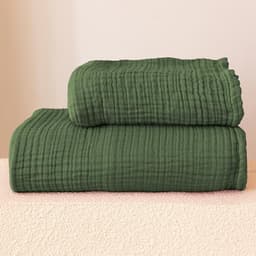
Handwoven 4-Layer Muslin Turkish Cotton Towel
Viva Maison · 4-Layer Muslin Turkish Cotton Towel (Denizli) · best for a small or unventilated bathroom, and anyone who wants a big towel that is not heavy
Four layers of 100% Turkish cotton gauze at a published ~32 x 67 in., handwoven in Denizli, OEKO-TEX STANDARD 100 certified, with a stated 3-5% shrinkage.
Viva Maison’s 4-layer muslin towel is the clearest published example of the format. The maker describes “four layers of 100% Turkish cotton gauze” in “long-staple Aegean cotton”, “handwoven in Denizli, Turkey”.
The size is the thing most people miss. At a published “~32 x 67” in. this is bath-sheet territory — four inches wider and a foot longer than the terry towel below it — while weighing far less, because four fine layers carry nothing like the cotton of a pile. You get a towel you can actually wrap in without a towel you have to wrestle onto a rail.
Viva Maison publishes two things almost nobody in this category states. The first is a shrinkage figure: “minimal shrinkage of about 3-5% after the first wash”, which on a 67 in. towel is two to three inches you should expect to lose. The second is a direct drying claim — “lighter and quicker to dry than a terry towel” and “Airy gauze layers that absorb fast, dry faster”.
It is also “OEKO-TEX Standard 100 certified” — the same standard the terry towel below it carries, and Viva Maison publishes that “Every color is covered by the towel’s OEKO-TEX Standard 100 certification”, which is the detail most brands leave vague when a range runs to ten colors.
Care is published and strict in one respect: “Machine wash cold (30°C max) with similar colors”, “Tumble dry low or line dry”, “Do not use fabric softener” and “Avoid bleach”. Softener is the one that matters: it coats the fiber and takes the absorbency with it.
Renter-Safe Install Rating
- Drilling
- None
- Tools
- None
- Time to fit
- None
- Power
- None
- Reversible on move-out
- Fully
Why: A towel. There is nothing to install and nothing to put back.
Read from published documentation, not from fitting one. Viva Maison — Handwoven 4-Layer Muslin Turkish Cotton Towel (Denizli), published fiber, layer count, dimensions, drying claim, shrinkage and care. How the verdict is derived: renter-safe ratings explained.
What’s wrong with it
No published weight and no published GSM, so it cannot be compared on density with the towels below it — and a flat four-ply cloth will never feel as deep in the hand as a pile.
What we can’t tell you
No drying time is published by anyone in this category, including here. “Dries faster” is a claim about direction, not a measurement.
Published specifications
| Weave | “four layers of 100% Turkish cotton gauze”; “Muslin is an open, breathable gauze weave” |
|---|---|
| Fiber | “100% Turkish cotton gauze”; “long-staple Aegean cotton” |
| Dimensions | Bath towel “~32 x 67” in. (“~80 x 170” cm); face and hand size “~18 x 34” in. — “All sizes are approximate” |
| Made in | “handwoven in Denizli, Turkey” |
| Drying claim | “lighter and quicker to dry than a terry towel”; “Airy gauze layers that absorb fast, dry faster” |
| Shrinkage | “minimal shrinkage of about 3-5% after the first wash” |
| Care | “Machine wash cold (30°C max) with similar colors”; “Tumble dry low or line dry (muslin loves air-drying)”; “Do not use fabric softener”; “Avoid bleach” |
| Weight | Not published |
| GSM | Not published |
| Certification | “OEKO-TEX Standard 100 certified”; “Every color is covered by the towel’s OEKO-TEX Standard 100 certification”; OEKO-TEX Standard 100 “certifies that the product meets the standard’s limit values for harmful substances” |
| Warranty | Not published |
#ad Price $44.99 as of October 18, 2026. Prices change; Amazon’s listing is the one that counts. How we’re funded.
2. The terry one
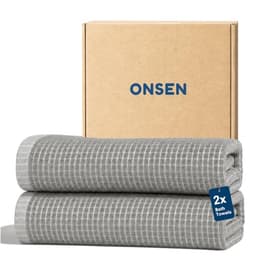
ONSEN Sculpted Terry Bath Towel
ONSEN · Sculpted Terry Bath Towel · best for anyone who wants pile against the skin and a published certification behind it
28 x 55 in. of 100% USA-grown cotton in a short-loop sculpted terry, OEKO-TEX STANDARD 100 certified, with a 60-shower trial.
ONSEN’s sculpted terry is terry built to narrow the gap. ONSEN publishes “28 x 55 in or 71 x 140 cm”, “100% USA-grown cotton” and a short-loop sculpted weave published as drying faster than traditional terry.
Short loops are the compromise position between the two fabrics on this page. You keep the pile — the thing people actually mean when they say they want a proper towel — while cutting the reservoir that makes a long-loop plush towel take a day and a half to dry. The third option, waffle, is compared with terry here.
It is “OEKO-TEX® STANDARD 100 certified”, which is a published standard with a test behind it rather than a brand claim — though so is the gauze towel above, so the label does not separate them. It carries the same no-fabric-softener rule: ONSEN publishes “avoid using fabric softeners & conditioners” alongside “wash every 3-4 days”. What that certification covers is here.
Renter-Safe Install Rating
- Drilling
- None
- Tools
- None
- Time to fit
- None — it is a towel
- Power
- None
- Reversible on move-out
- Fully
Why: Nothing is fitted or fixed. The rating exists to be honest about the whole catalog, and for a towel the honest answer is that there is nothing to install.
Read from published documentation, not from fitting one. ONSEN — Sculpted Terry Bath Towels, published dimensions, fiber, certification and care. How the verdict is derived: renter-safe ratings explained.
What’s wrong with it
At 28 x 55 in. it is a towel rather than a sheet — noticeably smaller than the gauze towel above it, for more money.
What we can’t tell you
ONSEN publishes neither a weight nor a GSM for this towel, so it cannot be ranked on density either.
Published specifications
| Dimensions | “28 x 55 in or 71 x 140 cm” |
|---|---|
| Material | “100% USA-grown cotton” |
| Weave | Sculpted terry — short loops, published as drying faster than traditional terry |
| Certification | “OEKO-TEX® STANDARD 100 certified” |
| Care | “Wash before first use”; “wash every 3-4 days in cold water on a gentle cycle”; “tumble dry low with wool dryer balls”; “avoid using fabric softeners & conditioners” |
| Trial | “60-Shower Trial” |
| Weight | Not published |
| GSM | Not published |
Source: ONSEN — Sculpted Terry Bath Towels, published dimensions, fiber, certification and care
#ad Price $59.99 as of October 18, 2026. Prices change; Amazon’s listing is the one that counts. How we’re funded.
3. The heavier terry-family option
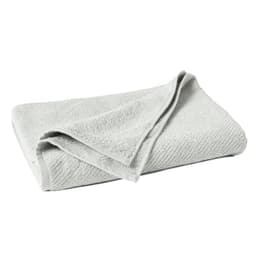
Air Weight Organic Towels
Coyuchi · Air Weight Organic Towels · best for someone who wants the substantial-towel feeling and has somewhere for it to dry
550 GSM of organic cotton in a twill weave with long loops, carrying GOTS, Fair Trade and Made Safe certification.
If the appeal of terry is weight in the hand, Coyuchi’s Air Weight towels are the version with a number attached: 550 GSM, in “A twill weave” with “long loops of pure organic cotton”, published as “100% organic cotton” that is “grown + woven in India”.
550 GSM is the useful reference point for this whole page, because it is the only published weight among the three. A four-layer gauze towel is nowhere near it — that is the entire design intent — and the gap is why one dries in hours and the other in a day. What GSM measures across everything we cover is here.
It also carries the longest certification line in our catalog: “GOTS + Fair Trade + Made Safe Certified”.
Renter-Safe Install Rating
- Drilling
- None
- Tools
- None
- Time to fit
- None
- Power
- None
- Reversible on move-out
- Fully
Why: A towel. There is nothing to install.
Read from published documentation, not from fitting one. Coyuchi — Air Weight Organic Towels, published GSM, certifications and construction. How the verdict is derived: renter-safe ratings explained.
What’s wrong with it
Long loops hold more water for longer. In a bathroom with poor ventilation this is the towel most likely to still be damp tomorrow.
What we can’t tell you
Coyuchi publishes no dimensions at all — the sizes are named but never measured — and its own store shows every variant sold out, so stock and color come down to the Amazon listing.
Published specifications
| Weight | 550 GSM for the bath towel, hand towel and washcloth; 900 GSM for the bath mat |
|---|---|
| Material | “100% organic cotton is grown + woven in India” |
| Construction | “A twill weave” with “long loops of pure organic cotton” |
| Certification | “GOTS + Fair Trade + Made Safe Certified” |
| Drying claim | “drying off quickly and efficiently” |
| Care | Cold wash, gentle cycle; tumble dry low and remove promptly |
| Dimensions | Not published — sizes are named but not measured |
| Availability | Every size and color still shows “Variant sold out or unavailable” on Coyuchi's own store (re-checked 2026-10-07); the bath towel is listed and in stock on Amazon |
Source: Coyuchi — Air Weight Organic Towels, published GSM, certifications and construction
#ad Price $48.00 as of October 18, 2026. Prices change; Amazon’s listing is the one that counts. How we’re funded.
Where to buy
Everything recommended on this page, in one place. Each link is an Amazon Associates link — we earn a commission at no extra cost to you, and it never decides a pick.
- $44.99View on Amazon
Handwoven 4-Layer Muslin Turkish Cotton Towel
Viva Maison · 4-Layer Muslin Turkish Cotton Towel (Denizli) · Renter verdict: Safe
- $59.99View on Amazon
ONSEN Sculpted Terry Bath Towel
ONSEN · Sculpted Terry Bath Towel · Renter verdict: Safe
- $48.00View on Amazon
Air Weight Organic Towels
Coyuchi · Air Weight Organic Towels · Renter verdict: Safe
#ad Prices are not shown because we only publish figures we have verified on the day. How we’re funded.
Questions people actually ask
what is the difference between terry and gauze towels
Terry is a pile fabric — thousands of cotton loops standing off a backing, each one holding water. Gauze is several fine flat layers woven together; Viva Maison publishes four layers of Turkish cotton gauze. Gauze is lighter, usually larger, and dries faster; terry gives you pile against the skin.
are gauze towels absorbent
Yes — four plies of cotton move water off skin perfectly well. What gauze has less of is capacity: fewer grams of fiber means less total water held, which shows up with long hair or a towel shared between two people rather than in normal single use.
do gauze towels dry faster than terry
Every maker publishes that direction and none publishes a drying time. Less fiber and more exposed surface dries sooner, which is why a four-ply gauze towel dries fastest here and a 550 GSM long-loop terry slowest. We have not timed them and will not put a number on it.
are muslin and gauze towels the same thing
In this market, yes. Viva Maison describes the fabric as 100% Turkish cotton gauze while selling the towel as muslin. What does vary is the number of layers — two, four and six-ply all exist, and more plies means more absorbency and more drying time.
do gauze towels shrink
Viva Maison publishes about 3-5% shrinkage after the first wash, which on its 67-inch towel is roughly two to three inches. That is a figure almost nobody in the category states, and it is worth factoring in before you measure the towel against a rail.
should you use fabric softener on towels
No, on either fabric. Viva Maison publishes do not use fabric softener and ONSEN publishes avoid fabric softeners and conditioners. Softener coats the fiber and a coated fiber repels water, which is the usual reason a towel stops absorbing long before it wears out.
Sources
- Viva Maison — Handwoven 4-Layer Muslin Turkish Cotton Towel (Denizli), published fiber, layer count, dimensions, drying claim, shrinkage and care
- ONSEN — Sculpted Terry Bath Towels, published dimensions, fiber, weave, certification and care
- Coyuchi — Air Weight Organic Towels, published 550 GSM, twill weave, fiber and certifications
Read next
Back to Bath Textiles.