How do towel warmers work?
There is no mystery inside the bar, and the makers publish enough to describe the whole mechanism without anyone taking one apart.
By Sawyer V. · · How we research
The short answer
We earn a commission if you buy through the links on this page, at no extra cost to you. It does not change which products we pick or what we say about them — here is exactly how that works.
Quick picks
Tap any row for the full write-up. Prices are checked against Amazon rather than remembered — where we have no verified figure the button says so.
| # | Product | Best for | Renter | Price |
|---|---|---|---|---|
| 1 |  WarmlyYours Ibiza Freestanding Towel Warmer 90 W in, 307 Btu an hour out, six bars, a plug and an overheat cutout at 149°F — every figure in the explanation below comes from this spec sheet. | Seeing the numbers that describe an electric rail | Safe | |
| 2 | No photo yet WarmlyYours Palma Wall-Mounted Plug-In Towel Warmer 60 W, 205 Btu an hour, four bars — two thirds of the Ibiza's power for two thirds of its output, which is the whole relationship in one product. | Seeing how the wattage scales with bar count | Owner-only | |
| 3 |  Zadro 20-Liter Towel Warmer Bucket 480 W into a sealed 20-liter tub on a 15 to 60 minute timer: not a rail at all, and the wattage is five times higher for the opposite reason. | Understanding what a bucket does instead | Safe |
The whole mechanism, in four sentences
Mains electricity enters a sealed loop of stainless steel tube and passes through a resistance element inside it. The element heats; the heat conducts through the tube wall and into the bar surface; a thermostat and an overheat cutout hold the bar at a set temperature rather than letting it climb. A damp towel draped across the bars warms, and water evaporates from it into the room air.
That is it. There is no fan, no element you can see, and on most rails nothing to adjust. The complexity in this category is in the mounting and the certification, not the physics.
Watts in, Btu out: the conversion that explains the spec sheet
Every electric rail publishes two power figures, and the second one is the first one in different units. One watt sustained for one hour is 3.412 Btu. Run that against three WarmlyYours rails:
| Rail | Published watts | Published Btu/hour | Watts × 3.412 |
|---|---|---|---|
| Palma (4 bars) | 60 W | 205 Btu | 204.7 |
| Ibiza (6 bars) | 90 W | 307 Btu | 307.1 |
| Barcelona (8 bars) | 150 W | 512 Btu | 511.8 |
The published Btu figure is the wattage, converted. Nothing is lost on the way, which is the useful part: a resistance heater turns effectively all of its electricity into heat, so the wattage on the box is the heat output. That is why a towel warmer is the one appliance in the bathroom whose running cost you can work out exactly. The cost arithmetic is here.
It also means bar count and wattage move together. More bars is more heated surface, which needs more watts to hold at the same temperature. A 60 W rail is not a weaker 150 W rail; it is a smaller one. Sizing is worked through here.
Why there is no temperature dial
Almost no towel rail has one, and the published specifications show why. WarmlyYours states an “Average Surface Temperature 122°F / 50°C” on its Grande rail, with a safety limit of 149 to 167°F; on the Huron the same two figures appear as “122°F / 50°C” average and a TempSmart limit of “149°F - 167°F / 65°C - 75°C”.
The rail is engineered to sit at one temperature and the cutout exists to stop it exceeding that. A dial would only let you make it worse: cooler, and the towel stops drying; hotter, and you are past the number the listing was certified against. The published temperatures across every warmer we cover are here.
How the towel actually dries
Drying is evaporation, and evaporation needs three things: heat, surface area and somewhere for the moisture to go. The bar supplies the first. You supply the second by draping the towel in a single layer rather than folding it in four. The room supplies the third, which is why a rail in a sealed, unventilated bathroom works far less well than the same rail with the extractor running.
This is also the answer to the most common complaint about these things. A rail that seems not to work is usually a rail with a bath sheet folded over it three times, presenting a quarter of its area to the heat. The draping technique is here.
And a dry towel does not smell. Mustiness is bacterial growth in a towel that stays damp for hours, which is the practical benefit most people do not anticipate. That problem is covered here.
Hydronic rails work differently
A hydronic rail has no element in it at all. It is plumbed into a heating system and hot water circulates through the same stainless loop, which means its output is set by your boiler rather than by a published wattage. It is also a plumbing job rather than a plug. Hydronic against electric is compared here.
What nobody publishes
Two numbers are missing across the whole category. The first is a duty cycle: no maker states what proportion of each hour the element is actually drawing power once the bar is up to temperature, so the honest running-cost sum assumes it runs continuously and is therefore a ceiling rather than a measurement.
The second is heat-up time on most models. WarmlyYours publishes “15-20 minutes” for the Infinity and Huron; on the Ibiza, the Palma and every bucket we cover, the field is blank. What the published figures do and do not tell you about time is here.
Every pick in full
3 we would buy. Each carries its Renter-Safe Install Rating, the published specs behind it, and the honest gap in what we know.
1. The mechanism at its simplest
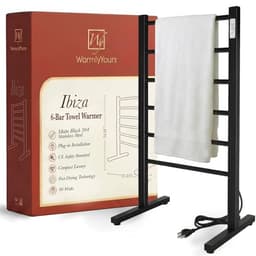
WarmlyYours Ibiza Freestanding Towel Warmer
WarmlyYours · TWS5-IBZ06PP · best for seeing the numbers that describe an electric rail
90 W in, 307 Btu an hour out, six bars, a plug and an overheat cutout at 149°F — every figure in the explanation below comes from this spec sheet.
The Ibiza is the cleanest illustration of the mechanism because WarmlyYours publishes every term of it: “90 W” at “120 V” and “0.75 A”, giving “307 Btu” an hour across “6” heated bars of “304-stainless steel”.
It is freestanding with a “71″” cord and a “NEMA 5-15 (Type B)” plug — a normal outlet, no wiring, no wall fixing. The safety side is published as “built-in TempSmart overheat protection” preventing surface temperatures above “149°F (65°C)”.
Renter-Safe Install Rating
- Drilling
- None
- Tools
- None
- Time to fit
- Not published
- Power
- Standard outlet
- Reversible on move-out
- Fully
Why: WarmlyYours publishes this one as freestanding with a NEMA 5-15 plug: it stands on the floor, plugs into a normal outlet, and leaves with you.
Read from published documentation, not from fitting one. WarmlyYours, Ibiza Freestanding Towel Warmer (TWS5-IBZ06PP). How the verdict is derived: renter-safe ratings explained.
What it costs to run — Electricity
- Rated power
- 90 W (WarmlyYours’s published figure)
- Run time
- 2 hours a day on a plug-in timer
- Electricity rate
- 18.34 cents per kWh (US residential average, June 2026)
90 W x 2 h / 1000 x $0.1834 = $0.033 a day
About 3 cents a day, or roughly $12 a year on a two-hour daily timer
Arithmetic on published specifications, not a measurement. Rate source: U.S. Energy Information Administration, Electric Power Monthly Table 5.6.A — US residential average 18.34 cents/kWh, June 2026.
What’s wrong with it
Six bars is a one-towel rail. Two bath sheets will not both dry on it.
What we can’t tell you
WarmlyYours publishes no heat-up time for the Ibiza, so how long the first towel takes is not stated.
Published specifications
| Wattage | “90 W” |
|---|---|
| Supply | “120 V”, “0.75 A” |
| Heat output | “307 Btu” per hour |
| Bars | “6” heated bars |
| Dimensions | “34.84″ (885 mm) H x 21.85″ (555 mm) W x 13.97″ (355 mm) D” |
| Material | “304-stainless steel”, published in “Polished Stainless Steel” and “Matte Black” finishes |
| Cord and plug | “71″” cord, “NEMA 5-15 (Type B)” |
| Mounting | “Freestanding” — no wall mounting or drilling |
| Safety | “built-in TempSmart overheat protection” preventing surface temperatures above “149°F (65°C)” |
| Certification | “cULus Listed” |
| Warranty | “5-year limited warranty” |
Source: WarmlyYours, Ibiza Freestanding Towel Warmer (TWS5-IBZ06PP)
#ad Price $351.00 as of October 18, 2026. Prices change; Amazon’s listing is the one that counts. How we’re funded.
2. The same mechanism, smaller
WarmlyYours Palma Wall-Mounted Plug-In Towel Warmer
WarmlyYours · TWS2-PLM04PP · best for seeing how the wattage scales with bar count
60 W, 205 Btu an hour, four bars — two thirds of the Ibiza's power for two thirds of its output, which is the whole relationship in one product.
The Palma publishes “60 W”, “205 Btu” per hour and “4” heated bars in a “Square” profile. Put it beside the Ibiza’s 90 W and 307 Btu and the arithmetic below stops being theoretical.
It mounts to the wall rather than standing on the floor, but it still ends in a “NEMA 5-15 (Type B)” plug on a “71″” cord, so there is no electrician in the story. Plug-in against hardwired is compared here.
Renter-Safe Install Rating
- Drilling
- Required
- Tools
- Drill
- Time to fit
- Not published
- Power
- Standard outlet
- Reversible on move-out
- With patching
Why: WarmlyYours ships it with a wall-mount hardware kit, which means anchors in tile or drywall. The plug end is renter-friendly; the bracket end leaves four holes you would have to make good.
Read from published documentation, not from fitting one. WarmlyYours, Palma Towel Warmer (TWS2-PLM04PP). How the verdict is derived: renter-safe ratings explained.
What it costs to run — Electricity
- Rated power
- 60 W (WarmlyYours’s published figure)
- Run time
- 24 hours a day, the way most people actually leave them
- Electricity rate
- 18.34 cents per kWh (US residential average, June 2026)
60 W x 24 h / 1000 x $0.1834 = $0.264 a day
About 26 cents a day left on permanently — roughly $96 a year
Arithmetic on published specifications, not a measurement. Rate source: U.S. Energy Information Administration, Electric Power Monthly Table 5.6.A — US residential average 18.34 cents/kWh, June 2026.
What’s wrong with it
Four bars and a 19.68 in. height: this is a hand-towel rail with ambitions, not a bath-sheet rail.
What we can’t tell you
No published heat-up time and no published surface temperature for this model.
Published specifications
| Wattage | “60 W” |
|---|---|
| Supply | “120 V”, “0.5 A” |
| Heat output | “205 Btu” per hour |
| Bars | “4” heated bars, “Square” profile |
| Dimensions | “19.68″” H x “17.71″” W x “4.33″” D |
| Material | “304-stainless steel”, “Polished Stainless Steel” finish |
| Cord and plug | “71″” cord, “NEMA 5-15 (Type B)” |
| Mounting | “Wall Mounted”, “Plug-in”, shipped with an “installation manual and hardware kit” |
| Certification | “cULus listed” |
| Warranty | “5-year limited warranty” |
#ad We have no verified live price for this one right now, so we are not showing a number. How we’re funded.
3. The format that works differently
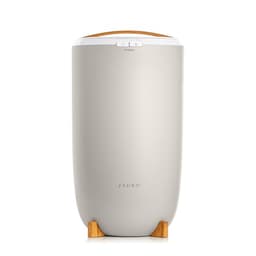
Zadro 20-Liter Towel Warmer Bucket
Zadro · TWB01 · best for understanding what a bucket does instead
480 W into a sealed 20-liter tub on a 15 to 60 minute timer: not a rail at all, and the wattage is five times higher for the opposite reason.
Zadro’s bucket publishes “480 W” maximum and a timer that runs “15, 30, 45 or 60 minutes before automatically shutting off”. A rail runs small and continuous; a bucket runs big and brief, because it is heating a thick folded towel inside a closed tub rather than warming a thin layer against a bar.
That is also why it cannot dry anything. There is nowhere for the moisture to go. Bucket against rack is decided here.
Renter-Safe Install Rating
- Drilling
- None
- Tools
- None
- Time to fit
- None — it arrives assembled and plugs in
- Power
- Standard outlet
- Reversible on move-out
- Fully
Why: It is an appliance that sits on the floor and plugs into an outlet. There is nothing to fit, so there is nothing to undo.
Read from published documentation, not from fitting one. Zadro, Large Towel Warmer Bucket 20L (TWB). How the verdict is derived: renter-safe ratings explained.
What it costs to run — Electricity
- Rated power
- 480 W (Zadro’s published maximum)
- Cycle length
- 30 minutes — the middle of Zadro’s own timer settings
- Electricity rate
- 18.34 cents per kWh (US residential average, June 2026)
480 W x 0.5 h / 1000 x $0.1834 = $0.044
About 4 cents for a 30-minute cycle, or roughly $16 a year if you run one every day
Arithmetic on published specifications, not a measurement. Rate source: U.S. Energy Information Administration, Electric Power Monthly Table 5.6.A — US residential average 18.34 cents/kWh, June 2026.
What’s wrong with it
A bucket warms one towel at a time, on a timer, and then stops.
What we can’t tell you
Zadro publishes no maximum temperature and no heat-up time — both read “Not published” on the spec sheet.
Published specifications
| Capacity | “20-Liter large towel heater tub” (5.3 gallons) |
|---|---|
| Maximum wattage | 480 W |
| Supply | 120 V AC, 60 Hz |
| Timer | “set timer to 15, 30, 45 or 60 minutes before automatically shutting off” |
| Dimensions | 21.25″ high, 12″ diameter |
| Weight | 8.5 lbs |
| Materials | “50% Plastic, 45% Metal, 5% Electronics” |
| Plug | “polarized B power plug for increased safety”, 83″ cord |
| Heat-up time | Not published |
| Maximum temperature | Not published |
#ad Price $169.99 as of October 18, 2026. Prices change; Amazon’s listing is the one that counts. How we’re funded.
Where to buy
Everything recommended on this page, in one place. Each link is an Amazon Associates link — we earn a commission at no extra cost to you, and it never decides a pick.
- $351.00View on Amazon
WarmlyYours Ibiza Freestanding Towel Warmer
WarmlyYours · TWS5-IBZ06PP · Renter verdict: Safe
- Check price on Amazon
WarmlyYours Palma Wall-Mounted Plug-In Towel Warmer
WarmlyYours · TWS2-PLM04PP · Renter verdict: Owner-only
- $169.99View on Amazon
Zadro 20-Liter Towel Warmer Bucket
Zadro · TWB01 · Renter verdict: Safe
#ad Prices are not shown because we only publish figures we have verified on the day. How we’re funded.
Questions people actually ask
how does a heated towel rail work
A resistance element sealed inside a stainless steel loop converts electricity to heat. The heat conducts into the bar surface, a thermostat holds it at roughly 122°F average, and a damp towel draped over it dries by evaporation.
do towel warmers use a lot of electricity
No. Published ratings run from 60 W on a four-bar rail to 155 W on a ten-bar one — less than a traditional light bulb in several cases. Buckets are different: Zadro publishes 480 W, but only for a 15 to 60 minute timed cycle.
what does the Btu figure on a towel warmer mean
It is the wattage converted: one watt sustained for an hour is 3.412 Btu. WarmlyYours publishes 90 W and 307 Btu on the Ibiza, 60 W and 205 Btu on the Palma, 150 W and 512 Btu on the Barcelona — the same number twice.
why does my towel warmer have no temperature setting
Because it is designed to hold one temperature. Makers publish an average surface temperature around 122°F and an overheat cutout at 149 to 167°F; a dial would only let you fall below the drying point or past the certified limit.
does a towel warmer dry a wet towel or just warm it
A rail does both — the towel dries by evaporation and feels warm while it does. A bucket only warms: it heats a towel inside a sealed tub, where the moisture has nowhere to go.
Sources
- WarmlyYours, Ibiza Freestanding Towel Warmer (TWS5-IBZ06PP) — published 90 W, 307 Btu, 6 bars, TempSmart limit
- WarmlyYours, Palma Towel Warmer (TWS2-PLM04PP) — published 60 W, 205 Btu, 4 bars
- WarmlyYours, Barcelona Freestanding Towel Warmer (TW-BC-08BS-FS2) — published 150 W, 512 Btu, 8 bars
- WarmlyYours — Grande 10 hardwired towel warmer TWS6-GRD10BH support page (average surface temperature and safety limit)
- WarmlyYours — Huron hardwired towel warmer TWS1-HRN08ZH support page (122°F average, TempSmart 149-167°F, 15-20 minute heat-up)
- Zadro, Large Towel Warmer Bucket 20L (TWB) — published 480 W, timer steps, unpublished maximum temperature
Read next
Back to Warmers & Comfort.